
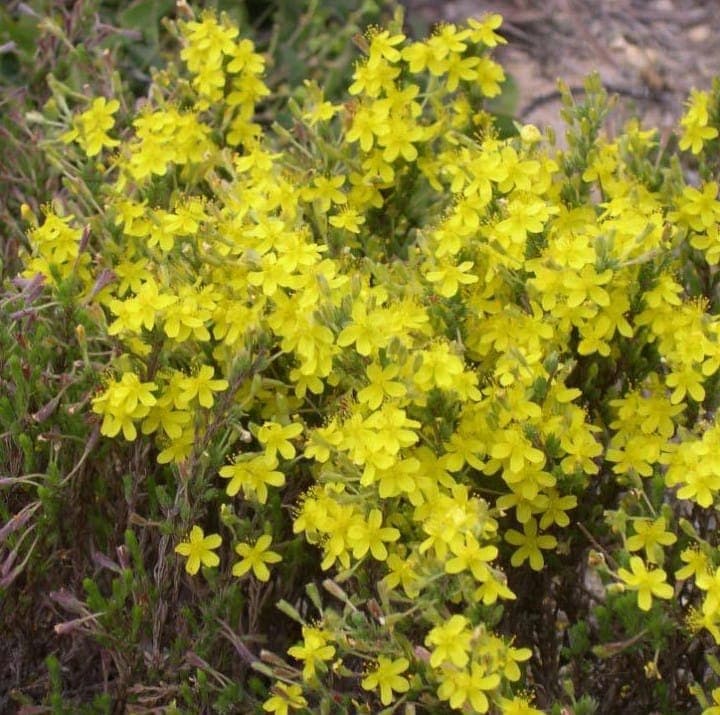
Christopher F. Miller, USDA NRCS / Public domain, via Wikimedia Commons
Beach-heath: complete guide
Hudsonia tomentosa
Want to see Beach-heath: complete guide in your garden?
1 minute, no credit card
Overview
Hudsonia tomentosa, commonly known as beach-heath, woolly beachheather, or sand-heather, is a low-growing, mat-forming subshrub in the Cistaceae family (the rock-rose family), native to the Atlantic coast and inland sandy habitats of eastern North America. Its natural range stretches from Labrador and the Northwest Territories south through Maritime Canada, New England, the Atlantic states as far south as South Carolina, and extends inland through the Great Lakes region to Minnesota, North Dakota, and as far west as Alberta and Saskatchewan. The species was described by botanist Thomas Nuttall in 1818.
The name 'tomentosa' refers to the dense, soft, woolly pubescence that covers stems, leaves, and flower buds, giving the plant its characteristic grayish appearance. This tomentum is a structural adaptation to the harsh conditions of open sand dunes and coastal heathlands, reducing solar radiation absorption and limiting moisture loss from the tiny scale-like leaves. The plant colonises bare, windswept sand, stabilising it with a spreading root network while building a tight, resilient surface mat above ground.
In garden cultivation outside North America, Hudsonia tomentosa is still relatively uncommon but steadily gaining recognition as an outstanding groundcover for extremely dry, acidic sandy soils where conventional groundcovers fail. Its slow growth rate, extreme cold hardiness, and minimal maintenance requirements make it a model plant for naturalistic, low-input landscapes. Plan your own heathland or coastal-style garden at gardenworld.app and see how plants like Hudsonia tomentosa can anchor a low-maintenance planting scheme.
The plant is fully hardy in USDA zones 2 to 6, enduring winters far colder than anything experienced in western Europe. Its primary requirements are full sun, excellent drainage, and acidic to mildly acidic soil - requirements easily met in coastal gardens and on sandy heathlands.
Appearance & bloom cycle
Hudsonia tomentosa grows as a densely-branched, spreading mat 15 to 30 cm tall, with horizontal branches that fan outward across the ground surface. A single plant may spread 60 to 100 cm across over several years, forming an interlocking mat with neighbouring plants. The branches are tightly clothed with minute, scale-like leaves of just 1 to 3 mm - so small and closely pressed to the stem that the overall effect resembles a compact, soft moss or a fine-textured heath. The entire plant is covered with dense, soft white hairs (the tomentum), giving it a woolly, grayish-green to silver-gray appearance that is particularly attractive in winter light.
The flowers are small but extraordinarily numerous: five-petalled, bright yellow, 4 to 6 mm across, in the characteristic style of the Cistaceae family. Each individual flower is ephemeral, lasting only a single day - another trait shared with rock-roses (Cistus) and sun-roses (Helianthemum). However, the plant produces flowers in such abundance during May and June (occasionally into early July) that the flowering period extends two to four weeks, during which the entire mat is smothered in yellow. After flowering, inconspicuous three-valved capsules form and eventually shed small seeds.
The foliage texture is fine and springy, and the mat has a pleasing resilience underfoot, making it usable as a low-traffic groundcover between stepping stones. The overall visual effect closely resembles Calluna vulgaris 'Silver Queen' but with a more uniform, tighter texture.
Ideal location
Full sun is absolutely essential. Hudsonia tomentosa evolved on open dunes and coastal heathlands where it receives unobstructed sunlight throughout the day. In partial shade, the mat becomes loose and open, flowering is drastically reduced, and the plant becomes susceptible to fungal disease. A south- or southeast-facing exposure is ideal. Avoid positioning under trees or near large shrubs that cast shade or drop leaf litter onto the mat.
The site must drain freely - standing water even for short periods is lethal. The plant excels in coastal, wind-exposed positions and tolerates salt spray. This makes it particularly valuable in seaside gardens. Planting distance within a groundcover scheme: 40 to 60 cm; expect the mat to close completely within three to five years. The plant's slow growth rate (rated 'slow' in authoritative databases) means patience is required, but the resulting carpet is long-lived and essentially self-sustaining.
Soil requirements
Hudsonia tomentosa demands acidic, nutrient-poor, well-drained sandy or sandy loam soil. The Trefle data gives a pH range of 5.5 to 6.9, but the plant performs best at pH 4.5 to 5.5, comparable to heather (Calluna vulgaris) and heath (Erica) cultivation. On neutral or alkaline soils, growth is poor and the plant gradually declines.
On soils with a pH above 6.0, substantial acidification is necessary before planting. Work 50% ericaceous (acidic) compost or peat into the planting area to a depth of 20 to 25 cm. Fertilization is neither necessary nor desirable - on rich soils, root rot and vigorous weed competition quickly defeat the plant. Do not use lime-based fertilizers. An annual application of low-dose ericaceous plant food (for rhododendrons and heathers) can help maintain soil acidity on marginally alkaline soils. A top-dressing of coarse quartzite sand (1 to 2 cm) around plants suppresses weeds and keeps the root zone warm and dry.
The plant's slow growth rate is a characteristic of its highly oligotrophic (nutrient-poor) habitat preference. Do not attempt to accelerate growth with fertilizers - you will encourage weakness, not strength.
Free design
Want to see Beach-heath: complete guide in your garden? Make a free design now.
Watering
Once established, Hudsonia tomentosa is among the most drought-tolerant plants in the temperate flora. In its native habitat, coastal dunes may go months without significant rainfall while the plant remains healthy and blooms freely. However, during the establishment phase (first two years after planting), regular watering is important to help the root system develop: water once per week during dry periods in the growing season, ensuring the top 15 to 20 cm of soil remains lightly moist.
From the third year onward, supplemental irrigation is rarely needed in north-west European climate conditions. Even during summers with prolonged dry spells (four to six weeks without significant rain), established plants generally cope without irrigation. When watering is necessary, water deeply and infrequently rather than shallowly and often - this encourages deep rooting, which in turn improves drought resilience. Never water from above in the evening, as wet foliage overnight promotes fungal disease in the dense mat.
Pruning
This species requires minimal pruning. Its naturally dense, rounded mat habit develops without intervention. If the mat becomes uneven or flowering diminishes over time, lightly trim the shoot tips in early spring (March-April), reducing each stem by no more than one third. Do not cut into old, bare wood - Hudsonia does not readily regenerate from leafless wood and hard pruning can kill sections of the mat.
Remove dead branches in spring. If the centre of an old mat becomes bare (a natural phenomenon in older specimens), fill the exposed area with sandy soil and top with a little dried moss to encourage lateral stems to re-root. Annual removal of any fallen leaves from neighbouring trees prevents shading and decay beneath the mat.
Maintenance calendar
January - February: No active care needed. The plant remains attractive through winter, its woolly texture catching frost and snow beautifully.
March - April: Check for frost damage or dead wood; remove if present. Light tip pruning if needed. Check soil pH; apply ericaceous fertilizer if pH is drifting above 6.0.
May - June: Flowering period. No maintenance required. Enjoy the yellow flowers. Water young plants (first two years) in dry spells.
July - August: Dry season. Continue watering first- and second-year plants weekly. Watch for signs of drought stress in hot, dry summers.
September - October: Growth season ends. No further pruning. Check for weed incursion around the mat edges.
November - December: Dormancy. No maintenance. Apply a light top-dressing of coarse quartz sand (1 to 2 cm) around plants if winter waterlogging is a risk.
Winter hardiness
Hudsonia tomentosa is rated in USDA zones 2 to 6, giving it extreme cold hardiness down to -45 degrees Celsius. Its native range includes subarctic Canada where winters are exceptionally severe. In all of western, central, and northern Europe, this plant is fully hardy without any winter protection. The plant experiences the cold of the North American Atlantic coast - where coastal exposure combines with sub-zero temperatures - and emerges from winter in excellent condition.
In warmer, wetter climates (zone 7 and above), summer humidity combined with poorly-drained soils can cause problems. Ensure excellent drainage in such conditions. The plant's real vulnerability is not cold but persistent winter wetness on heavy soils, which leads to crown rot. Sandy, freely-draining soil is the best winter insurance.
Companion plants
Hudsonia tomentosa belongs in the company of other acid-loving, nutrient-poor soil plants:
- Calluna vulgaris cultivars ('H.E. Beale', 'Gold Haze', 'Silver Queen'): same soil requirements, complementary flower colors and seasons, plant 30 to 40 cm apart.
- Erica tetralix (cross-leaved heath) and Erica carnea (winter heath): extend the flowering season and enjoy identical growing conditions.
- Festuca glauca (blue fescue): steel-blue compact tufts that contrast beautifully with the gray-green of the Hudsonia mat, 25 to 30 cm apart.
- Empetrum nigrum (crowberry): another low-growing acid-soil shrublet, with black berries in autumn.
- Arctostaphylos uva-ursi (bearberry): low mat-forming shrub for acidic, sandy soil with white flowers and red berries.
- Thymus serpyllum (wild thyme): low carpeting herb for the edges of the heath mat, same drought tolerance.
Avoid lime-tolerant companions like lavender, roses, or most ornamental grasses. Hudsonia combines best with ericaceous plants and dry-land species. Available from specialist heath and heather nurseries in the UK and Europe.
Closing
Hudsonia tomentosa is a plant of extraordinary character - small in stature, unhurried in growth, but enduring in its beauty and ecological value. For coastal gardens, dry heathland borders, and sandy acid soils, it provides a groundcover solution that conventional plants cannot match: true drought tolerance, minimal maintenance, and a genuine ecological contribution to the garden landscape.
For design inspiration and help planning a coastal or heathland garden, visit gardenworld.app and see how plants like beach-heath can form the foundation of a low-maintenance, naturalistic planting scheme.
Want to see Beach-heath: complete guide in your garden? Make a free design now.
Upload a photo, pick a style, and get a photorealistic design with plant list in under a minute.
10,000+ gardens designed already
No credit card required


Similar plants
Curled-leaf rock rose: complete guide
Cistus crispus
Everything you need to grow Cistus crispus, the curled-leaf rock rose from the western Mediterranean. Siting, soil, pruning, and winter care fully explained.
Marjoram-leaved sun rose: complete guide
Helianthemum marifolium
Everything about Helianthemum marifolium, the marjoram-leaved sun rose: location, dry soil, flowering season and care for this Mediterranean rock plant in your garden.
Fumana laevis: complete guide
Fumana laevis
Smooth needle-rockrose from eastern Spain - a rare Mediterranean alpine shrub. Needle-fine leaves, golden flowers. Extreme drought tolerance, minimal maintenance.