
Alvesgaspar / CC BY-SA 3.0, via Wikimedia Commons
Curled-leaf rock rose: complete guide
Cistus crispus
Want to see Curled-leaf rock rose: complete guide in your garden?
1 minute, no credit card
Overview
Cistus crispus, commonly known as curled-leaf rock rose, is a compact subshrub in the family Cistaceae. It grows naturally across the western and central Mediterranean basin, with confirmed native populations in Algeria, France, Morocco, Portugal, Sardinia, and Tunisia. In its natural range it colonises dry, rocky hillsides, maquis scrubland, and garrigue, thriving in poor soil and relentless sun. The species was formally described by Carl Linnaeus in 1753, making it one of the earliest named members of a genus that encompasses around twenty species.
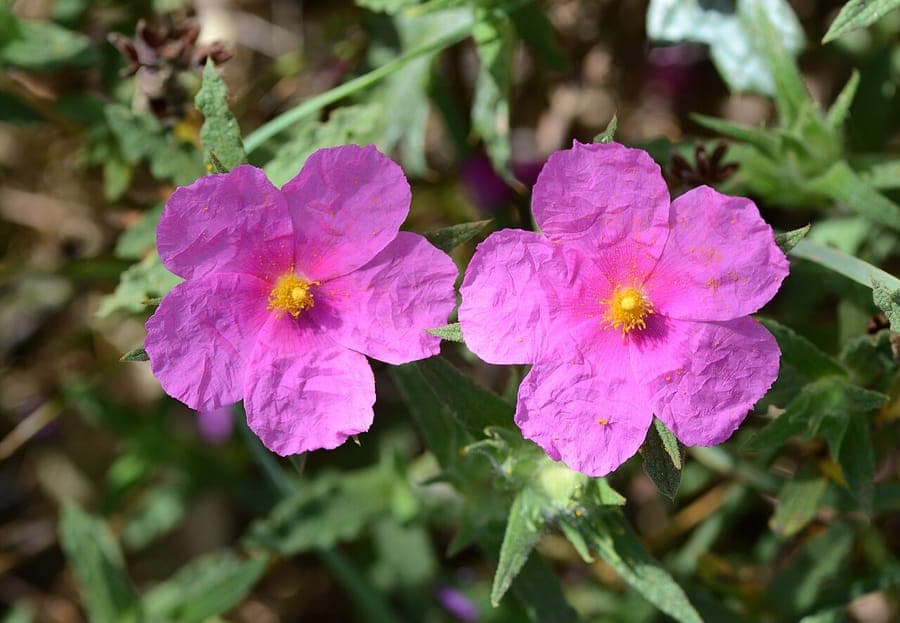
The botanical epithet crispus means curled or ruffled, a direct description of the distinctively wavy, crinkled leaf margins that set this species apart from smoother-leaved relatives like Cistus salviifolius. The flowers are a vivid purple-pink to magenta, with a warm yellow centre of stamens. Each individual flower lasts only a single day, but the plant produces them in such abundance that the flowering display continues for four to six weeks in May and June.
In gardens across northern Europe, Cistus crispus is valued for Mediterranean-themed borders, gravel gardens, and sunny walls. It can be found at specialist garden centres and increasingly at general retailers. On gardenworld.app you can explore how rock roses integrate into water-wise front garden designs alongside other drought-tolerant Mediterranean shrubs.
Appearance and bloom cycle
Cistus crispus grows as a rounded, bushy subshrub reaching 30 to 60 cm in height and a similar spread. Young shoots are densely covered in fine, sticky hairs that give the plant a greyish-green appearance and help limit water loss through the leaf surface. The leaves are oval to elliptic, up to 4 cm long, with strongly waved and crinkled margins that give each leaf the look of crumpled fabric.
Flowering begins in May and peaks through June in most temperate garden climates. Each flower has five petals in shades ranging from light lavender-pink to a deep magenta-purple, each with a sunny yellow centre formed by a dense cluster of golden stamens. The petals have a tissue-paper delicacy and a slight sheen. After each flower's single-day performance, a small rounded seed capsule develops that splits open in the heat of summer, releasing seeds onto the surrounding soil.
The flowers are excellent for pollinators - bees, particularly native solitary bee species, visit the flowers frequently for their abundant pollen. The bloom period of late spring to early summer coincides with a critical feeding window for many native bee populations.
Ideal location
Full sun is non-negotiable for Cistus crispus. In its native Mediterranean habitat it grows on completely open, unshaded slopes receiving sun for the entire day. In a northern European garden, choose the warmest and sunniest position available - a south or southwest-facing aspect is ideal. A sheltered microclimate created by a warm stone wall, a paved terrace, or a south-facing house wall that absorbs and radiates heat greatly improves performance and winter survival in marginal climates.
The plant tolerates wind but dislikes the cold, salt-laden winds of Atlantic coastal areas. In exposed coastal gardens, provide shelter with a hedge or wall on the northwest side. Partial shade reliably leads to weak, open growth and significantly reduced flowering.
Soil
Poor, very well-drained soil is the key requirement. In the wild, Cistus crispus grows on lean, often calcareous substrates with a slightly acidic pH of around 5.0 to 5.5, though in cultivation it tolerates a somewhat wider pH range. The absolute requirement is that the soil must never remain waterlogged. Heavy clay is unsuitable unless significantly amended.
For clay-heavy soils, work in 40 to 50 percent coarse grit or sharp sand through the top 30 cm before planting. Avoid adding too much organic matter as rich soil encourages lush, soft growth that is more vulnerable to cold and disease. A topdressing of limestone chippings or gravel around the plant both improves drainage and reflects heat back onto the foliage, approximating Mediterranean conditions. Avoid low-lying spots where rainwater pools after storms.
Free design
Want to see Curled-leaf rock rose: complete guide in your garden? Make a free design now.
Watering
Once properly established, Cistus crispus is one of the most drought-tolerant shrubs for temperate gardens. During the first year after planting, water twice weekly to help the root system establish. After the first year, the plant is largely self-sufficient in a temperate climate with moderate summer rainfall.
During prolonged dry summers (more than three weeks without rain), a weekly deep watering that penetrates 20 to 30 cm into the soil is beneficial. Shallow surface watering encourages shallow rooting and is counterproductive. Never water if the soil is still moist from a previous session. Root rot from persistent wet conditions is the most common cause of plant death. Winter watering is almost never necessary and can be harmful.
Pruning
Gentle pruning after flowering is the correct approach. Cistus cannot tolerate being cut back into old, woody stems - this invariably causes the cut branches to die back. Prune immediately after the main flowering period in June or July: remove the finished flowering shoots and trim back the current season's extension growth to just above a basal pair of leaves. This keeps the plant compact and encourages the development of new side shoots that carry next year's flowers.
Young plants can be pruned a little more firmly to build a denser framework. Older plants should be tidied to a neat shape without cutting into bare wood. In early spring, remove any branches that died during winter before new growth begins. After an unusually cold winter, wait until new growth starts before pruning so you can clearly see which wood is dead.
Maintenance calendar
January-February: plant is dormant; check for frost damage but do not prune yet. March-April: remove dead branches; water lightly if soil is very dry and there has been no rain for two weeks. May-June: peak flowering season; no intervention needed - simply enjoy the display. June-July: prune immediately after flowering; no fertilising. July-August: secondary growth period; deep water weekly during extreme drought. September-October: plant prepares for winter dormancy; no more pruning. November-December: protect in cold climates with a dry mulch of straw or leaves around the base; cover with horticultural fleece if night temperatures are forecast below -8 degrees Celsius.
Winter hardiness
Cistus crispus is moderately hardy, surviving short periods down to approximately -10 to -12 degrees Celsius. In USDA zone 8 (covering most Atlantic coastal areas of western Europe) it overwinters reliably without protection. In zone 7 and colder, winter protection is advisable: mound dry straw or leaves around the base and cover with horticultural fleece during hard frosts.
The combination of cold and wet is more dangerous than cold alone. Frozen, waterlogged soil around the root zone is lethal to rock roses. Excellent drainage and a protective gravel mulch around the crown significantly reduce this risk. Container growing is a practical option for zone 6 and colder - move the pot into an unheated greenhouse or conservatory from November to March. At gardenworld.app you can find tailored planting advice for Mediterranean shrubs in cooler northern European climates.
Companion plants
Cistus crispus combines beautifully with other Mediterranean and drought-tolerant plants. Lavender (Lavandula angustifolia and Lavandula stoechas) is the classic partner: the blue-purple lavender spikes complement the magenta-pink rock rose flowers perfectly. Rosemary and sage (Salvia officinalis) share the same soil and water preferences and add aromatic qualities to the planting.
Helianthemum nummularium (sun rose), a close relative in the Cistaceae family, works well as a low edge plant. Stachys byzantina adds silver-grey ground-level texture. Phlomis fruticosa provides a taller yellow-flowered backdrop with similar cultural requirements. For the front of a sunny border, Ophiopogon planiscapus or low ornamental Sedum varieties fill the gaps attractively. Specialist garden centres in the UK and Ireland stock a good range of Cistus species and cultivars alongside other Mediterranean shrubs.
Closing
Cistus crispus is a jewel for any sunny, dry garden. Its wavy, textured foliage is attractive throughout the year, and the lavish display of purple-pink flowers in May and June is one of the highlights of the garden calendar. With minimal water, poor soil, and the right sun exposure, this rock rose remains loyal for years. Anyone who wants to bring a Mediterranean feel to their front garden without high maintenance will find Cistus crispus one of the most dependable and rewarding choices available.
Want to see Curled-leaf rock rose: complete guide in your garden? Make a free design now.
Upload a photo, pick a style, and get a photorealistic design with plant list in under a minute.
10,000+ gardens designed already
No credit card required


Similar plants
Cistus salviifolius: complete guide
Cistus salviifolius
Discover the Sage-leaf rockrose: Cistus salviifolius. A Mediterranean shrub with white flowers and sage-like foliage, highly drought tolerant and ideal for rock gardens.
Cistus ladanifer: complete guide
Cistus ladanifer
Discover the stunning gum rock-rose with white flowers and aromatic foliage. Perfect for Mediterranean gardens and dry locations. Read our comprehensive care guide now.