
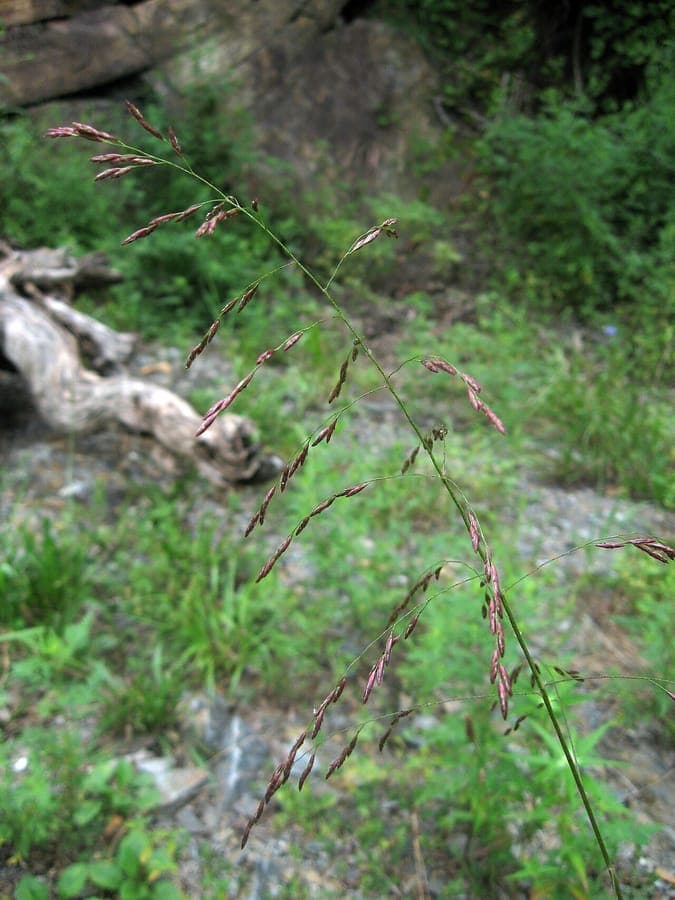
Mason Brock (Masebrock) / Public domain, via Wikimedia Commons
Purpletop tridens: complete guide
Tridens flavus
Want to see Purpletop tridens: complete guide in your garden?
1 minute, no credit card
Overview
Purpletop tridens (Tridens flavus), also known as redtop or purpletop, is a striking warm-season bunch grass from the Poaceae family, native to the central and eastern United States and extending into northeastern Mexico. This ornamental grass has earned a devoted following among native plant enthusiasts and low-maintenance gardeners alike, prized for its characteristic purplish-red flower spikelets that emerge in late summer and age gracefully to a warm copper-bronze, remaining decorative well into winter.
In its native range - spanning from Connecticut to Florida and westward to Nebraska, Kansas, and Texas - purpletop tridens colonises roadsides, disturbed grasslands, old fields, and open woodland edges on dry, infertile soils. It belongs to the genus Tridens, named for the three-toothed lemmas of its flowers, while the species epithet flavus (Latin for yellow) refers to the yellowish hue of the fresh spikelets before the purple pigmentation intensifies. Understanding this plant's natural ecology - tough, sun-drenched, well-drained ground - is the key to growing it successfully in the garden. Visit gardenworld.app to discover how this grass fits beautifully into dry, low-maintenance garden designs.
Appearance and bloom cycle
Purpletop tridens forms dense, upright clumps reaching 60 to 120 centimeters in height and 30 to 60 centimeters in width. The mid-green foliage is flat and slightly rough-textured on the upper surface, 3 to 8 millimeters wide. One distinctive characteristic is a shiny, oily or sticky deposit on the lower portions of the stem and leaf sheaths - a trait that has earned the plant regional nicknames like 'grease grass.' This secretion does not harm the plant or surrounding vegetation.
The real spectacle begins in August when the open, airy panicles emerge, laden with small spikelets that display a beautiful purple-red to reddish-purple coloration. This comes from the pigmented glumes and lemmas, which catch and reflect light with a silky sheen. As summer transitions to autumn, the spikelets ripen and shift to a warm coppery bronze, a color that holds beautifully through winter. The panicles sway gracefully in even a light breeze, adding movement and rhythm to the planting. In group plantings of five or more specimens, the combined visual effect of hundreds of nodding bronze plumes in the low-angled winter sun is genuinely spectacular.
Ideal location
Full sun is essential for purpletop tridens to perform at its best. It tolerates no more than two or three hours of light dappled shade per day; beyond that, the clumps become floppy and open. Position in open, sunny spots away from overhanging trees or north-facing walls. South- or west-facing aspects with free air circulation suit it perfectly.
This grass shines in native prairie plantings, dry meadow gardens, and naturalistic borders. It is well-suited to slopes and banks where irrigation is difficult, roadside plantings, urban green spaces, and low-maintenance beds where plants must largely fend for themselves. Because it does not spread aggressively by runners, it can also be used as a specimen planting in larger containers or as edging to define garden rooms. Its adaptability to urban conditions, including compacted soils and pollution, makes it valuable in civic landscaping projects as well.
Soil
Purpletop tridens thrives on lean, dry, well-drained soils. Its natural habitat is dry grassland and open woodland on acidic to neutral substrates (pH 4.5 to 6.5), often on sandy loam, gravel, or rocky soils. It performs poorly on heavy, waterlogged clay or on fertile, highly amended garden soils, where the lush growth can become floppy and less ornamentally attractive, and winter survival rates may decline.
No soil improvement is necessary or even desirable before planting. If your soil is heavy clay, mixing in coarse grit or sand to improve drainage is worthwhile, but adding compost or fertiliser would be counterproductive. Purpletop tridens is one of those plants that genuinely thrives on neglect - it has evolved to extract maximum performance from minimal resources, which makes it outstanding value for difficult, unimproved garden spots.
Watering
Once established, purpletop tridens is an excellent drought-tolerant grass that needs virtually no supplemental irrigation in the typical British, Belgian, or Dutch garden. In the first growing season after planting, regular watering every 10 to 14 days during dry spells helps the root system establish. After that, the plant generally survives and thrives on natural rainfall alone.
In periods of extreme, prolonged drought (six weeks or more without significant rainfall), a thorough deep soak once a fortnight will prevent die-back. The plant has the ability to enter a temporary semi-dormant state during intense summer heat and drought, then resume vigorous growth when rainfall returns. Never allow water to pool around the root crown; standing water, especially in winter, is the primary cause of mortality in this species. In most garden situations in north-western Europe, installed correctly in well-drained soil, irrigation is simply not necessary once the plant is settled.
Free design
Want to see Purpletop tridens: complete guide in your garden? Make a free design now.
Pruning
Purpletop tridens requires minimal pruning and is best left standing through winter. The dried clumps with their bronze-coloured seed heads provide outstanding visual interest in the winter garden and offer valuable seed food for small birds, including finches and sparrows. Leaving the grass standing also protects the crown from the worst of the cold.
The ideal time to cut back is in late winter or early spring - mid-March to early April - just before new growth begins. Cut the whole clump back to about 10 to 15 centimeters above ground level using sharp secateurs or hedge shears. New growth will appear within two to three weeks. If you prefer a tidier winter garden, cutting back in November after the first hard frosts is also possible, though you sacrifice the winter ornamental value. Do not cut back in early autumn while the plant is still actively growing - this weakens the root reserve and reduces cold hardiness.
Maintenance calendar
February - March: Inspect the clump. Do not cut back until new growth is emerging at the base. April: Cut old stems back to 10-15 cm. New leaves emerge rapidly. May - June: Fast vegetative growth. No feeding required. Water only during prolonged dry spells. July - August: Stems reach full height. Flower panicles emerge in August with characteristic purple-red coloration. September: Full ornamental value. Spikelets begin aging to copper-bronze in the autumn light. October - November: Seed heads ripen fully. Remove if you wish to limit self-seeding. December - January: Outstanding winter structure. Leave undisturbed for birds and garden interest.
Winter hardiness
Purpletop tridens is an exceptionally cold-tolerant grass, surviving temperatures well below -25 degrees Celsius in its native range, which places it reliably in USDA hardiness zone 4. Across north-western Europe, including the Netherlands, Belgium, and the United Kingdom, winters rarely approach these extremes, meaning that purpletop tridens overwinters effortlessly without any protective measures.
The root crown remains alive even during prolonged freezing spells, producing fresh new growth in spring once temperatures climb consistently above 10 degrees Celsius. In Mediterranean climates (USDA zones 9 and above), the plant may go semi-dormant during the hottest, driest months of summer but recovers well when autumn rains arrive. Do not mulch over the crown in winter, as this can trap moisture and cause rotting. The natural die-back of the foliage provides its own insulating layer around the crown.
Companion plants
Purpletop tridens works beautifully in combination with other drought-tolerant, sun-loving perennials and ornamental grasses. Classic prairie companions include: Echinacea purpurea (purple coneflower), Rudbeckia fulgida (black-eyed Susan), Liatris spicata (blazing star), Salvia nemorosa (woodland sage), Agastache foeniculum (anise hyssop), and Aster laevis (smooth aster). These combinations peak across different months, ensuring continuous interest from spring through to December.
For a fully naturalistic prairie effect, pair purpletop tridens with other warm-season grasses such as Schizachyrium scoparium (little bluestem), Bouteloua curtipendula (side-oats grama), and Sorghastrum nutans (Indian grass). In more structured borders, the airy, upright habit of purpletop tridens makes an effective contrast to bold-leaved perennials like Bergenia or low mounding plants like Geranium or catmint. Plants are available seasonally at most garden centres. Visit gardenworld.app to visualise how purpletop tridens could transform your front garden or border design.
Closing
Purpletop tridens is one of those genuinely underused ornamental grasses that deserves far wider recognition in European gardens. Its credentials are impressive: exceptional drought and heat tolerance, thriving on infertile soils, minimal maintenance requirements, outstanding late-season colour from purple through coppery bronze, winter structural interest, and ecological value for seed-eating birds. If you are planting a native-inspired meadow, naturalising a difficult dry slope, or simply looking for an authentic and beautiful alternative to high-maintenance garden plants, purpletop tridens earns its place without question. The combination of elegant movement, rich autumnal tones, and near-zero care requirements make it an investment that pays generous dividends every year.
Want to see Purpletop tridens: complete guide in your garden? Make a free design now.
Upload a photo, pick a style, and get a photorealistic design with plant list in under a minute.
10,000+ gardens designed already
No credit card required


Similar plants
Sporobolus pungens: complete guide
Sporobolus pungens
Sporobolus pungens is a stoloniferous Mediterranean coastal grass with outstanding salt and drought tolerance, perfect for seaside and dry gardens.
Mediterranean aegilops: complete guide
Aegilops biuncialis
Everything about Aegilops biuncialis, a Mediterranean annual grass with ornamental spikes and outstanding drought tolerance for dry gardens.
Silver bluestem: complete guide
Bothriochloa saccharoides
Full guide to Bothriochloa saccharoides (silver bluestem): site, soil, watering, winter hardiness, pruning, and garden companions.