
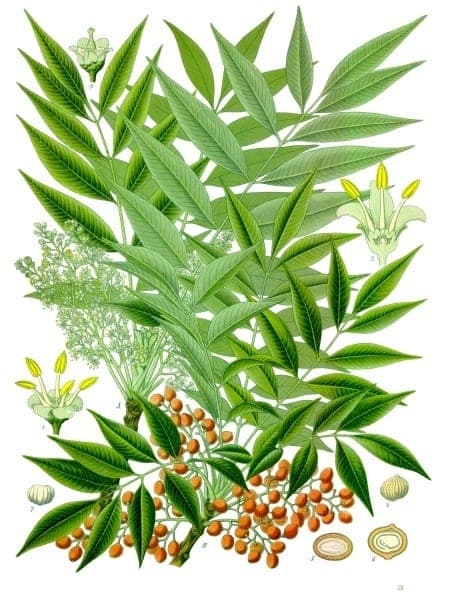
Franz Eugen Köhler, Köhler's Medizinal-Pflanzen / Public domain, via Wikimedia Commons
Japanese waxtree (Toxicodendron succedaneum): complete guide
Toxicodendron succedaneum
Want to see Japanese waxtree (Toxicodendron succedaneum): complete guide in your garden?
1 minute, no credit card
Overview
Toxicodendron succedaneum, known as the Japanese waxtree, scarlet rhus, or lacquer tree, is an attractive deciduous tree naturally occurring from the Himalayas to tropical East Asia. The tree is primarily known for its spectacular autumn coloration, with leaves transitioning from green to gold, orange, and deep red. Despite its beautiful appearance, the tree contains toxic oils in the leaves, bark, and roots that can cause contact dermatitis.
The Japanese waxtree grows preferably in temperate to warm climates and reaches heights of 8-15 meters in ideal conditions. In the garden, it is a striking specimen due to its form and spectacular fall display.
Appearance and Bloom
Toxicodendron succedaneum has distinctive feathered leaves with multiple small leaflets along a central vein. The leaves are green during the growing season with fine to medium texture. The tree flowers in small, greenish blooms growing in thin panicles, usually inconspicuous.
In autumn, the leaves undergo a dramatic transformation, with colors ranging from gold and orange to bright red, depending on temperature and moisture conditions. This fall coloring is one of the tree highlights.
Ideal Location
Toxicodendron succedaneum grows best in full sun to partial shade. For the most spectacular fall coloration, full sun is desirable. The tree is relatively hardy and can grow in diverse soils, from neutral to acidic.
Plant the tree in a visible location where you can fully enjoy the fall display. However, be careful to avoid regular contact with the tree, especially on warm days when toxic oils are released.
Soil
Toxicodendron succedaneum is not particularly fussy about soil type and grows in both sandy and clay soils. The tree prefers well-drained soil with neutral to acidic pH (pH 5.0-7.0). Add organic matter when planting for better structure and moisture retention.
The tree is drought-tolerant once well-established, making it suitable for dry gardens or xeriscaping.
Free design
Want to see Japanese waxtree (Toxicodendron succedaneum): complete guide in your garden? Make a free design now.
Watering
During the first year, water Toxicodendron succedaneum regularly to establish a strong root system. Water deeply and regularly during dry periods. Once established, the tree is drought-tolerant and requires less frequent watering.
Avoid waterlogging, especially in winter. A mulch around the base of the tree helps maintain moisture.
Pruning
Prune Toxicodendron succedaneum in late winter before growth begins. Remove dead, diseased, or crossing branches. The tree can also be pruned to control its form, although it best maintains its natural shape.
Always wear gloves and long sleeves when pruning, as the tree sap can cause skin irritation. Wash thoroughly after pruning.
Maintenance Calendar
- Spring: Prune dead wood, water regularly
- Summer: Check for fungal diseases, avoid wetting foliage
- Fall: Enjoy spectacular colors, rake leaves
- Winter: Protection in very cold regions, possible pruning
Winter Hardiness
Toxicodendron succedaneum is suitable for USDA zones 8-11 in most cases. In regions with severe winters, protection may be needed. In very cold areas, the tree may regrow from root stocks after frost damage.
In colder climates, it may be better to grow the tree in a pot and bring it indoors for winter protection.
Companion Plants
Toxicodendron succedaneum works well in combination with other trees offering fall color, such as Acer (Japanese maple) and Liquidambar (sweetgum). For understory plants, shade-tolerant species can be used, as long as direct contact with the tree is avoided.
Surround it with low-growing shrubs and groundcovers that are non-toxic.
Closing
Toxicodendron succedaneum is a spectacular choice for gardens where fall color is an important objective. The tree offers years of beauty, provided you are careful with skin contact. With regular care and a good sunny location, you will have a tree that transforms your garden anew each autumn.
Perfect for gardenworld.app users seeking dramatic seasonal variation and fall displays. Discover more seasonal inspiration on gardenworld.app!
Want to see Japanese waxtree (Toxicodendron succedaneum): complete guide in your garden? Make a free design now.
Upload a photo, pick a style, and get a photorealistic design with plant list in under a minute.
No credit card required


Similar plants
Skunkbush sumac: complete guide
Rhus trilobata
Everything about Rhus trilobata: siting, soil, autumn colour, pruning, and how this tough ornamental shrub earns a place in any garden.
Winged sumac: complete guide
Rhus copallinum
Everything about Rhus copallinum, the winged sumac with spectacular autumn colour. Location, pruning and garden value in full detail.
Aromatic sumac: complete guide
Rhus aromatica
Full guide to aromatic sumac (Rhus aromatica): planting, soil, care, pruning and companion plants for dry, sunny gardens and slope stabilisation.