
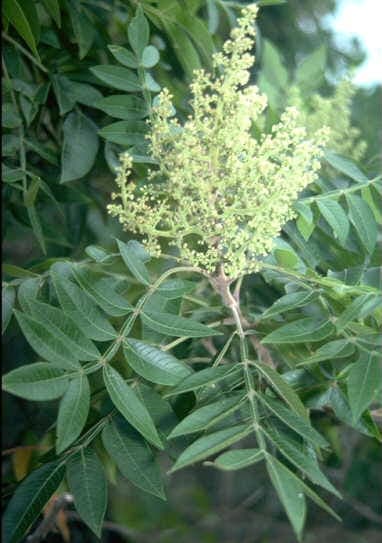
Wikimedia Commons / Public domain, via Wikimedia Commons
Winged sumac: complete guide
Rhus copallinum
Want to see Winged sumac: complete guide in your garden?
1 minute, no credit card
Overview
Rhus copallinum, widely known as winged sumac, shining sumac, dwarf sumac, mountain sumac or black sumac, is a deciduous shrub or small tree in the family Anacardiaceae - the same family as cashew and mango. It was described by Carl Linnaeus in 1753 and is native to the central and eastern United States, ranging from Ontario and the north-eastern coastal states south to Florida and Texas, with an outlying population in Cuba. The common name "winged sumac" refers to the distinctive winged rachis of the compound leaves - a flat, leaf-like expansion of the leaf stalk between the leaflets that makes identification straightforward. With its spectacular autumn foliage display of crimson, orange, scarlet and burgundy, Rhus copallinum ranks among the finest autumn-colouring shrubs available for medium to large gardens. Use gardenworld.app to explore how a winged sumac could fit into a front garden design before you plant.
Appearance and bloom cycle
Rhus copallinum is a shrub that typically reaches 1 to 3 metres in garden conditions but can occasionally achieve 4 to 5 metres when growing on impoverished, open sites in the wild. Its habit is broad and somewhat irregular, with wide-spreading branches that form an open crown. The plant spreads by root suckers and can gradually form a colonising thicket, which is an advantage in larger landscape gardens but requires management in smaller spaces.
The leaves are pinnately compound with 9 to 21 oblong, glossy, dark green leaflets. The rachis is distinctively winged - flattened and widened between the leaflets - which is the defining field identification character. In summer the leaves are glossy green with a leathery texture. The real display begins in September and October when the foliage transitions through intense shades of red, orange, purple and deep crimson. Few shrubs outside the Acer genus rival this colour intensity.
The flowers are small, yellow-green and relatively inconspicuous, appearing in late summer in upright panicles above the foliage. Rhus copallinum is dioecious: male and female flowers are borne on separate plants. The fruits are small, densely hairy, dark red to brown nutlets clustered in compact panicles that persist well into winter. These persistent fruit clusters are ecologically significant: many bird species feed on them during winter when other food sources are scarce.
Ideal location
Rhus copallinum is an emphatically sun-loving shrub. In nature it grows on open, dry sites: rocky hillsides, forest edges, roadsides, old field margins and calcareous or sandy ridges. Full sun is the primary requirement; in partial shade the plant grows more slowly and autumn colour is noticeably less vivid.
In the garden the winged sumac works well as a specimen shrub in an open lawn, as part of an autumn interest border alongside other colourful shrubs, or as an informal screening hedge along a boundary. Its tolerance for dry, impoverished soils and urban pollution makes it suitable for challenging city garden situations. Allow adequate space: a mature plant needs at least 2 by 2 metres to develop freely. Its suckering habit can be channelled positively in wilder parts of the garden.
Soil
Rhus copallinum is a tough, adaptable shrub that tolerates a wide range of soil types but performs best on well-drained, moderately fertile to poor soils with a pH of 5.3 to 7.5. Dry, sandy or stony soils are among its preferences. It is equally at home on acidic and moderately calcareous ground. Heavy clay is less ideal due to waterlogging risk, but adequate drainage on clay soils allows satisfactory establishment.
Avoid excessive feeding: on rich, heavily composted garden soil the plant grows rank and vigorous in a vegetative sense, which can reduce autumn colour intensity and compromise the characteristic open structure. Lean, slightly impoverished soil conditions produce more compact growth and the most vivid foliage colour. No elaborate soil preparation is needed beyond removing weeds and ensuring adequate drainage.
Free design
Want to see Winged sumac: complete guide in your garden? Make a free design now.
Watering
Once well established, winged sumac is one of the most drought-tolerant shrubs available for temperate gardens. Its adaptation to the dry, rocky habitats of eastern North America gives it an excellent capacity to withstand extended dry spells. In the first two growing seasons after planting, regular supplementary watering is needed to build a healthy root system - water young plants at least once a week during dry spells of more than two weeks.
From the third year onward, supplementary watering in an average European summer is rarely necessary. The plant can endure prolonged drought without permanent damage; leaves may wilt slightly in extreme heat but recover fully after rainfall. Winter waterlogging poses a greater threat than summer drought; always ensure that the planting site has free drainage, particularly on clay or compacted soils.
Pruning
Rhus copallinum requires very little pruning to maintain its characteristic open, spreading habit. The plant flowers on one-year-old wood and the best time to prune is early spring before the leaves emerge, typically in late February or early March. At this time remove any dead or frost-damaged branches and correct the overall form if desired by cutting long, over-extended shoots back to a lateral branch or healthy bud.
An important practical note: the milky sap of Rhus species can cause a contact skin reaction in sensitive individuals, somewhat similar to that caused by poison sumac (Toxicodendron vernix), although Rhus copallinum itself is generally considered non-toxic. Wear gloves and protective clothing when pruning and wash hands thoroughly after contact with sap. Remove the root suckers that the plant produces regularly around its base each spring to prevent unwanted spread and keep the planting area tidy.
Maintenance calendar
February through March: prune dead and damaged branches before leaf-out; remove excess root suckers from around the plant base. April and May: foliage emerges; check for any winter damage. No feeding is needed unless the soil is extremely impoverished. June through August: active summer growth; water newly planted specimens weekly during dry periods. September and October: peak autumn display; avoid pruning. November: leaf fall; remove leaves from lawn areas but leave fruit clusters in place for birds. December through January: dormant period; check drainage conditions at the planting site. For design ideas incorporating autumn-colour shrubs like Rhus copallinum, gardenworld.app offers a custom front garden design tool that lets you plan planting compositions before committing to purchase.
Winter hardiness
Rhus copallinum is reliably winter-hardy in USDA zones 4 to 9. In North-Western Europe - broadly corresponding to USDA zones 7 and 8 - the plant over-winters without difficulty. The branches are reasonably frost-resistant and even if above-ground parts are damaged by extreme cold, the root system pushes up vigorous new growth in spring.
Young plants in their first winter can be given some additional protection with a layer of bark chip mulch around the base to insulate the root zone during hard frost. After the second year no protection is needed. The plant is robust enough for most North-Western European climate conditions, including coastal areas exposed to salt-laden winds.
Companion plants
Rhus copallinum is most effective when combined with other shrubs and perennials that share its preference for open, dry sites. Scots pine (Pinus sylvestris) and common juniper (Juniperus communis) provide evergreen backdrops that make the sumac's crimson autumn colour stand out dramatically. For complementary autumn tones, pair with staghorn sumac (Rhus typhina) or other Rhus relatives to create a multi-layered, colourful autumn display.
Among perennials, rudbeckia, echinacea and tall prairie species such as Panicum virgatum make good companions in a dry, prairie-inspired border. Low-growing sedums and Hylotelephium fill the ground around the base of the shrub with little competition for water. Avoid moisture-loving broad-leaved plants such as hostas in the same zone. Winged sumac is available at most good garden centres in the UK and Ireland during the spring season.
Closing
Rhus copallinum is a shrub that delivers much and demands little: spectacular autumn colour, strong drought tolerance, ecological value for birds and insects, and a broad tolerance for less-than-ideal soil conditions. For anyone seeking a robust, low-maintenance and visually striking shrub for a sunny border or garden boundary, the winged sumac is an outstanding choice. Plant it in the right location and it will surprise you each autumn with an increasingly vivid display. Visit gardenworld.app to see how drought-tolerant shrubs like Rhus copallinum can form the backbone of a beautiful, sustainable front garden design.
Want to see Winged sumac: complete guide in your garden? Make a free design now.
Upload a photo, pick a style, and get a photorealistic design with plant list in under a minute.
10,000+ gardens designed already
No credit card required


Similar plants
Chios buttercup: complete guide
Ranunculus chius
Everything about Ranunculus chius, the Mediterranean buttercup with yellow flowers. Location, care and use in the garden.
Knotted buttercup: complete guide
Ranunculus nodiflorus
Everything about Ranunculus nodiflorus, the rare Western European buttercup of wet habitats. Origin, care and garden value.