
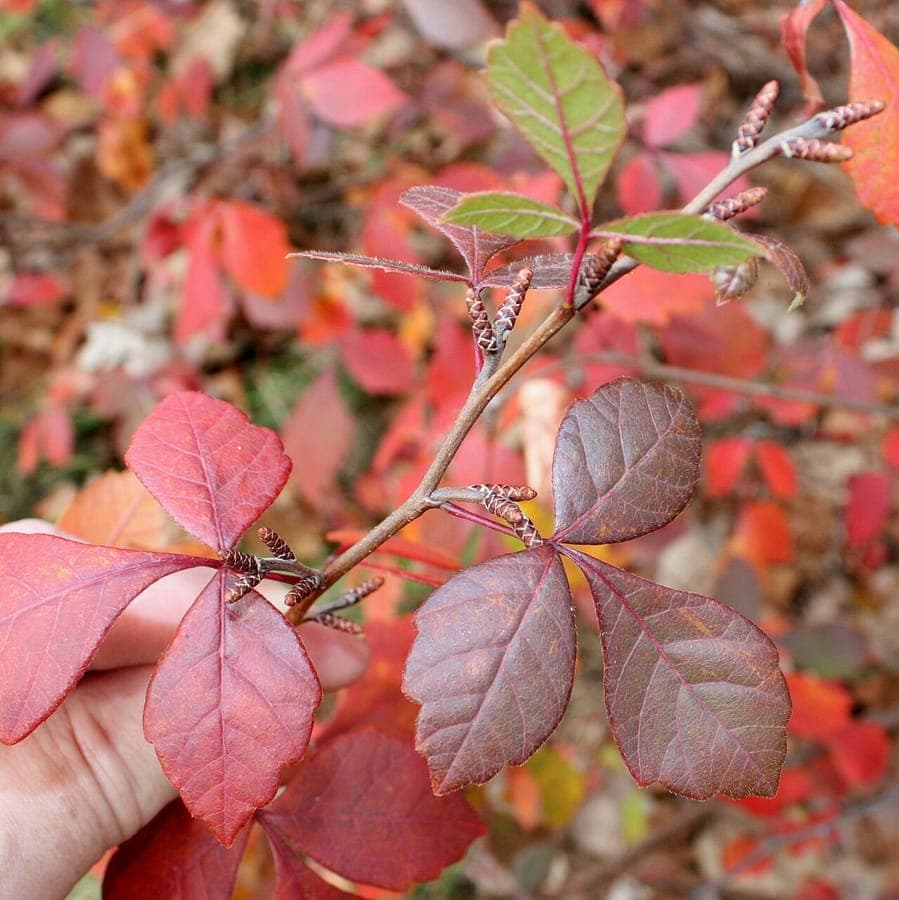
Bruce Marlin / CC BY-SA 3.0, via Wikimedia Commons
Aromatic sumac: complete guide
Rhus aromatica
Want to see Aromatic sumac: complete guide in your garden?
1 minute, no credit card
Overview
Rhus aromatica, commonly known as aromatic sumac or fragrant sumac, is a deciduous shrub native to eastern North America from Canada south to Mexico. A member of the Anacardiaceae family, it is closely related to staghorn sumac (Rhus typhina) but much lower-growing and better suited to garden use. The name 'aromatic' refers to the distinctive spicy-citrus scent released when the leaves, twigs, or fruits are bruised or crushed.
In North American horticulture this shrub has been valued for decades as a tough, adaptable groundcover for dry slopes and difficult urban sites. In Europe it remains relatively underused but is gaining recognition as gardeners look for plants that perform reliably in the increasingly hot, dry summers that characterise contemporary European growing conditions.
In the garden, aromatic sumac typically grows 60 to 180 cm tall and spreads considerably wider, forming broad mounds. The cultivar 'Gro-Low' is the most widely grown in European garden centres: it stays low at 30 to 60 cm while spreading 150 to 240 cm, making it ideal as a large-scale groundcover on slopes and banks. 'Green Mound' is a slightly taller, more regular form. 'Autumn Amber' is selected specifically for its exceptional orange-red autumn colour.
Beyond its garden value, aromatic sumac has a long history of use among indigenous North American peoples. The tart, hairy fruits were used to make a lemonade-like drink rich in vitamin C. The leaves and bark had documented medicinal applications in several nations.
Appearance & bloom cycle
Aromatic sumac is a trifoliate shrub: each leaf is divided into three glossy, oval to diamond-shaped leaflets with toothed margins, somewhat resembling poison ivy in leaf shape - though the two are easily distinguished by leaf texture and habitat. The leaflets are 4 to 7 cm long, glossy dark green above and paler beneath. When rubbed, they release the characteristic aromatic scent that gives the plant its name.
Flowering happens early in the season - March to April - before the leaves have fully opened. Clusters of tiny yellow flowers appear on bare twigs and are conspicuous against the still-dormant landscape. These early flowers are a valuable resource for honeybees, mason bees, and other early-emerging pollinators that are foraging before most other garden plants have even budded.
The fruits ripen through summer and into early autumn: small, densely hairy, bright red drupes borne in dense clusters. They have a tart, lemony taste. Birds, particularly thrushes, robins, and starlings, eat the fruits freely in late summer and early autumn when other food sources are becoming scarce.
The season's true highlight arrives in autumn, when the foliage transforms through orange to vivid scarlet and deep purple. On a lean, sunny site the colour can be breathtaking. Autumn colour is most intense on soils that are dry and low in nitrogen - rich, moist conditions produce more muted yellows and oranges.
Ideal location
Aromatic sumac thrives in full sun and tolerates light partial shade. In full shade it becomes leggy, flowers poorly, and shows less dramatic autumn colour. South- and west-facing slopes and open, exposed positions give the best results. The plant is extremely wind-tolerant.
One of its greatest strengths is adaptability to difficult urban conditions: road verges, traffic islands, and car parks. It tolerates road salt, vehicle exhaust, and compact, poor soils better than most ornamental shrubs. This resilience makes it an increasingly popular choice for public landscaping on challenging sites.
For residential gardens, aromatic sumac works exceptionally well as a large groundcover on slopes where conventional planting would require constant irrigation and maintenance. It also performs in wide borders where its spreading habit can be appreciated rather than constrained. Use gardenworld.app to visualise how aromatic sumac would work in your own garden layout before planting.
Soil requirements
This shrub is highly adaptable to soil type, but strongly prefers well-drained conditions. Its preferred pH range is 6.5 to 8.0, meaning it grows equally well on neutral loam, sandy soils, and calcareous substrates including chalk and limestone. On alkaline soils it often outperforms many other ornamental shrubs that struggle with high pH.
Heavy clay soils that remain waterlogged in winter are the main constraint. Standing water around the roots causes crown and root rot. On clay-heavy sites, incorporate plenty of coarse sand and fine grit to a depth of 40 cm before planting, and consider raising the planting level slightly to ensure drainage.
Once established, aromatic sumac actually benefits from lean conditions. Fertile, nitrogen-rich soils produce excessive leafy growth, reduced flowering, and less vivid autumn colour. Avoid adding compost or fertiliser to the planting hole or as an annual top dressing. A mineral mulch of bark chippings or gravel helps retain moisture without enriching the soil.
The spreading root system that develops in established plants is also effective at binding soil on slopes, preventing erosion. This quality, combined with low maintenance requirements, makes it a standard recommendation for difficult steep slopes in landscape projects.
Free design
Want to see Aromatic sumac: complete guide in your garden? Make a free design now.
Watering
Established aromatic sumac is one of the most drought-tolerant shrubs available for temperate European gardens. Once rooted in after the first growing season, it typically requires no supplemental irrigation even through dry summers.
In the first year after planting, regular deep watering is essential to establish the root system. During dry periods, water once a week, ensuring the soil is moistened to 25 to 30 cm depth. Deep infrequent watering is far better than shallow frequent irrigation, as it encourages the roots to grow deeper into the subsoil where moisture reserves are more reliable.
From year two onward, the plant is largely self-sufficient in the UK and northwestern Europe. During exceptional drought (more than three weeks without rain), young plants may benefit from an occasional deep watering. Mature plants are rarely stressed even by prolonged dry spells; the wide lateral root system finds moisture from a large area of soil.
A practical indicator: if leaves droop slightly in midday heat but recover fully by morning, the plant is coping. If morning droop persists, a deep watering is warranted.
Pruning
Aromatic sumac requires minimal pruning in most garden situations. As a groundcover or slope stabiliser it can be left entirely alone. As a specimen shrub in a border it is best allowed to develop its natural, wide-spreading, mound-forming habit with no intervention.
If pruning is needed, do it immediately after flowering in April or May, before new leaves have fully expanded. Remove dead, damaged, or crossing branches back to healthy wood. Hard rejuvenation pruning - cutting the whole plant back to 30 cm - is tolerated but is rarely necessary and will reduce flowering in the following year.
An important safety note: the sap of Rhus aromatica contains urushiol-related compounds that can cause contact dermatitis in sensitive individuals, similar to (but milder than) poison ivy. Always wear gloves when pruning and wash hands and tools thoroughly afterwards. Most people have no reaction, but it is wise to be cautious at first contact.
For cultivar 'Gro-Low', occasional trimming of spreading stems helps maintain desired coverage area if needed, but this is purely optional.
Maintenance calendar
March-April: Early bloom on bare twigs attracts pollinators. No action needed; simply enjoy the show.
April-May: Leaves emerge. Prune after flowering if shaping is desired. Remove dead wood.
May-June: Leafy growth established. Fruit development begins. Water young plants if dry spells occur.
July-August: Fruits ripen red. Birds begin feeding. No maintenance needed for established plants.
September-October: Spectacular autumn colour develops. No pruning. Note the colour range to inform future planting decisions.
November-February: Dormant. Bare twig structure provides shelter for small birds. No action required.
Winter hardiness
Aromatic sumac is fully hardy across the UK, the Netherlands, Belgium, Germany, France, and most of Europe. Its USDA hardiness rating of zones 3 to 9 covers temperatures to -40 °C with ease. Winter hardiness is never a concern for this species in temperate European conditions.
The plant drops its leaves in autumn and enters full dormancy with an attractive tracery of grey-brown twigs. It re-leafs reliably in spring. No frost protection is needed, even for first-year plants. In well-drained soil the risk of winter loss is effectively zero.
The only winter risk is waterlogged soil - not frost. On sites prone to standing water after autumn and winter rainfall, improving drainage before planting is the key preventive measure. A gravel mulch around the root crown helps keep the most vulnerable part of the plant dry during wet winters.
Companion plants
Aromatic sumac pairs well with other sun-loving, drought-tolerant shrubs and perennials:
- Juniperus horizontalis 'Blue Chip' or 'Wiltonii' (creeping juniper): low-growing, blue-needled conifers that provide year-round structure alongside the seasonal interest of aromatic sumac's green leaves, red fruits, and autumn colour.
- Calamagrostis acutiflora 'Karl Foerster' (feather reed grass): an upright ornamental grass 120-150 cm tall that contrasts beautifully with the wide, spreading form of Rhus aromatica.
- Sedum 'Herbstfreude' (stonecrop): rosy flower heads from August to October that complement the autumn display of the sumac; both plants share the same preference for dry, lean conditions.
- Spiraea japonica 'Goldflame': golden-yellow emerging leaves and pink flowers that play beautifully against the glossy green summer foliage of aromatic sumac.
- Lavandula angustifolia (lavender): grey-blue foliage and violet-blue flowers that harmonise with the aromatic quality and muted flowering of the sumac.
- Geranium sanguineum (bloody cranesbill): low-growing, blue-pink perennial that thrives in the same dry, sunny conditions and blooms from May to October.
For ready-made garden designs featuring drought-tolerant shrubs and groundcovers, browse the inspiration gallery at gardenworld.app.
Closing
Aromatic sumac deserves far wider use in European gardens than it currently receives. From its early spring flowers that feed pollinators, through its handsome summer foliage, to its spectacular autumn colour and winter bird feeding value - this shrub delivers multi-season interest with almost no maintenance. On dry slopes, in low-maintenance borders, and in difficult urban sites, few shrubs can match its combination of resilience, adaptability, and seasonal beauty.
Want to see Aromatic sumac: complete guide in your garden? Make a free design now.
Upload a photo, pick a style, and get a photorealistic design with plant list in under a minute.
10,000+ gardens designed already
No credit card required


Similar plants
Skunkbush sumac: complete guide
Rhus trilobata
Everything about Rhus trilobata: siting, soil, autumn colour, pruning, and how this tough ornamental shrub earns a place in any garden.
Winged sumac: complete guide
Rhus copallinum
Everything about Rhus copallinum, the winged sumac with spectacular autumn colour. Location, pruning and garden value in full detail.
Yellow mombin: complete guide
Spondias mombin
Everything about yellow mombin: cultivation, location, care, and fruit of this tropical tree native to Central and South America.