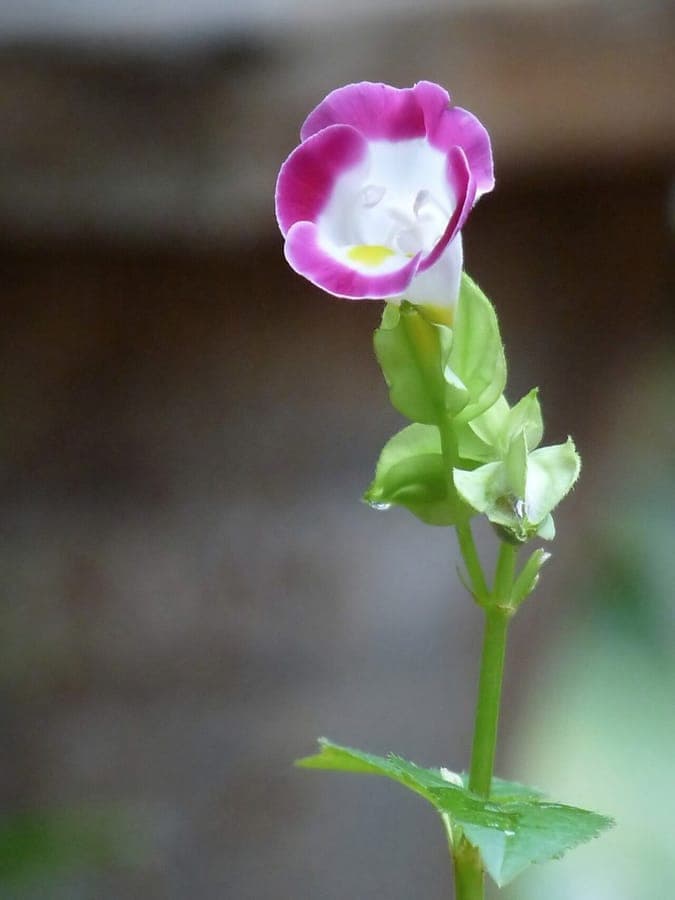
Jeevan Jose, Kerala, India / CC BY-SA 4.0, via Wikimedia Commons
Wishbone flower: complete guide to growing torenia
Torenia fournieri
Want to see Wishbone flower: complete guide to growing torenia in your garden?
Full design in HD: €7.99
Look after your Wishbone flower with the GardenWorld app
Identify plants with your camera and get a care calendar with reminders for this plant.


Overview
Shady patios and north-facing balconies are notoriously hard to fill with flowers. Geraniums sulk, petunias stretch towards the light, and by midsummer the containers look tired. Wishbone flower (Torenia fournieri) is one of the most reliable answers to that problem. This compact annual from South-East Asia flowers from June until the first frost, producing small, velvety trumpet blooms in blue, violet, pink, white or burgundy, often with a bright yellow blotch in the throat.
Torenia fournieri belongs to the family Linderniaceae and grows wild in Indochina, in damp, partly shaded woodland edges and scrub. The common name comes from the two stamens inside the flower, which arch together into a shape resembling a chicken's wishbone. It is also sold as bluewings, a nod to the deep blue lobes of the original wild form.
The plant stays low, usually 15–30 cm tall and 20–30 cm across, with a bushy, branching habit. That makes it ideal for pots, window boxes, hanging baskets and the front of a shady border. If you are wondering how seasonal colour like this fits into a wider plan, gardenworld.app can create a garden design for you that gives the shadier corners of your plot a proper role, including spots for summer bedding such as torenia.
Appearance and bloom cycle
The stems are square in cross-section, soft and green, sometimes tinged red. The leaves are arranged in opposite pairs, oval to lance-shaped, 3–5 cm long and finely toothed along the margin.
The flowers are the main attraction. Each one is 2–3 cm long, tubular and two-lipped, with an upper lip and a three-lobed lower lip. The wild form has a pale violet throat, deep purple-blue lobes and a yellow spot on the central lobe of the lower lip. Garden selections come in white edged with pink or blue, rose, magenta, burgundy, lemon yellow and various bicolours. The bloom in the photograph, white with a magenta rim and a yellow blotch, is a typical cultivated form.
Torenia flowers continuously from June to October as long as temperatures stay warm. It is self-cleaning: spent flowers drop on their own, so there is no need to deadhead. Bumblebees and other bees visit regularly. One detail rewards a closer look: the two lobes of the stigma snap shut within seconds when touched, a mechanism that helps retain pollen and one that plant scientists have studied for years.
Ideal location
Torenia thrives in partial shade: morning sun followed by afternoon shade, or the dappled light beneath trees. An east-facing patio, a bright north-facing balcony or a spot under a pergola suits it perfectly. In full midday sun the leaves scorch and pots dry out far too quickly, especially during hot spells. In deep, dark shade the plant still grows but flowers less freely.
Warmth matters as much as light. As a tropical plant, torenia grows happily above 15 °C and stalls below 10 °C. Wait until the last frosts have passed, usually mid to late May, before planting outside, and choose a sheltered position out of cold wind.
Hanging baskets at eye level show off the intricate flowers well, as do window boxes. In borders, use torenia as an edging plant in front of hostas and ferns. A spacing of 20–25 cm will knit together into a continuous carpet within a few weeks.
Soil requirements
For containers, use a good-quality multipurpose or peat-free compost with added organic matter, which holds moisture without becoming compacted. Mixing in 10–20% perlite keeps the texture open. Drainage holes are essential, as torenia dislikes sitting in water.
In open ground, torenia does best in humus-rich, moisture-retentive yet free-draining soil. Improve heavy clay with leaf mould or garden compost, and add compost to light sandy soil to help it hold water. The ideal pH is between 5.5 and 7, slightly acidic to neutral.
The root system is fine and fairly shallow. Plant at the same depth as in the nursery pot, firm gently and water in straight away. Avoid moving plants once established, as the roots resent disturbance.
Free preview
Want to see Wishbone flower: complete guide to growing torenia in your garden? Make a free preview of your design.
Watering
Consistently moist is the key phrase. Torenia should never dry out completely; when it does, it drops its buds and takes a while to recover. At the same time, surplus water must be able to drain away. Check the compost daily with a finger, and water when the top 2 cm feels dry.
In July and August that often means daily watering for small pots and hanging baskets, and sometimes twice a day during heatwaves. Water in the morning where possible, aiming at the compost rather than the leaves and flowers. Wet foliage overnight increases the risk of grey mould. In borders, a mulch of compost or fine bark helps to retain moisture.
In a confined pot, torenia is a hungry plant. Add a liquid flowering-plant feed to the watering can every two weeks from June to late August, or mix controlled-release granules into the compost at planting time. Too much nitrogen produces lush leaves and few flowers, so stick to the dose on the label.
Pruning
Torenia needs very little pruning. A few weeks after planting, pinch out the tips of the longest shoots just above a pair of leaves. This encourages branching and a fuller plant.
By midsummer a plant can become leggy, particularly in low light. Cut the longest stems back by about a third and within two to three weeks it will be covered in buds again. There is no need to remove faded flowers, but do take off yellowing leaves and damaged stems so fungal problems have no foothold.
To keep a favourite colour, take tip cuttings 5–8 cm long in August. They root within two weeks in a glass of water or in moist cutting compost at 20 °C. Overwinter the young plants on a bright windowsill in a room at around 15 °C. Success is not guaranteed, as torenia is naturally short-lived, but it is worth a try.
Maintenance calendar
February–March: Sow indoors at 20–22 °C. The seed is dust-fine and needs light to germinate, so scatter it on moist seed compost and do not cover it. Seedlings appear after 10–14 days.
April: Prick out seedlings in twos or threes into small pots and grow them on in a bright spot at 16–18 °C. Pinch out the tips once they have four pairs of leaves.
May: Harden off young plants by placing them outdoors during the day. Plant out once all risk of frost has passed.
June–August: Peak flowering. Water regularly and feed every two weeks. Trim back leggy stems and check the undersides of leaves for aphids and whitefly.
September–October: Flowering continues as long as nights stay above 8–10 °C. Take cuttings to overwinter indoors if you wish.
November–January: Clear away plants after the first frost and store seed from non-hybrid plants in a cool, dry place.
To keep on top of these jobs, the planting calendar on gardenworld.app helps you time sowing, planting out and feeding throughout the season.
Winter hardiness
Torenia fournieri is not frost hardy. It suffers damage a few degrees above freezing, and even a light frost kills it. In a temperate climate it is therefore grown as an annual: sown or bought in spring, enjoyed from June to October, and cleared after the first frost.
Toxicity is not a known concern. Torenia is not regarded as poisonous to people, dogs or cats. Even so, it is an ornamental plant rather than food, so it is sensible to discourage children and pets from nibbling it.
Companion plants
Torenia is made for the shade container, alongside other plants that enjoy the same moist, sheltered conditions. Busy Lizzie (Impatiens walleriana) is the classic partner: both flower all summer in partial shade and share the same thirst. White busy Lizzies with blue torenia create a fresh, cool effect.
Trailing lobelia (Lobelia erinus) spills over the edge of a basket and intensifies the blue tones. For foliage colour and contrast, choose coral bells (Heuchera micrantha) with dark purple or lime-green leaves, or caladium (Caladium bicolor) with its large, patterned foliage. A hardy fuchsia (Fuchsia magellanica) adds height and suits the same position.
In borders, plant torenia at the front of hostas, ferns and shade-tolerant grasses, where the low flowers fill the gaps between larger foliage plants. Avoid pairing it with sun-loving, drought-tolerant plants such as lavender or sage, whose needs are the opposite.
Final thoughts
Torenia fournieri is one of the most rewarding summer bedding plants for shade. It flowers for four months, needs no deadheading and brings colour to places where little else will bloom. Keep the compost evenly moist, feed regularly and wait until the weather is properly warm before planting out, and you will be rewarded with a mass of tiny trumpets.
Try a hanging basket on a north-facing terrace planted with blue and white torenia and trailing lobelia. It is a simple combination that looks good from early summer until autumn.
Frequently asked questions about Wishbone flower
Is Wishbone flower winter hardy?
Torenia fournieri is not frost hardy. It suffers damage a few degrees above freezing, and even a light frost kills it.
When and how do you prune Wishbone flower?
Torenia needs very little pruning. A few weeks after planting, pinch out the tips of the longest shoots just above a pair of leaves.
How much water does Wishbone flower need?
Consistently moist is the key phrase. Torenia should never dry out completely; when it does, it drops its buds and takes a while to recover.
Where does Wishbone flower grow best?
Torenia thrives in partial shade: morning sun followed by afternoon shade, or the dappled light beneath trees. An east-facing patio, a bright north-facing balcony or a spot under a pergola suits it perfectly.
What soil does Wishbone flower need?
For containers, use a good-quality multipurpose or peat-free compost with added organic matter, which holds moisture without becoming compacted. Mixing in 10–20% perlite keeps the texture open.

See it in your garden
See Wishbone flower in your garden
One photo of your garden and a few questions. You see the result in about a minute.
Try it with a photoIdentify this plant in your own garden. Identify a plant
Similar plants
Busy lizzy: complete guide
Impatiens walleriana
Discover Busy lizzy (Impatiens walleriana): a colorful flowering plant for shade. Rich blooms, compact, easy-care. Growing tips for gardens and containers.
Lobelia erinus: complete guide
Lobelia erinus L.
Lobelia erinus is popular trailing plant with blue or red flowers, perfect for hanging baskets and containers. Flowers continuously all summer long.
Alumroot: complete guide
Heuchera micrantha
Discover how to grow and care for Heuchera micrantha: ideal light, soil, watering, and seasonal maintenance for thriving plants in your garden.
