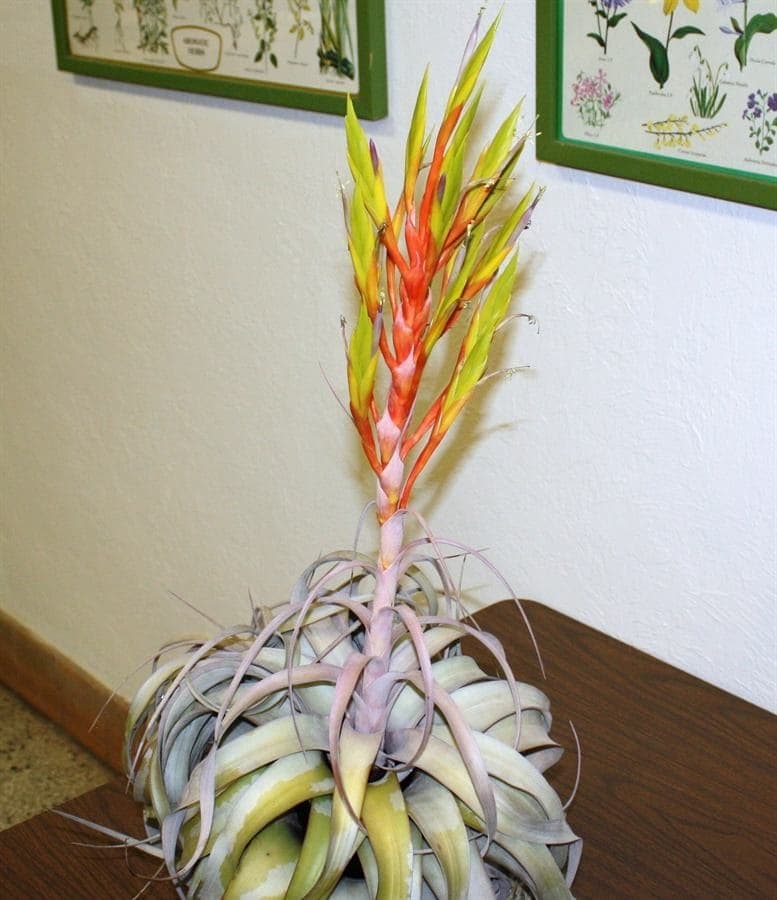
Bocabroms / CC BY-SA 3.0, via Wikimedia Commons
Tillandsia xerographica: the king of air plants
Tillandsia xerographica
Want to see Tillandsia xerographica: the king of air plants in your garden?
Full design in HD: €7.99
Look after your Tillandsia xerographica with the GardenWorld app
Identify plants with your camera and get a care calendar with reminders for this plant.


Overview
Tillandsia xerographica is the giant among air plants you can keep indoors. Most tillandsias fit in the palm of your hand, but this one grows into a silver-grey rosette 30 to 40 cm across, with broad leaves that curl elegantly outwards and downwards. It is no surprise that growers call it the king of air plants.
In the wild it grows in southern Mexico, Guatemala and El Salvador, in dry forest and open spots with plenty of light. It lives there as an epiphyte on tree branches and has to cope with long dry spells. That is where the name comes from: xerographica refers to dryness. The leaves are densely covered in silvery scales, the trichomes, which take up moisture from the air and from showers and also shield the plant from strong sun.
That makes it very different from the familiar small air plant Tillandsia ionantha. Xerographica grows slowly, usually stays as a single large rosette, tolerates more sun and drought and needs less water. It is more of a living sculpture than a plant to tuck in among others. If you want to give it a central role in a room that ties in with your garden or patio, you can have a garden design made on gardenworld.app that links indoors and out.
Appearance and flowering
The leaves are several centimetres wide at the base and taper into long, narrow points that curl and sometimes twist around each other. They are silver-grey, and in good light the youngest leaves take on a pink to lilac tinge. A young nursery plant often measures 15 to 20 cm, and it takes years to reach full size.
A rosette flowers only after many years, and only once. A sturdy, branched flower spike then rises from the centre, clearly visible in the photograph. The bracts along the stem turn pink to red, the side branches carry yellow-green bracts, and tubular purple flowers appear between them. The spike stays attractive for months. Afterwards the mother plant produces a few pups at its base and slowly declines, which can easily take a year or longer.
A protected species: CITES Appendix II
Tillandsia xerographica is listed on Appendix II of CITES, the international convention that regulates trade in threatened animals and plants. Wild populations have declined sharply because of large-scale collecting for the ornamental plant trade. International trade is therefore only allowed with the proper permits, and strict import rules apply within the European Union.
For you as a buyer that means one simple rule: buy only nursery-grown plants. If in doubt, ask where the plant comes from. A reputable seller will know where it was raised. Cultivated plants are also healthier and adapt far better to life indoors than plants taken from the wild.
Position and light
This species loves light and tolerates more sun than most air plants. A spot close to a south-, east- or west-facing window is ideal. In summer, strong midday sun behind glass can get too hot, so a sheer curtain or half a metre's distance from the window is enough. A spot in the middle of a room or in a dark hallway is too gloomy: the plant will not grow there and loses its silver sheen.
From late May to September it can go outdoors in a bright, sheltered spot. Give it a few days in light shade to adjust before it gets more sun.
Watering or misting
Tillandsia xerographica wants less water than its smaller relatives and, above all, it must dry quickly and completely after each watering. Water easily collects in the broad leaf bases, and that leads to rot.
Most growers recommend a quick dunk rather than a long soak. During the growing season, dip the plant once a week for a few seconds up to a couple of minutes in rainwater or tap water left to stand overnight. Alternatively, mist it thoroughly until all the leaves are wet. Then shake it well and stand or hang it upside down so all the water drains from the centre and the leaf bases. Only put it back once it feels dry.
In winter, once every ten to fourteen days is enough. If the leaves curl more than usual and feel thin, water a little more often. A brown, soft base means the plant has stayed too wet.
Free preview
Want to see Tillandsia xerographica: the king of air plants in your garden? Make a free preview of your design.
Mounting and display
This species does not need to be fixed to anything. It looks good sitting loose in a shallow dish, on a stand or on a candlestick, where the curling leaves can hang freely. Never put it in compost or in a closed glass container. If you do want to hang it or mount it on wood, use fishing line or a soft tie around the lowest leaves, and never copper wire, as copper is toxic to tillandsias.
Because it is so large, it makes the most impact on its own, at eye level on a sideboard or windowsill. Just make sure it never sits in a puddle on a saucer.
Feeding and growth rate
This air plant grows slowly, and that is fine. A few new leaves a year is normal. From April to September you can add a quarter of the usual dose of orchid or bromeliad fertiliser to the misting water once a month. More feed will not speed it up, but it will make it more vulnerable. Avoid fertilisers containing urea or copper.
The pups that appear after flowering are best left on the mother plant until they are sturdy, at least a third of her size. With this species that takes a long time. You can then separate them carefully, or let the group grow on together.
Care calendar
January and February: A quick dunk or misting every ten to fourteen days. Give it as much light as possible.
March and April: Back to weekly watering. First light feed.
May: From late May it can go outdoors in a sheltered, bright spot.
June to August: Water weekly and mist extra on hot days. Feed monthly.
September: Bring indoors before nights drop below 10 °C.
October to December: Water less, always let it dry completely, and keep it away from radiators.
The plant calendar on gardenworld.app shows month by month what your air plants and other houseplants need.
Rest and winter
Tillandsia xerographica is not hardy and must overwinter indoors. Temperatures between 15 and 30 °C are ideal; below 10 °C it stops growing and frost kills it. It has no true dormancy, but growth almost stops in the dark months. Water less then and give it as much daylight as you can. It copes with dry indoor air better than most air plants, but a spot directly above a radiator is still too extreme.
Toxicity to pets
Tillandsias are considered non-toxic to cats, dogs and people, so a cat nibbling the leaf tips is in no danger. For the plant it is another story: chewed tips do not grow back and spoil the rosette for years. Place a large xerographica somewhere pets cannot reach.
Companion plants
This big air plant is a statement piece that needs little company. In a group it looks lovely beside silvery, trailing Spanish moss (Tillandsia usneoides), which shares its grey colour but has a completely different form. A staghorn fern (Platycerium bifurcatum) on a board adds a green counterweight. Epiphytic flowering plants such as the moth orchid (Phalaenopsis amabilis) or the leaf cactus Epiphyllum oxypetalum also suit the same bright corner, although they need a little more water. Give each its own watering rhythm.
Final thoughts
Tillandsia xerographica is a plant for anyone who appreciates calm and form. Give it plenty of light, short waterings and always a thorough drying, and it will remain a silver sculpture in your home for years. Buy only nursery-grown plants so that wild populations in Central America have a chance to recover. And be patient: if it ever flowers, it is an event you will not soon forget.

See it in your garden
See Tillandsia xerographica in your garden
One photo of your garden and a few questions. You see the result in about a minute.
Try it with a photoIdentify this plant in your own garden. Identify a plant
Similar plants
Spanish Moss (Tillandsia usneoides): complete guide
Tillandsia usneoides
Tillandsia usneoides, known as Spanish moss, is an epiphytic bromeliad without roots. Perfect for indoors or protected outdoor spots, this unusual plant offers magical, airy appeal.
Common staghorn fern: complete guide
Platycerium bifurcatum
Discover the Common staghorn fern (Platycerium bifurcatum), a fascinating epiphytic fern from Australia. Learn about care, ideal growing conditions, and how to grow this remarkable plant in your indoor space.
Phalaenopsis amabilis: complete guide
Phalaenopsis amabilis (L.) Blume
Phalaenopsis amabilis (Moon Orchid) is an elegant houseplant with gorgeous white flowers. Learn care, watering, and blooming techniques.
