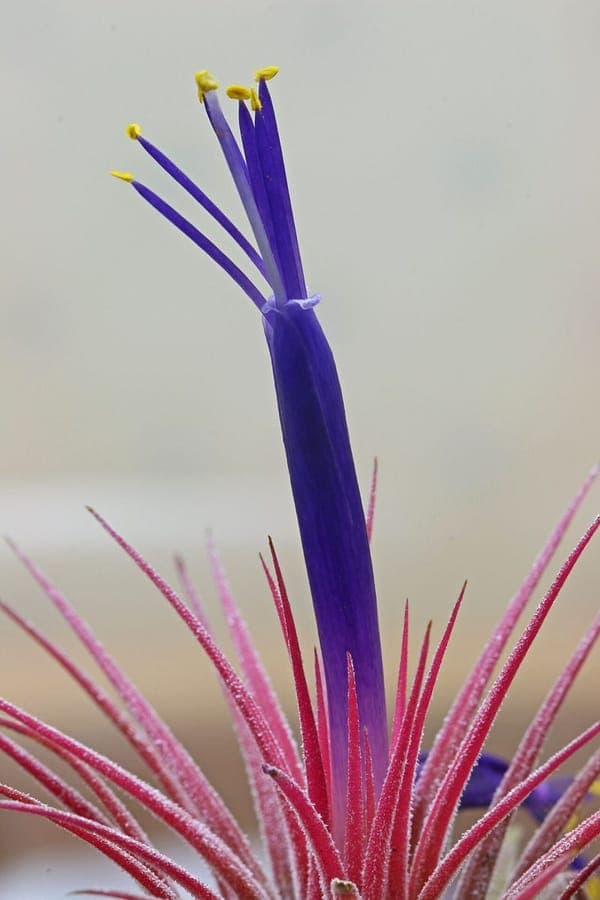
Andrey Zharkikh from Salt Lake City, USA / CC BY 2.0, via Wikimedia Commons
Tillandsia ionantha: caring for the sky plant
Tillandsia ionantha
Want to see Tillandsia ionantha: caring for the sky plant in your garden?
Full design in HD: €7.99
Look after your Tillandsia ionantha with the GardenWorld app
Identify plants with your camera and get a care calendar with reminders for this plant.


Overview
Tillandsia ionantha is the air plant you are most likely to see in florists and garden centres, and with good reason. It stays small, it grows without any compost, and just before flowering the leaves at its heart turn from green to vivid red. Then violet tubular flowers with yellow stamens emerge, exactly as in the photograph. Its common name is sky plant, and like all tillandsias it is usually labelled air plant.
Tillandsias belong to the bromeliad family. This species grows wild from Mexico through Central America, as an epiphyte on tree branches and occasionally on rocks. Its roots serve only as anchors. Water and nutrients are taken in through the leaves, which are covered in tiny silvery scales called trichomes. These give the foliage its soft grey-green sheen and catch every drop of rain or dew.
Because no pot or compost is involved, you can put this little plant almost anywhere: on a piece of driftwood, in a shell, in an open glass globe or on a thread in front of a window. If you want your indoor and outdoor greenery to work together, you can have a garden design made on gardenworld.app that links the two spaces.
Appearance and flowering
A rosette of Tillandsia ionantha is usually 5 to 10 cm tall. The leaves are stiff, narrowly triangular and pointed, packed together like a tiny bouquet. There are many forms and cultivars. 'Fuego' turns a particularly bright red, 'Druid' goes yellow-green at flowering and has white flowers, and 'Peanut' stays round and squat.
Each rosette flowers once in its life. First the inner leaves blush red or pink, transforming the plant within a few weeks. Then one or more violet flowers, 3 to 4 cm long, push out of the centre. The flowers last from a few days to a couple of weeks, the red colouring rather longer. After flowering the mother plant produces two to four young rosettes, or pups, at its base. Over a few years the species builds up into a dense clump or even a ball of dozens of rosettes.
Position and light
Give this air plant plenty of bright light. A spot close to an east- or west-facing window is ideal, and a few hours of gentle morning sun encourage the red flowering colour. Behind south-facing glass the summer midday sun can be too strong, so move it half a metre back from the window or put up a sheer curtain. A bathroom with a window is a good place, as the humidity is higher there. A dark corner or a shelf in the middle of a room is not enough; the plant fades and barely grows.
From late May to September Tillandsia ionantha can go outdoors in the dappled shade of a tree or under a canopy. It loves rainwater, but make sure it can dry quickly after a shower.
Watering or misting
This is where things usually go wrong with air plants, in both directions. The plant definitely needs water, but its centre must never stay wet for long.
The most reliable method is soaking. During the growing season, submerge the plant once a week for 15 to 20 minutes in a bowl of water at room temperature. Use rainwater, filtered water or tap water left to stand overnight. Water from a softener is unsuitable because it contains salt. After soaking, shake the plant gently and lay it upside down on a towel so the water drains out of the centre. It should be completely dry within about four hours, and only then should you put it back.
If you prefer misting, spray the plant two or three times a week until the leaves glisten. In dry, heated rooms misting alone is often not enough, so combine it with a soak every fortnight.
Read the leaves. If they roll inwards lengthways and turn noticeably greyer, the plant is thirsty. If the base turns brown and soft, or leaves fall out of the centre, it has stayed too wet and rot has set in.
Free preview
Want to see Tillandsia ionantha: caring for the sky plant in your garden? Make a free preview of your design.
Mounting and hanging
Never put an air plant in compost: the base will rot. Fix it to a dry surface such as driftwood, cork, a stone or a shell. Use fishing line, a soft plant tie or a dab of plant-safe glue applied to the lowest leaves, never to the heart. Never use copper wire, as copper is toxic to tillandsias.
Glass globes are popular, but choose an open one and do not put the plant in straight after soaking. In a closed container moisture lingers and the plant rots within weeks. If you hang several plants, leave a little space between them so air can move freely.
Feeding and pups
Feeding is not essential, but it helps growth and flowering. From April to September add a quarter of the normal dose of orchid or bromeliad fertiliser to the soaking water once a month. Avoid fertilisers containing urea or much copper.
You can leave the pups that appear after flowering in place. They form an attractive clump on their own, which also holds moisture better. If you want to separate them, wait until a pup is a third to half the size of its mother and twist it gently away at the base. The spent mother rosette slowly dries out and can be removed once it shrivels.
Care calendar
January and February: Slow growth. Soak every ten days and let it dry thoroughly. Give it as much light as possible.
March and April: Growth picks up. Return to weekly soaking and give the first feed.
May: From late May the plant can go outdoors in light shade.
June to August: Soak weekly and mist extra in warm weather. Feed monthly.
September: Bring indoors before nights drop below 10 °C.
October to December: Water less often. Watch out for dry air near radiators.
The plant calendar on gardenworld.app shows month by month what your air plants and other houseplants need.
Rest and winter
Tillandsia ionantha is not hardy. It is happiest between 12 and 30 °C, barely grows below 10 °C and is lost once it freezes. Indoors, in an ordinary living room, it overwinters without trouble. It has no real dormancy, but growth slows during the dark months. Water less often then, let it dry especially well after each soak, and do not hang it right above a radiator.
Toxicity to pets
Tillandsias are considered non-toxic to cats, dogs and people, so a cat nibbling the leaves is in no danger. The plant is another matter: cats often find the stiff, wobbling leaves irresistible and drag it off the shelf. It is better to hang it out of reach, on a thread or high up on a wall.
Companion plants
Air plants look best in groups. Pair Tillandsia ionantha with the grey, trailing Spanish moss (Tillandsia usneoides), hung like a little curtain. A staghorn fern (Platycerium bifurcatum) on a board has the same natural look and enjoys the same bright, humid bathroom. A moth orchid (Phalaenopsis amabilis) also fits, as it is an epiphyte too and likes a similar spot. A spider plant (Chlorophytum comosum) in a hanging pot alongside makes the whole display greener and fuller.
Final thoughts
Tillandsia ionantha is the ideal first air plant. It is small and tough, and its red flowering colour is a real surprise. The rules are simple: plenty of light, a weekly soak, always let it dry properly and never plant it in compost. Stick to that and you will see it produce pups after flowering, growing slowly from a single rosette into a colourful clump.

See it in your garden
See Tillandsia ionantha in your garden
One photo of your garden and a few questions. You see the result in about a minute.
Try it with a photoIdentify this plant in your own garden. Identify a plant
Similar plants
Spanish Moss (Tillandsia usneoides): complete guide
Tillandsia usneoides
Tillandsia usneoides, known as Spanish moss, is an epiphytic bromeliad without roots. Perfect for indoors or protected outdoor spots, this unusual plant offers magical, airy appeal.
Common staghorn fern: complete guide
Platycerium bifurcatum
Discover the Common staghorn fern (Platycerium bifurcatum), a fascinating epiphytic fern from Australia. Learn about care, ideal growing conditions, and how to grow this remarkable plant in your indoor space.
Phalaenopsis amabilis: complete guide
Phalaenopsis amabilis (L.) Blume
Phalaenopsis amabilis (Moon Orchid) is an elegant houseplant with gorgeous white flowers. Learn care, watering, and blooming techniques.
