Wikimedia Commons / CC BY-SA 3.0, via Wikimedia Commons
Tillandsia aeranthos: care guide for a tough air plant
Tillandsia aeranthos
Want to see Tillandsia aeranthos: care guide for a tough air plant in your garden?
Full design in HD: €7.99
Look after your Tillandsia aeranthos with the GardenWorld app
Identify plants with your camera and get a care calendar with reminders for this plant.


Overview
Tillandsia aeranthos is an air plant from south-eastern South America, where it grows in southern Brazil, Uruguay, Paraguay and north-eastern Argentina. In the wild it clings to tree branches as an epiphyte, often along rivers and in open woodland, and never sees a pot of compost. It belongs to the bromeliad family (Bromeliaceae), alongside the pineapple and the familiar houseplant bromeliads with a water-filled cup at their centre. In Argentina and Uruguay it is one of the plants known as clavel del aire, roughly "carnation of the air".
What sets this species apart from many of the air plants sold in shops is how robust it is. Coming from a region with cool winters, it copes with lower temperatures and more water than the frosty-white desert species, and it soon builds up into a clump of dozens of rosettes. If you have ever watched an air plant shrivel or rot, Tillandsia aeranthos is a forgiving species to learn on. It needs no pot, no soil and no elaborate set-up: good light, regular water and moving air are enough.
Appearance and flowering
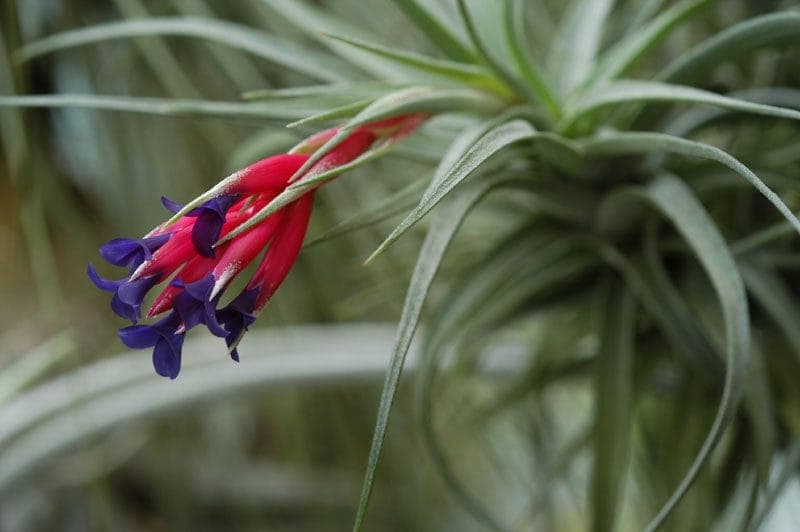
The plant forms a short stem with its leaves arranged in a tight spiral. They are stiff, narrowly triangular, 5 to 10 cm long and end in a sharp tip. A fine coat of scales, called trichomes, gives the foliage its silvery-green sheen. Those scales are the secret of every air plant: they trap water and nutrients and pass them into the leaf. The roots only anchor the plant to bark or stone.
Over the years the stem lengthens to 15 or 20 cm and the base produces a growing cluster. In Britain and the rest of north-west Europe it usually flowers from late winter into spring. A short, nodding or angled spike emerges from the centre, carrying pink to red bracts. Between them deep blue to violet flowers open one or two at a time. Each flower lasts only a few days, yet the bracts stay coloured for weeks. You will also find darker red forms and more compact selections, and the popular 'Bergeri' is usually regarded as a form or hybrid of this species.
Position and light
Give Tillandsia aeranthos plenty of light. A spot close to an east- or west-facing window is ideal, because it gets the gentler morning or evening sun. Strong midday sun through glass can scorch the leaves in summer, especially straight after watering. A north-facing window is usually too dim: growth slows, colour fades and flowers rarely appear.
The great advantage of this species is that it can live outdoors from late May until the end of September. Hang it in the dappled shade of a tree, under a pergola or from a balcony that is not in full sun all day. Rain, breeze and bright light give a more compact plant and better flowering. Just keep an eye out for blackbirds and slugs, which sometimes carry a loose plant away. Indoors, never shut it in a sealed glass globe: still, humid air is the quickest route to rot.
Watering: soaking and misting
Air plants take up water through their leaves. The most reliable method is soaking. During the growing season, submerge the plant once a week for 15 to 30 minutes in rainwater, or in tap water that has stood overnight. Lift it out, turn it upside down and shake the water from between the leaves. Then lay it on a towel or hang it straight back in an airy spot. It should be completely dry within three to four hours.
In winter, when light levels drop, soaking every ten to fourteen days is plenty. In a warm, centrally heated room you can mist in between, ideally in the morning so the plant is dry by evening. A well-watered plant feels firm and its leaves splay slightly. If the leaves curl tightly inwards or feel soft, it is thirsty. If the base turns brown and the centre pulls away, it has had too much water that sat for too long. Avoid distilled water and water from a domestic softener, which contains too much sodium.
Free preview
Want to see Tillandsia aeranthos: care guide for a tough air plant in your garden? Make a free preview of your design.
Humidity and temperature
In the wild Tillandsia aeranthos receives dew, rain and a fresh breeze. Indoors, humidity of 50 to 60 % is welcome, but the species is less fussy than many of its relatives. Air movement matters more. A windowsill near a window that is often opened, a bathroom with a window or a bright kitchen all suit it well.
It grows best between 12 and 28 °C. It shrugs off cool nights of 5 °C, and in its native range it sometimes survives a brief, light frost, but do not rely on that. Bring it inside before the first frost, which in most of the UK means some time in October. A cool, bright winter at 10 to 15 °C actually encourages spring flowering.
Mounting and display
Because it needs no soil, Tillandsia aeranthos can be fixed almost anywhere: on driftwood, cork bark, a branch, a stone or in a wire holder. Use nylon thread, fishing line, a sliver of cork or plant-safe glue. Never use copper wire, as copper is toxic to bromeliads. Glue only the base of the stem, and let hot glue cool before it touches the plant.
Do not sit it in a dish of moss or pebbles that stays wet. If you mount it on a wall, leave a few centimetres behind the plant so air can circulate. As the clump grows, simply let it hang as a silvery-green ball.
Feeding
Air plants need very little food. From April to September, add a liquid feed for bromeliads, orchids or air plants to the soaking water once a month at a quarter of the strength given on the bottle. Choose a fertiliser without urea and without copper if you can. Too much feed burns the leaf tips. Do not feed in winter.
After flowering and pups
As with every bromeliad, each rosette flowers only once. Afterwards the plant produces one or more pups at its base and between the leaves. The mother rosette stays attractive for months and then slowly dies back. Snip off the spent spike once it turns brown.
If you want a clump, simply leave the pups in place. After a few years you will have a dense ball that flowers again and again. If you want extra plants, wait until a pup is a third to half the size of its parent before you separate it. Twist it off gently or cut it away with a sharp knife. Remove dead mother plants in good time so moisture does not linger inside the clump.
Care calendar
January-February: Keep cool and bright. Soak every ten to fourteen days. Watch for the first flower spikes.
March-May: Main flowering. Soak weekly again and start a light feed in April. From late May the plant can go outside.
June-August: Outdoors in light shade. In dry, warm weather soak or mist twice a week. Feed monthly.
September-October: Bring indoors before the first frost and check for pests. Stop feeding.
November-December: Brightest spot in the house, away from radiators. To keep track of soaking and flowering, add the watering days to the plant calendar on gardenworld.app.
Toxicity to pets
The ASPCA, the American animal welfare organisation with a large plant database, does not list Tillandsia aeranthos, or the genus Tillandsia, on its pages. Every bromeliad that does appear in its lists, such as Guzmania lingulata and the neoregelias, is classed as non-toxic to dogs and cats. No toxic compounds are known from air plants. Even so, a loose air plant makes a tempting toy for a cat: it gets dragged around, chewed and damaged, and eating plant material can cause vomiting. Hang it out of reach.
Companion plants
Tillandsia aeranthos looks good alongside other epiphytes. Combine it with other air plants on a piece of driftwood, or hang it next to a staghorn fern (Platycerium bifurcatum) or a moth orchid (Phalaenopsis). Spanish moss (Tillandsia usneoides) makes a fine contrast with its stiff, pointed rosettes. Beside bromeliads such as Aechmea fasciata, or a Christmas cactus (Schlumbergera), it forms a calm, silvery backdrop. If you want your greenery to flow from the house onto the patio, you can have a garden design made on gardenworld.app that includes a summer corner for air plants beneath a tree or pergola.
Final thoughts
Tillandsia aeranthos is one of the most rewarding air plants: sturdy, quick to grow and willing to flower every spring in pink and deep blue. Give it strong light, a weekly dip in rainwater, a quick drying time and a summer outdoors, and within a few years it becomes a clump you will be proud to hang in the window.

See it in your garden
See Tillandsia aeranthos in your garden
One photo of your garden and a few questions. You see the result in about a minute.
Try it with a photoIdentify this plant in your own garden. Identify a plant
Similar plants
Spanish Moss (Tillandsia usneoides): complete guide
Tillandsia usneoides
Tillandsia usneoides, known as Spanish moss, is an epiphytic bromeliad without roots. Perfect for indoors or protected outdoor spots, this unusual plant offers magical, airy appeal.
Common staghorn fern: complete guide
Platycerium bifurcatum
Discover the Common staghorn fern (Platycerium bifurcatum), a fascinating epiphytic fern from Australia. Learn about care, ideal growing conditions, and how to grow this remarkable plant in your indoor space.
Phalaenopsis amabilis: complete guide
Phalaenopsis amabilis (L.) Blume
Phalaenopsis amabilis (Moon Orchid) is an elegant houseplant with gorgeous white flowers. Learn care, watering, and blooming techniques.
