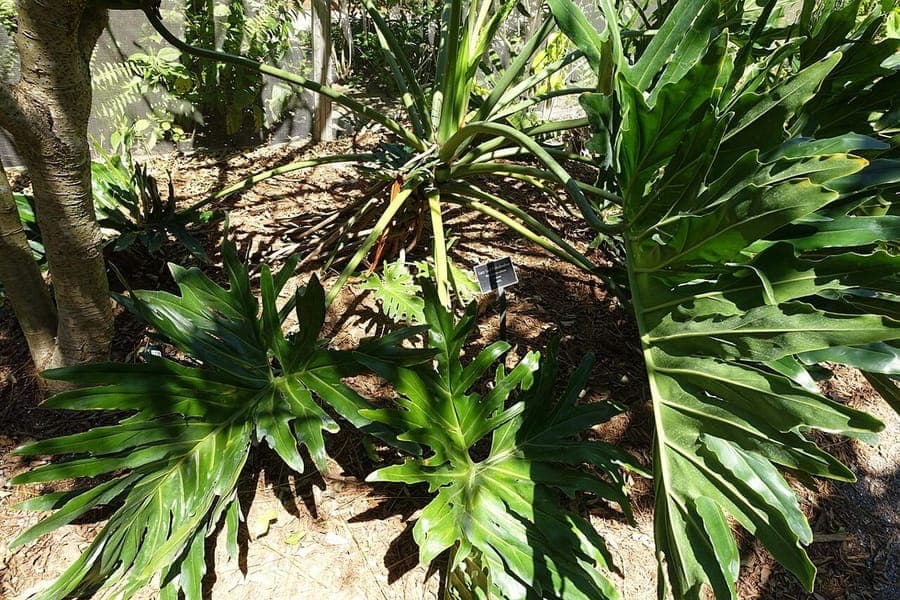
Daderot / CC0, via Wikimedia Commons
Lacy tree philodendron (Thaumatophyllum bipinnatifidum): complete guide
Thaumatophyllum bipinnatifidum
Want to see Lacy tree philodendron (Thaumatophyllum bipinnatifidum): complete guide in your garden?
Full design in HD: €7.99
Look after your Lacy tree philodendron with the GardenWorld app
Identify plants with your camera and get a care calendar with reminders for this plant.


Overview
If you have ever seen a houseplant with huge, deeply cut leaves taking up half a living room, there is a good chance it was a lacy tree philodendron. Botanists now call it Thaumatophyllum bipinnatifidum. For decades it was sold as Philodendron bipinnatifidum or Philodendron selloum, but in 2018 it was moved, along with a few close relatives, into the separate genus Thaumatophyllum. Garden centres and plant shops often still use the old label, so do not be confused: it is the same plant.
Thaumatophyllum bipinnatifidum belongs to the arum family (Araceae) and is native to South America, mainly southern Brazil, Paraguay, Bolivia and northern Argentina. In the wild it grows in humid forests, along riverbanks and in marshy hollows. Unlike many philodendrons, it does not climb. Instead it forms an upright, short trunk that may eventually lean over and creep along the ground. Thick aerial roots emerge from this trunk in search of support and moisture.
In northern Europe it is very much an indoor plant for people with space to spare. A mature specimen easily reaches 1.5 m tall and just as wide indoors. If you would like to see how such a statement plant fits into a conservatory or garden room alongside your outdoor planting, you can have a garden design made on gardenworld.app that links the inside and outside of your home.
Appearance and growth
The foliage is the main attraction. Young plants have fairly simple, heart-shaped leaves with a few lobes. As the plant matures, each new leaf is cut more deeply until it looks almost twice divided, which is where the species name bipinnatifidum comes from. In a glasshouse or planted out in the subtropics, a mature leaf can exceed 1 m in length; indoors most leaves stay between 40 and 80 cm. They are glossy dark green, leathery and held on long, rounded stalks.
When old leaves drop, they leave distinctive scars on the trunk, giving it a scaly, patterned look. This is perfectly normal and not a sign of disease. Flowering is rare indoors. Outdoors in warm climates, mature plants eventually produce a thick spadix inside a spathe that is green to purplish on the outside and creamy white within. Like several members of the arum family, the flowers warm themselves up while they are open.
Growth is fairly quick in summer: in good conditions a new leaf appears every few weeks. In winter the plant almost stops growing.
Ideal location
Give the plant bright light without harsh midday sun. A spot a metre or two from an east- or west-facing window is ideal, or further back from a south-facing one. Direct sun through glass can scorch brown patches on the leaves, especially in summer. In too little light the leaf stalks become long and floppy and the new leaves stay small and less divided.
Because it grows so wide, you really need to plan for space. Avoid narrow walkways where people brush past the leaves. Turn the pot a quarter turn every few weeks so it does not lean towards the window.
From late May to mid September the plant can go outside to a sheltered, partly shaded spot, such as a covered patio. Let it acclimatise in full shade for a week first, otherwise the leaves will scorch. Bring it back in as soon as night temperatures drop below 10 °C.
Compost and repotting
Use an airy, free-draining mix. A good recipe is two parts houseplant compost, one part fine orchid bark and one part perlite. This lets oxygen reach the roots and prevents water from lingering. A pot with a drainage hole is essential.
Repot young plants every spring into a pot one size larger. Older, heavy specimens only need repotting every two to three years; in between, simply refresh the top layer of compost. Choose a sturdy, heavy pot, as a large plant with lots of foliage is top-heavy and can easily tip over in a lightweight plastic one. Aerial roots that grow over the rim can be guided back into the pot or simply left to hang.
Free preview
Want to see Lacy tree philodendron (Thaumatophyllum bipinnatifidum): complete guide in your garden? Make a free preview of your design.
Watering and humidity
Water when the top 3 to 5 cm of compost feels dry. In summer that is roughly once a week, in winter once every two to three weeks. Water thoroughly until it runs out of the drainage hole, then empty the saucer after fifteen minutes. Soggy roots are the quickest route to root rot.
The plant appreciates humidity above 50%. Most living rooms fall short of that in winter, but fortunately Thaumatophyllum bipinnatifidum is far less fussy than a calathea. Keep it away from radiators and wipe the leaves with a damp cloth now and then. This removes dust so the leaves catch more light, and it helps deter spider mites.
From April to September, feed every two to three weeks with a liquid fertiliser for foliage plants at half strength. Do not feed in winter.
Care and pruning
Proper pruning is not needed. Cut off yellow or damaged older leaves as close to the trunk as possible with clean, sharp scissors. It is natural for the lowest leaves to die off over time.
If the plant becomes too large, you cannot simply cut the trunk back as you would a shrub. You can, however, remove a few of the oldest leaves to keep it more compact. Wear gloves when cutting, as the sap irritates the skin.
Watch for spider mites, mealybugs and scale insects, particularly in winter when the air is dry. Check the undersides of the leaves and the leaf axils regularly. Light infestations can be wiped away with a cloth and a little mild soapy water.
Maintenance calendar
March–April: Repot young plants and start feeding again. Check for pests that built up over winter.
May–June: Strong growth. Water and feed regularly. Move the plant outdoors to a sheltered, partly shaded spot if you like.
July–August: Protect from strong sun. Check more often whether the compost has dried out in hot weather.
September–October: Bring the plant in before nights turn cold. Reduce feeding.
November–February: Rest period. Water less, do not feed, and keep the plant away from cold draughts and hot radiators.
Temperature and hardiness
The ideal temperature range is 18 to 27 °C. Below 12 °C growth stops and the risk of root rot rises. In the UK and the Low Countries the plant is therefore not hardy outdoors in any sense.
In its native range and in mild coastal climates, such as parts of Spain and Portugal, it is grown in the open ground and survives a brief, light frost of a few degrees below zero, although the leaves will be damaged. That is not an option further north: never leave the plant outside when frost is forecast. An unheated conservatory is usually too cold in winter as well.
Toxicity to pets
Thaumatophyllum bipinnatifidum is toxic to cats, dogs, rabbits and other pets, and to people too. All parts contain needle-shaped calcium oxalate crystals. Chewing a leaf causes an immediate burning sensation in the mouth and throat, followed by swelling, drooling and sometimes vomiting. Large amounts can cause breathing difficulties due to swelling in the throat.
Keep the plant out of reach of small children and of cats that like to nibble on greenery. Clear away fallen leaves straight away. If your pet has chewed the plant, rinse its mouth with water and contact your vet. The sap can also irritate sensitive skin, so wear gloves when pruning and repotting.
Companion plants
A lacy tree philodendron is a statement plant in its own right, but it looks wonderful grouped with other tropical foliage. A Swiss cheese plant (Monstera deliciosa) gives a similar jungle feel with a different leaf shape. The bird of paradise (Strelitzia reginae) adds height and strong vertical lines. In front, a peace lily (Spathiphyllum wallisii) or a ZZ plant (Zamioculcas zamiifolia) copes with lower light levels. A giant taro (Alocasia macrorrhizos) completes the tropical look, though it needs plenty of space.
Bear in mind that most of these plants are also toxic to pets. If you have cats, choose a spot they cannot reach.
Final thoughts
Thaumatophyllum bipinnatifidum is a houseplant for anyone with room to spare and a love of bold, sculptural leaves. It is tough, grows quickly and forgives the odd missed watering. Give it bright light without harsh sun, an airy compost, moderate watering and a warm spot, and it will reward you for years with ever larger and more deeply cut leaves. Just remember that it is toxic and keep it away from cats, dogs and small children.
To keep track of when to repot, feed or move the plant outdoors, use the plant calendar on gardenworld.app. That way you will not miss a moment through the year, and your lacy tree philodendron will stay healthy and impressive.
Frequently asked questions about Lacy tree philodendron
Is Lacy tree philodendron winter hardy?
The ideal temperature range is 18 to 27 °C. Below 12 °C growth stops and the risk of root rot rises.
How much water does Lacy tree philodendron need?
Water when the top 3 to 5 cm of compost feels dry. In summer that is roughly once a week, in winter once every two to three weeks.
Where does Lacy tree philodendron grow best?
Give the plant bright light without harsh midday sun. A spot a metre or two from an east- or west-facing window is ideal, or further back from a south-facing one.

See it in your garden
See Lacy tree philodendron in your garden
One photo of your garden and a few questions. You see the result in about a minute.
Try it with a photoIdentify this plant in your own garden. Identify a plant
Similar plants
Monstera deliciosa: complete guide
Monstera deliciosa
Discover the fruit-salad plant (Monstera deliciosa) - a popular houseplant with characteristic holes in leaves. Professional care and growing tips for success.
Strelitzia reginae: complete guide
Strelitzia reginae
Strelitzia reginae is a beautiful plant from the Strelitziaceae family. Discover everything about cultivation and care in this guide.
Peace lily: complete guide
Spathiphyllum wallisii
How to grow a peace lily (Spathiphyllum wallisii): light, watering, repotting, getting it to flower again, and why it is toxic to cats and dogs.
