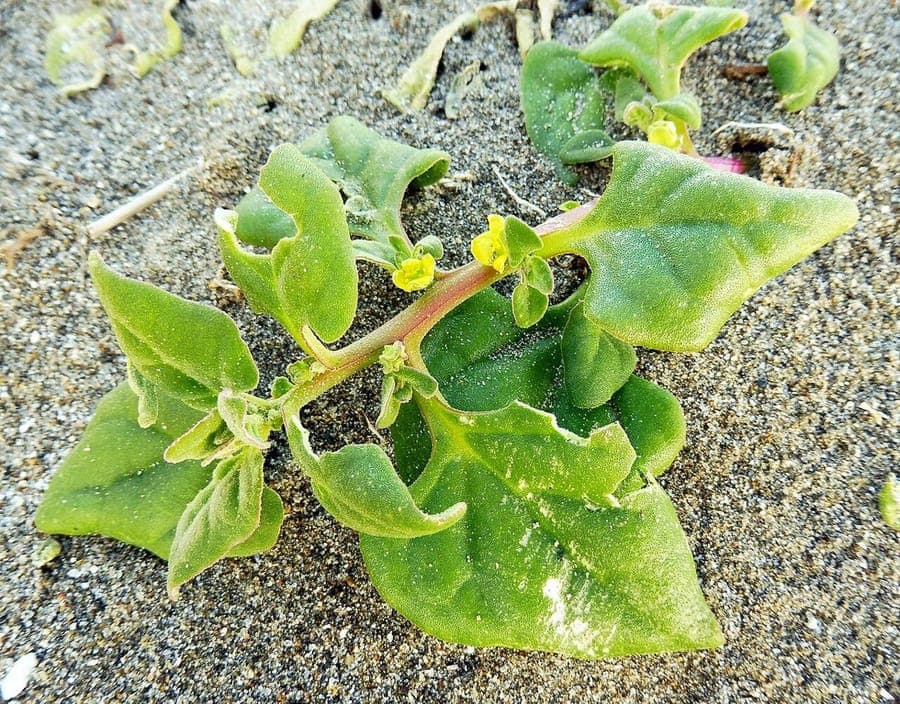
Mason Brock (Masebrock) / Public domain, via Wikimedia Commons
New Zealand spinach: sowing, harvesting and use
Tetragonia tetragonioides
Want to see New Zealand spinach: sowing, harvesting and use in your garden?
Full design in HD: €7.99
Look after your New Zealand spinach with the GardenWorld app
Identify plants with your camera and get a care calendar with reminders for this plant.


Overview
New Zealand spinach (Tetragonia tetragonioides) is the answer to a familiar frustration in the vegetable garden: ordinary spinach bolts in no time once summer arrives. This plant does not. It actually grows best in the heat and, from late June until the first frost, keeps producing tender shoot tips week after week that you cook just like spinach. One well-established plant can keep a household in greens all summer long.
Despite the name, it is no relation of true spinach. Tetragonia tetragonioides belongs to the ice plant family (Aizoaceae) and grows wild along the coasts of New Zealand, Australia, Japan and South America. There it lives on sandy beaches, dunes and rocky shores, which explains its fleshy leaves and its tolerance of salt and drought. In the eighteenth century Captain James Cook had the leaves boiled to protect his crew from scurvy, and the plant soon found its way into European kitchen gardens.
You can grow New Zealand spinach without worry, but do not let it seed freely near coastal dunes. It has naturalised in a number of coastal areas in southern Europe and North Africa. In an ordinary vegetable patch it is a rewarding summer crop. If you want to lay out your kitchen garden efficiently, with room for this vigorous grower, you can have a garden design made on gardenworld.app that takes into account the space each crop needs.
Like spinach, the leaves contain oxalic acid. Eating small amounts raw is fine, but if you eat a lot or are prone to kidney stones, blanch the leaves briefly and discard the cooking water. For the same reason, do not feed large quantities to pets.
Appearance and flowering
The plant grows sprawling to semi-upright, forming a loose mat 30 to 60 cm high and up to 1 m or more across. The stems are fleshy, green to reddish and branch freely. The leaves are triangular to diamond-shaped, 3 to 10 cm long, thick and succulent. Look closely and you will see a fine, granular sheen of tiny water-filled cells on the surface, which gives them a slightly silvery look. The photo shows just such a young shoot on sand, with its typical triangular leaves.
From June onwards, small and inconspicuous yellow flowers about 5 mm across appear in the leaf axils; they have no true petals. They develop into hard, angular fruits with four or five little horns, each containing several seeds. These fruits are what you sow. They drop easily, so the plant often self-seeds in the vegetable garden.
Position
New Zealand spinach loves a warm, sunny spot. Light shade is acceptable, but the yield will be smaller. It copes with heat, wind and even salty sea air, which makes it very well suited to coastal gardens and to sunny plots where lettuce and spinach scorch in summer.
Allow plenty of room: a single plant soon covers a square metre. Give it a corner of the bed or the edge of a raised bed where it can spill over the side. It also grows in a large container or balcony trough of at least 30 litres, as long as you water faithfully.
Soil requirements
The plant is not fussy. It grows in sand, loam and humus-rich garden soil, provided drainage is good. Cold, wet ground in spring slows it down badly. A pH between 6 and 7.5 is fine.
The richer the soil, the lusher the growth and the more tender the leaves. Work in a few handfuls of well-rotted compost at planting time. After a month or two you can scatter a little more compost or an organic vegetable feed around plants that are being picked hard. Do not overdo the nitrogen, though, or the leaves will build up more nitrate.
Free preview
Want to see New Zealand spinach: sowing, harvesting and use in your garden? Make a free preview of your design.
Sowing and planting out
The seeds have a hard coat and germinate slowly, so soak them in lukewarm water for 12 to 24 hours before sowing. Sow indoors from early April, two or three seeds per pot, 2 cm deep, at 15 to 20 °C. Germination takes two to three weeks, sometimes longer. Each fruit can produce several seedlings; keep the strongest.
Only plant out after mid-May, once there is no longer any risk of frost. Space plants 60 to 80 cm apart. You can also sow directly outdoors from mid-May, but harvesting will then start later. Hardening off for a week in a cold frame or a sheltered spot prevents a check in growth after planting.
Watering and care
Although the plant survives drought, it produces the best leaves when the soil stays lightly moist. In dry spells water thoroughly at the base twice a week. A mulch of grass clippings or straw holds in moisture and keeps the leaves clean.
Otherwise the plant asks for little. Slugs tend to leave it alone once it has some size, but young plants need protecting at first. Diseases are rare. If it becomes too straggly, cut back the long trailing stems; it will branch again. If you do not want it to self-seed, keep picking the tips so fewer fruits ripen, and gather up any fallen seeds.
Harvesting and use
You can start harvesting about six to eight weeks after planting out, from late June. Pinch or snip off the top 5 to 10 cm of each shoot, including the young leaves and stem. Older, lower leaves are tougher. Regular picking, ideally once or twice a week, keeps the plant compact and makes it produce new tips, so you can carry on until the first frost.
In the kitchen, use it like spinach: blanch or wilt it briefly with butter, garlic, cream or nutmeg. The leaves shrink less than ordinary spinach and stay a little firmer, which suits quiches, bakes, curries and soups. Young tips are also good raw in small amounts in a mixed salad. Freshly picked leaves keep for two to three days in the fridge, and they can be blanched and frozen.
Growing calendar
April: Soak the seeds for 12 to 24 hours and sow indoors at 15 to 20 °C.
Early May: Harden off the young plants. Prepare the bed with compost.
Mid-May: Plant out 60 to 80 cm apart once frost is over, or sow directly.
June: Water in dry weather and mulch. First harvest in late June.
July to September: Pick shoot tips weekly. Top-dress with compost if needed.
October: Last harvest before the first frost. Clear the plants; fallen seed may come up by itself the following year.
If you want to know when to sow and harvest what, the planting calendar on gardenworld.app helps you fit New Zealand spinach into your summer growing.
Winter hardiness
Tetragonia tetragonioides is not hardy. The plant dies with the first frost, and even a light frost around 0 °C damages the fleshy leaves. In north-western Europe it is therefore grown as an annual summer vegetable. The seeds inside the hard fruits do survive the winter in the soil, however, so spontaneous seedlings often appear in spring. They come up late, once the ground has warmed thoroughly.
Companion plants
As a heat-loving summer crop, New Zealand spinach goes well with other summer vegetables. It makes an attractive ground cover at the foot of tomatoes (Solanum lycopersicum), at a sensible distance from the stems. Next to courgettes (Cucurbita pepo) and nasturtiums (Tropaeolum majus) it fills a sunny edge of the bed. Malabar spinach (Basella alba) is a climbing counterpart you can grow behind it, and pot marigold (Calendula officinalis) draws in beneficial insects. Do not plant it among small, slow crops, as it will soon smother them.
Final thoughts
New Zealand spinach is the perfect summer stand-in for ordinary spinach. It does not bolt in the heat, copes with drought and wind, and supplies leaves for months from just one or two plants. Soak the seeds, sow indoors in April, plant out after mid-May and pick the tips every week. That way you have fresh greens all summer, exactly when other leafy crops give up.
Frequently asked questions about New Zealand spinach
Is New Zealand spinach winter hardy?
Tetragonia tetragonioides is not hardy. The plant dies with the first frost, and even a light frost around 0 °C damages the fleshy leaves.
How much water does New Zealand spinach need?
Although the plant survives drought, it produces the best leaves when the soil stays lightly moist. In dry spells water thoroughly at the base twice a week.
What soil does New Zealand spinach need?
The plant is not fussy. It grows in sand, loam and humus-rich garden soil, provided drainage is good.

See it in your garden
See New Zealand spinach in your garden
One photo of your garden and a few questions. You see the result in about a minute.
Try it with a photoIdentify this plant in your own garden. Identify a plant
Similar plants
Tomato: complete guide
Solanum lycopersicum
Everything you need to know about growing tomatoes: ideal conditions, care tips, soil needs, and companion plants. Perfect for backyard gardens and containers.
Pumpkin and courgette: complete guide
Cucurbita pepo
Growing pumpkins and courgettes: practical guide to cultivating these popular summer vegetables in your garden.
Garden nasturtium: complete guide
Tropaeolum majus
Discover the colorful world of garden nasturtiums. This tropical flower is easy to grow and full of edible blooms. Complete cultivation guide.
