
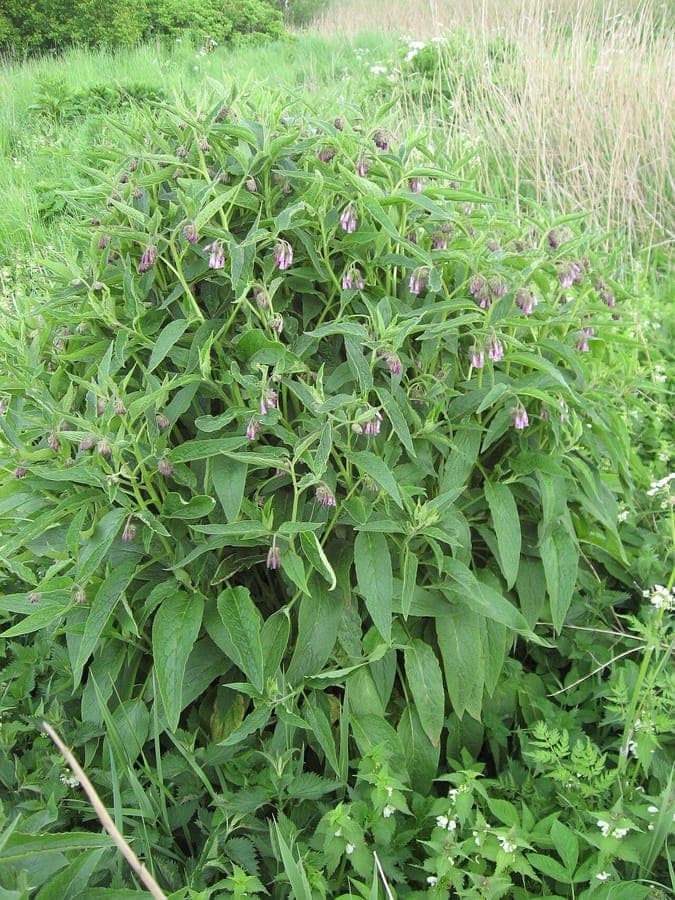
Kim Hansen / CC BY-SA 3.0, via Wikimedia Commons
Russian comfrey: complete guide to Symphytum x uplandicum
Symphytum x uplandicum
Want to see Russian comfrey: complete guide to Symphytum x uplandicum in your garden?
1 minute, no credit card
Overview
Russian comfrey (Symphytum x uplandicum) is a robust, long-flowering perennial with a dual role in the garden: it is both an attractive ornamental plant and one of the most useful organic gardening tools available. This hybrid between common comfrey (Symphytum officinale) and rough comfrey (Symphytum asperum) inherits the vigour of both parents and has been widely adopted in permaculture and organic kitchen gardens across northern Europe.
The plant's reputation rests largely on its function as a dynamic accumulator - its deep roots mine minerals from far below the surface and concentrate them in the rapidly decomposable leaves, which break down into a rich, potassium-heavy plant feed. Cut and composted or used directly as a mulch, the leaves provide a free, renewable fertiliser that rivals commercial preparations. But beyond this practical role, Russian comfrey is a genuinely attractive garden plant: the hanging clusters of blue, purple and pink bells draw bumblebees, honeybees and butterflies from May to August, and the large, rough-textured leaves form a spreading groundcover that suppresses weeds effectively.
On gardenworld.app you will find garden design examples where comfrey features as a key element in naturalistic and low-maintenance planting schemes. It works particularly well in the shadier corners of a garden where few ornamental plants thrive.
Appearance and bloom cycle
Symphytum x uplandicum forms a sturdy, upright clump 60 to 120 cm tall and 60 to 90 cm wide. The roots are fleshy, very dark and penetrate deeply - sometimes 180 cm into friable soil. This deep root system makes the plant extremely drought-tolerant once established, but also means it is difficult to remove once settled in, since any root fragment left in the ground can regenerate.
The leaves are large - 30 to 40 cm long - broadly oval to lance-shaped, covered in stiff, slightly irritating hairs. The stem leaves are stalkless and decurrent, running down the stem in a characteristic way that helps identify the plant.
The flowers appear from May to August in drooping, scorpioid cymes. The colour passes from rose-pink buds to open flowers of rich blue, violet or purple - a characteristic colour change shared by the whole borage family (Boraginaceae) to which comfrey belongs. The nectar-rich, tubular bells are designed for bumblebees with their long tongues, but many other pollinators visit regularly.
After flowering, small dark nutlets form. The hybrid is generally less invasive by seed than the common species, though some self-seeding does occur.
Ideal location
Russian comfrey is remarkably adaptable. It grows in full sun to deep shade, though it flowers most freely in light to partial shade. In deep shade under large trees it produces impressive foliage but fewer flowers.
It prefers moist, deeply worked ground but survives perfectly well on dry sites once its deep roots reach moisture. It thrives in neglected corners, alongside fences, at the base of hedges and in those awkward spots where little else will grow. The north-facing side of a building is no problem for this plant.
On gardenworld.app, design ideas show comfrey used as an underplanting beneath ornamental shrubs, as a bank stabiliser or as an edging plant along waterways. Its versatility makes it a practical choice for difficult garden situations.
Soil requirements
Comfrey grows in sand, loam and clay, including heavy, wet clay that many plants cannot tolerate. Neutral to slightly acidic pH (5.5 to 7.0) is ideal, but it tolerates a wider range. On poor, thin soils it still grows well - its deep roots access nutrients that surface-feeders cannot reach.
Think of Russian comfrey as a soil builder in your garden. Harvest the leaves several times per year and use them as a liquid fertiliser (steep in water for three to four weeks) or as a direct mulch around hungry crops. Each leaf is rich in potassium, nitrogen and phosphorus - exactly what fruit trees, tomatoes and beans need.
The cultivar 'Bocking 14' is widely grown in organic gardens specifically because it produces fertile seeds only rarely, which reduces the spread beyond intended areas.
Watering
Once established, Russian comfrey needs virtually no supplementary water. Its deep roots access moisture that surface plants cannot reach, even during dry summers. Only in the first year after planting is regular watering in dry spells useful - aim for weekly deep watering during prolonged dry periods to help the plant establish.
On sandy soils prone to rapid drying, monthly supplementary watering in midsummer is sensible. In most garden soils, however, the plant looks after itself completely.
Prolonged waterlogging on heavy clay with a high water table is the one condition it tolerates less well than drought. On poorly drained soils, improve conditions at planting time with coarse grit or raised beds.
Free design
Want to see Russian comfrey: complete guide to Symphytum x uplandicum in your garden? Make a free design now.
Pruning
Russian comfrey requires very little attention, but a few simple interventions improve both its ornamental and practical value significantly.
After the first flush of flowers in June or July, cut the whole plant back to about 15 cm above ground. Within two to three weeks, fresh foliage regenerates and the plant blooms again in August. This cutting can be repeated up to three times per growing season, yielding both fresh mulch material and a prolonged display of flowers.
To prevent self-seeding, remove the spent flower clusters before the nutlets ripen. This is only necessary if you want to control spread strictly.
In autumn (October to November), cut the whole plant down to ground level. The hardy root crown overwinters without protection and new growth appears the following spring, sometimes as early as February in mild winters.
If the clump becomes too large, divide it in spring or autumn: dig out sections from the outer edge of the clump, each with a piece of root, and replant or share them.
Maintenance calendar
February to March: New growth emerges. Remove any dead material from the previous year. Top-dressing with compost is beneficial but not essential.
April: Rapid growth. The plant reaches full size quickly. Good time to divide large clumps if needed.
May to June: First flowering. Bumblebees and bees visit constantly. First mulch or liquid feed harvest possible.
June to July: Cut back after first flowering for a fresh flush of leaves and a second round of blooms.
August: Second or third flowering depending on cutting frequency. Further mulch material available.
September: Seed development if not cut back. Check for unwanted self-seeding in nearby beds.
October to November: Cut down to ground level. Use the material as mulch or add to the compost heap.
December to January: Dormancy. The root crown overwinters without any protection.
Winter hardiness
Russian comfrey is fully cold-hardy in USDA zones 3 to 9, corresponding to temperatures as low as -40 degrees Celsius. No winter protection is needed in northern European gardens.
The top growth dies back after the first frost, but the fleshy root crown survives even the coldest winters. The plant is so adaptable that it naturalises extensively along roadsides, railway embankments and waste ground throughout north-west Europe - clear evidence of its hardiness.
In mild winters, new growth can appear as early as February. In cold years, wait until March before assuming the plant has not survived - it almost certainly has.
Companion plants
Russian comfrey works well alongside plants that share its tolerance of shade and moisture:
Bird cherry (Prunus padus) - the early-flowering tree attracts the same pollinators, and comfrey makes an excellent underplanting beneath its canopy.
Wood sorrel (Oxalis acetosella) - a delicate low-growing companion for shaded corners.
Foxglove (Digitalis purpurea) - shares the same love of part shade and damp conditions, attracting the same bumblebees with its tubular purple flowers.
Purple loosestrife (Lythrum salicaria) - in a waterside planting, the two make a striking combination of purple spikes and blue bells.
Meadowsweet (Filipendula ulmaria) - another lover of moist, semi-shaded spots, flowering white in midsummer.
Look for Russian comfrey at specialist herb nurseries or online growers. Garden centres sometimes stock it in the perennials section. The cultivar 'Bocking 14' is the most commonly available form in the UK and is the best choice for gardens where you want to limit self-seeding.
Final thoughts
Russian comfrey is a plant for gardeners who want more from their planting than pure ornamental effect. It blooms for three months, feeds the bees, improves the soil, suppresses weeds and survives the coldest winters without any care. In a shady corner, along a fence or as part of a kitchen garden system, it earns its place many times over.
For garden design ideas that combine functional and ornamental plants in a coherent scheme, gardenworld.app offers a straightforward design tool that lets you visualise the finished planting before you begin. A plant as versatile as Russian comfrey deserves a well-considered position in your garden.
Want to see Russian comfrey: complete guide to Symphytum x uplandicum in your garden? Make a free design now.
Upload a photo, pick a style, and get a photorealistic design with plant list in under a minute.
10,000+ gardens designed already
No credit card required


Similar plants
Comfrey (Symphytum officinale): complete guide
Symphytum officinale
Everything you need to know about comfrey: cultivation, care and applications. A robust healing plant with multiple benefits for any garden.
Breadbutter: complete guide
Borago officinalis
Learn how to grow Breadcrumb (Borago officinalis) in your garden: ideal light, soil pH, bloom time and care tips for UK and US climates.
Echium vulgare: complete guide
Echium vulgare
Viper's bugloss with intense blue flowers. Ideal for wildflower meadows and pollinator gardens. Learn how to grow it on gardenworld.app.