
Kasjanek24 / CC BY-SA 4.0, via Wikimedia Commons
Echium vulgare: complete guide
Echium vulgare
Want to see Echium vulgare: complete guide in your garden?
1 minute, no credit card
Overview
Echium vulgare, commonly known as viper's bugloss or blueweed, is a colorful herbaceous plant native to Europe that perfectly adapts to wild gardens and flower meadows. This biennial to short-lived perennial produces long, narrow flower spikes with intensely blue flowers and is an absolute magnet for bees, bumble bees, and butterflies. Self-seeding of this prolific wonder happens almost effortlessly!
Appearance & Bloom
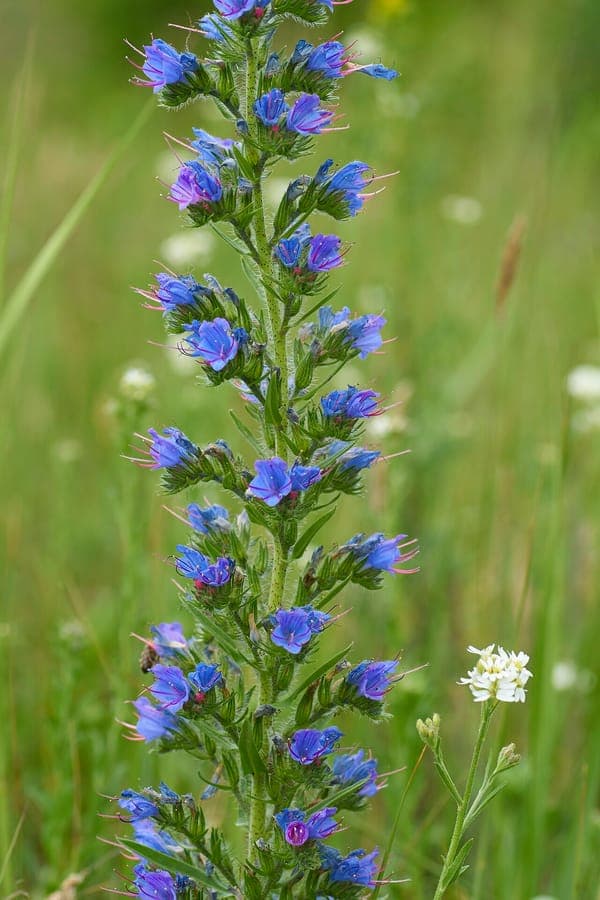
Viper's bugloss grows as a dense, upright plant 30-80 cm tall (depending on soil fertility). Leaves are linear-lanceolate, 8-20 cm long, and coarsely hairy. Flowers appear May-August: long, self-supporting flower spikes (up to 30 cm long) bearing hundreds of small tubular flowers that open in intensely blue-purple, sometimes pink in bud. The plant is generously packed with flowers.
Ideal Location
Viper's bugloss thrives in full sun to partial shade, but flowers most abundantly in full sun. The plant is extremely wind and weather tolerant. Perfect spots: wildflower meadows, flower borders, rough ground, or wildflower patches. Plant spacing: 30-45 cm. Direct sowing in field possible in May.
Soil
Echium vulgare is undemanding about soil. Sandy, well-draining soil is ideal. Heavy clay soils are less suitable (moisture excess). The plant thrives in poor, dry soil. Nutrient-rich soil promotes leaf growth but fewer flowers. pH 6.5-7.5 optimal.
Watering
Once established, viper's bugloss is extremely drought-tolerant. Watering only needed in extreme drought. Young plants (first 6 weeks) require regular watering. Too much water promotes fungal disease and weakness. Containerized plants need slightly more frequent watering than ground plants.
Free design
Want to see Echium vulgare: complete guide in your garden? Make a free design now.
Pruning
Pruning is not really necessary. Remove spent flower spikes in July for continued blooming. Seedheads can fully ripen and self-seed - usually desired in wildflower gardens! Dieback happens naturally. The plant dies after seed-set.
Maintenance Calendar
April-May: Sow seed directly in field or plant pre-grown plants. June: First flowers appear, check water. July-August: Massive blooming, possibly remove spent spikes. September: Blooming stops, seed ripens, plant declines. October-November: Seed drops naturally, soil incorporates or stays on surface. March-April: Young seedlings reappear from seed.
Winter Hardiness
Echium vulgare is very hardy (USDA zone 4-5, to -35°C). Excellent for all of northern Europe! It's a biennial: first year rosette only, second year blooming. In mild climates it can overwinter as a young plant. Protection unnecessary.
Companion Plants
Viper's bugloss pairs beautifully with other wildflowers: Papaver rhoeas (common poppy), Centaurea cyanus (cornflower), Knautia arvensis (field scabious), Vicia villosa (hairy vetch), Lupinus angustifolius (narrow-leaf lupin), Leucanthemum vulgare (ox-eye daisy), Malva moschata (musk mallow). Together they create a vibrant, pollinator-rich meadow.
Conclusion
Echium vulgare is ideal for those seeking naturalness and low maintenance. With its intensely blue flowers and pollinator-supporting characteristics, it provides essential food for beneficial insects. The plant self-seeds prolifically, so you just sit back and watch your garden become wilder and more beautiful. Discover more wildflower garden ideas on gardenworld.app.
Want to see Echium vulgare: complete guide in your garden? Make a free design now.
Upload a photo, pick a style, and get a photorealistic design with plant list in under a minute.
No credit card required


Similar plants
Echinops exaltatus: complete guide
Echinops exaltatus
The tall globe thistle with stunning blue ball flowers. Perfect for pollinator gardens and sustainable landscaping. Read the full growing guide on gardenworld.app.
Empetrum nigrum: complete guide
Empetrum nigrum
Crowberry, a hardy evergreen groundcover with black berries. Perfect for alpine gardens and moorland landscapes. Learn more on gardenworld.app.