
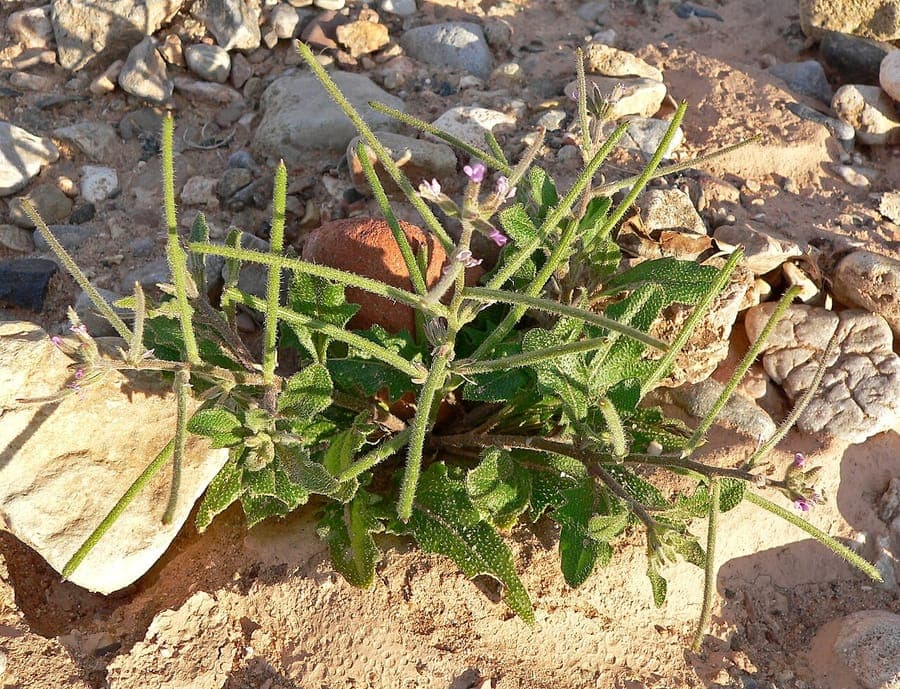
Stan Shebs / CC BY-SA 3.0, via Wikimedia Commons
African mustard: complete guide
Strigosella africana
Want to see African mustard: complete guide in your garden?
1 minute, no credit card
Overview
Strigosella africana, commonly called african mustard, turkish mustard, or african stock, is a small annual herb in the mustard family (Brassicaceae). The species was described scientifically in 1972 by Botschantzev, based on the earlier basionym Hesperis africana L. first described by Linnaeus. It is native to a broad arc stretching from the Mediterranean basin across the Middle East and Central Asia to the western Himalaya and parts of China, encompassing countries such as Morocco, Spain, Italy, Greece, Turkey, Iran, Afghanistan, Pakistan, and Xinjiang. Beyond this natural range it has been introduced to parts of western and central Europe as well as North and South America, where it sometimes appears as a casual weed of disturbed ground. Although Strigosella africana is not widely available at mainstream garden centres in the UK, it draws interest from botanically minded gardeners, naturalistic planting enthusiasts, and those specialising in drought-tolerant or Mediterranean-style gardens. Its compact size, fast life cycle and tolerance of dry, impoverished conditions make it a practical choice for gravel gardens, dry borders, and experimental annual wildflower mixes. For design ideas incorporating drought-tolerant annuals into front-garden schemes, gardenworld.app is an excellent starting point.
Appearance and bloom cycle
Strigosella africana is an upright to loosely branching annual reaching 20 to 40 cm in height under favourable conditions. Both stems and leaves are densely covered with stiff, spreading hairs, giving the plant a greyish-green, slightly rough texture - an attribute captured in the genus name Strigosella, derived from the Latin 'strigosus' (harshly hairy). The leaves are pinnately lobed to deeply divided, somewhat resembling dandelion leaves, which explains the synonym Malcolmia taraxacifolia. The flowers are four-petalled, typical of all Brassicaceae, and range from white to pale pink or lilac, arranged in loose terminal racemes. Flowering takes place from early spring through early summer, depending on sowing time and climate. Pollinators visiting the flowers include hoverflies and small solitary bee species. After pollination the plant sets long, slender seed pods (siliques) characteristic of the mustard family. Once the seeds ripen, the entire plant dies, completing its annual life cycle. Self-seeding is common when the pods are allowed to mature and split open on the plant.
Ideal location
In its natural habitat Strigosella africana occupies open, sun-exposed to lightly shaded sites on well-drained, dry to moderately moist soils. It thrives on rocky slopes, roadsides, abandoned fields and ruderal waste ground. In a garden setting, choose a position with full sun to light partial shade and good drainage. A south- or west-facing aspect is ideal. The plant performs well in a Mediterranean corner, a gravel garden, a dry border, or a sunny front garden where the soil warms up quickly and stays relatively dry in summer. It is unfussy about soil type as long as drainage is adequate: it tolerates sandy, loamy and even stony substrates. Rich, fertile soils are actually disadvantageous, as they promote lush vegetative growth at the expense of flowering and compact habit. Light intensity requirements are moderate but not extreme; in its native range it also colonises north-facing slopes, though flowering is best in full sun.
Soil
Strigosella africana prefers dry, mineral-rich but not overly fertile soils. The optimal pH range is 7.0 to 7.5, indicating a preference for neutral to mildly alkaline, often calcareous substrates. A sandy or gravelly loam is ideal. Heavy clay soils with poor drainage are poorly tolerated, as waterlogging at the roots rapidly leads to rot. If your soil is heavy, work coarse sand or fine grit into the upper 20 to 30 cm before sowing. Small amounts of compost can be incorporated for a basic nutrient balance, but avoid rich fertilisers or high-nutrient composts: these encourage soft, leafy growth at the expense of the compact, floriferous habit the plant is known for. In containers, a cactus or Mediterranean potting mix supplemented with extra perlite works very well.
Free design
Want to see African mustard: complete guide in your garden? Make a free design now.
Watering
Watering Strigosella africana requires minimal effort, as the species is markedly drought-tolerant. In its native regions it survives on restricted rainfall and long dry summers. In garden conditions in temperate western Europe, average seasonal rainfall is generally sufficient for established plants. Water only when the soil has remained dry for an extended period - typically more than two weeks without significant rain - and then water thoroughly but infrequently. Avoid overwatering, as standing water around the roots is the quickest route to rot. Seedlings in pots or trays need slightly more regular moisture until they are established, but once they are growing strongly they can rely largely on rainfall. In a dry summer on a south-facing plot, watering once every two weeks is adequate. The guiding principle is less is more: plants experiencing mild drought stress tend to flower more prolifically than those kept consistently moist.
Pruning
As an annual plant, Strigosella africana requires almost no pruning or deadheading. The plant follows a straightforward sequence: germination, vegetative growth, flowering, seed setting, and die-back within a single growing season. If you wish to extend the flowering period slightly, you can remove spent flower stalks before the seed pods fully develop, encouraging the plant to put more energy into producing new flower buds rather than into seed maturation. This is, however, only a temporary measure. At the end of the season, allow some plants to set seed if you want them to self-seed naturally for the following year. In that case, leave the plants standing until the siliques turn brown and begin to split. After seed dispersal you can remove the dry plant material or leave it as winter habitat for insects. No autumn or winter pruning is needed, as the plant dies after the first hard frost in any case.
Maintenance calendar
February to March: sow seeds indoors under glass or on a light frost-free windowsill for early plants. April: direct sow outdoors once the risk of frost has passed. May: thin seedlings to 10 to 15 cm spacing to allow sufficient air circulation and root space. June to July: main flowering period; remove spent stems if you want to extend flowering. August: seed pods ripen; leave them on the plant if self-seeding is desired. September: plants die back after seed maturation; remove dead material or leave it as wildlife habitat. October to November: collect and store ripe seeds in a cool, dry place for sowing the following spring. December to January: no action needed; optionally loosen the soil in planting areas in preparation for the next season.
Winter hardiness
Strigosella africana is a true annual and does not overwinter as a living plant. The parent plant dies after seed ripening, and the cycle restarts from seed in the following season. Seeds are reasonably frost-tolerant and can survive in the soil through winter. In regions with severe, prolonged frost and no snow cover some seed loss may occur, but typically a portion of the seed bank survives intact. In USDA hardiness zone terms, the plant is not rated as a perennial, but for seed viability and self-seeding capacity it performs reliably in zones 6 to 10. In zone 5 and colder it is advisable to collect seeds and store them indoors, sowing them outside in spring. A light mulch of leaf compost or straw over the seed zone can help protect overwintering seeds in colder climates. Gardenworld.app provides planting design examples for gardens in a range of climatic zones.
Companion plants
Because of its preference for dry, sunny positions, Strigosella africana combines well with other Mediterranean and drought-tolerant annuals and perennials. Attractive combinations include Malcolmia maritima (the closely related Virginia stock, now also reclassified under Strigosella by some authorities), Eschscholzia californica (California poppy), Nigella damascena (love-in-a-mist), Gypsophila elegans, and various Iberis species. For a fully Mediterranean character, pair it with perennials such as Salvia officinalis, Thymus vulgaris, Lavandula angustifolia, and low-growing Allium species. Front-garden combinations with gravel mulches and low drought-tolerant groundcovers also work very well, as shown in the design gallery on gardenworld.app. Avoid pairing it with moisture-loving plants such as Astilbe, Primula or Hosta, which require conditions the opposite of what Strigosella needs.
Closing
Strigosella africana is a modest but quietly charming annual that rewards gardeners with its fast pace of growth, adaptability to dry and impoverished conditions, and delicate small flowers. It makes few demands, fits into a wide range of garden styles from Mediterranean to naturalistically rugged, and lends itself to self-seeding plantings that evolve slightly each year. Whether you tuck it into a sandy border, a gravel garden, or a pot on a sun-drenched patio, this small mustard plant consistently delivers more interest than its modest size might suggest.
Want to see African mustard: complete guide in your garden? Make a free design now.
Upload a photo, pick a style, and get a photorealistic design with plant list in under a minute.
No credit card required


Similar plants
Brassica cretica: complete guide
Brassica cretica
Brassica cretica, the Cretan cabbage, grows wild on Aegean cliffs. Discover how to grow this drought-tolerant, yellow-flowered Mediterranean perennial.
Corsican cabbage: complete guide
Brassica insularis
Corsican cabbage is a rare Mediterranean rock cabbage with white flowers and blue-green leaves. Location, soil and winter protection.
Prostrate cabbage: complete guide
Brassica procumbens
Prostrate cabbage is a creeping North African cliff plant with yellow flowers. Discover location, soil type and winter protection.