
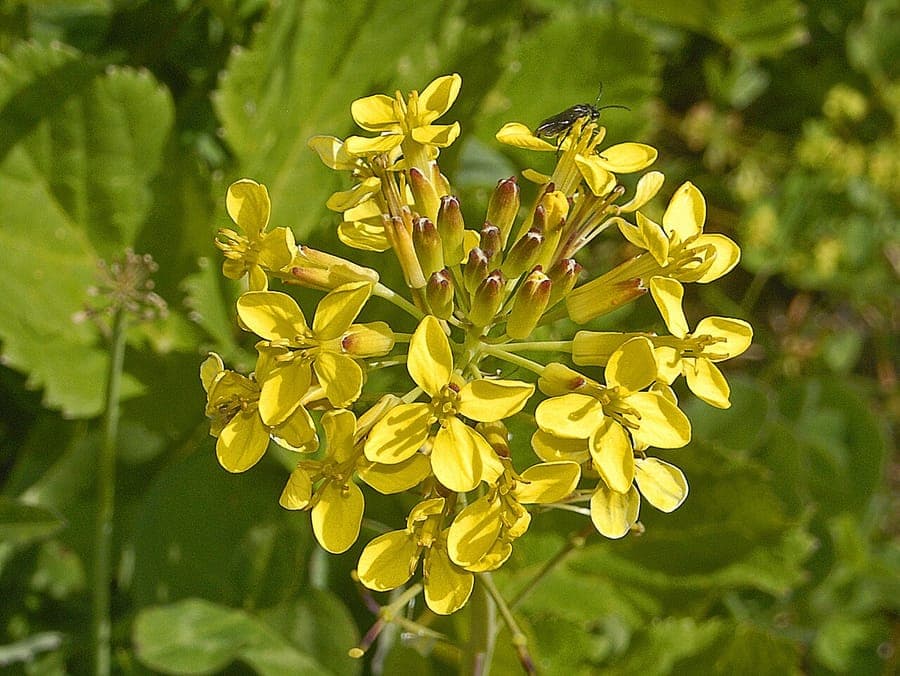
Hectonichus / CC BY-SA 3.0, via Wikimedia Commons
Richer's wallflower-cabbage: complete guide
Coincya richeri
Want to see Richer's wallflower-cabbage: complete guide in your garden?
1 minute, no credit card
Overview
Coincya richeri, also known historically as Brassica richeri, Erucastrum richeri and Rhynchosinapis richeri, is a remarkable plant in the family Brassicaceae (mustards and cabbages). The species was formally described under its current name in 1983 by Greuter and Burdet, based on earlier work by the eighteenth-century French botanist Villars who had published the plant as Brassica richeri. The epithet richeri honours the French botanist Richer de Belleval, an early pioneer of French botanical science. In German the plant is known as Richers Lacksenf, and in French as Chou de Richer or Coincye de Richer. The native range is restricted to the southwestern Alps of France and Italy, where the plant grows on rocky calcareous slopes, mountain meadows and alpine zones. It is a notable plant for its isolated position in the alpine flora and its conspicuous yellow flowers that closely resemble those of common mustard or rocket. At gardenworld.app you can explore rock garden and alpine garden designs where unusual mountain plants like this one play a central role.
Appearance and bloom cycle
Coincya richeri has the typical appearance of a Brassicaceae member: erect, well-branched stems reaching 20 to 60 cm in height, with deeply cut or pinnately lobed leaves. The lower leaves are often larger and somewhat fleshy, the upper leaves smaller and clasping the stem. The entire plant is covered with fine hairs that give it a slightly grey-green or matte green appearance. The flowers are bright yellow, composed of four petals arranged in a cross (characteristic of the family), gathered in raceme-like inflorescences that open gradually from the base upwards. Flowering occurs in July and August, at the height of the brief alpine summer. After flowering, slender siliqua (pods) develop containing small round seeds. The plant is perennial but sometimes behaves as biennial: forming a leaf rosette in the first year, then flowering and setting seed in the second.
Ideal location
In its natural habitat, Coincya richeri grows on fully sun-exposed, south-facing rocky slopes and calcareous cliffs in the sub-alpine and alpine zones of the southwestern Alps. In the garden it has similar requirements: at least six hours of direct sunlight per day on a free-draining site. The plant is well suited to rock gardens, stony slopes, dry-stone walls and larger scree plantings. It tolerates wind well - which in its mountain habitat is more the rule than the exception - but benefits from a sheltered position during particularly wet winters. In temperate regions of northwestern Europe, it can be grown as a distinctive speciality for the rock garden, provided drainage is excellent.
Soil
Coincya richeri prefers free-draining and ideally calcareous soil, matching its mountain habitat. On heavy, wet or nitrogen-rich soils the plant performs poorly. When planting, improve the lower layer with sharp sand or coarse grit in a ratio of one-third to one-half sand. Lime can be added on acid soils to raise the pH to the optimal range of 6.5 to 7.5. Avoid placing compost or manure close to the roots; the plant does best on lean soils where competition from other plants is low.
Free design
Want to see Richer's wallflower-cabbage: complete guide in your garden? Make a free design now.
Watering
Once established, Coincya richeri is reasonably drought-tolerant thanks to a deep root system that can access moisture from lower soil layers. During the growing season, supplementary watering is only needed during exceptional dry spells. Overwatering is harmful; the combination of wet roots and warm temperatures can lead to crown rot. During winter the plant should be kept as dry as possible, since persistent wet conditions at the roots in cold months are one of the main risks for overwintering Brassicaceae in the garden. Newly planted specimens need regular watering for the first few weeks until established.
Pruning
Coincya richeri requires little pruning. After flowering, the spent stems can be cut back to just above the leaf rosette to give the plant a tidier appearance and redirect energy to vegetative growth rather than seed set. If you want the plant to self-seed - a useful strategy for naturalisation in a rock garden - allow the pods to ripen fully before cutting the stems. Spring pruning to remove damaged or dead stems from the previous season is also well tolerated. Hard pruning to the base is best avoided on older specimens, as recovery is slower than in young plants.
Maintenance calendar
January to February: plant is dormant; ensure good drainage and protect young plants with a grit collar if needed. March: inspect for winter damage, remove dead stems from the previous year. April: start of growth; apply a thin layer of lean compost if desired. May: growth accelerates, weed regularly around the plant. June: pre-bloom stage, keep the bed weed-free and well drained. July to August: full bloom; water only during extreme drought and enjoy the yellow flowers. September: pods ripen; leave for self-seeding or prune after flowering. October: plant enters dormancy, reduce watering. November to December: winter dormancy, drainage is critical.
Winter hardiness
Coincya richeri is a genuine mountain plant, hardy in USDA hardiness zones 5 through 8. The plant tolerates hard frosts well, provided the soil drains freely. In its alpine home, snow cover for several months is normal and even protective: the snow insulates the leaf rosette from extreme cold. The real challenge in cultivation is not cold itself but the combination of wet roots and cold - a situation far more common in many north-western European gardens than in the alpine habitat. A layer of coarse grit around the crown dramatically improves winter drainage and reduces the risk of rot. Container-grown plants are more vulnerable to complete freeze-through than in-ground specimens.
Companion plants
For a naturalistic alpine look in the rock garden, Coincya richeri combines well with other limestone-loving mountain plants. Consider Draba species (whitelow-grasses), Aethionema (stonecress), other low Brassicaceae relatives, Potentilla rupestris (rock cinquefoil), Campanula cochleariifolia (fairy thimble bellflower) and low-growing Viola species. The yellow flowers of Coincya contrast beautifully with the blue tones of Geranium subcaulescens or Globularia species. At gardenworld.app you can commission a personalised garden design that incorporates plants like Coincya richeri correctly into a rock garden or naturalistic front garden scheme.
Closing
Coincya richeri is one of the most distinctive members of the Brassicaceae found in the alpine flora of the southwestern Alps - little known outside botanical circles, but well worth introducing to a wider audience. Its bright yellow flowers, robust mountain constitution and relative ease of cultivation on a well-drained, sunny site make it a valuable contribution to any rock garden or alpine planting. For gardeners seeking an unusual plant with a rich botanical history and mountain character, Coincya richeri is an excellent choice.
Want to see Richer's wallflower-cabbage: complete guide in your garden? Make a free design now.
Upload a photo, pick a style, and get a photorealistic design with plant list in under a minute.
10,000+ gardens designed already
No credit card required


Similar plants
Brassica cretica: complete guide
Brassica cretica
Brassica cretica, the Cretan cabbage, grows wild on Aegean cliffs. Discover how to grow this drought-tolerant, yellow-flowered Mediterranean perennial.
Corsican cabbage: complete guide
Brassica insularis
Corsican cabbage is a rare Mediterranean rock cabbage with white flowers and blue-green leaves. Location, soil and winter protection.
Prostrate cabbage: complete guide
Brassica procumbens
Prostrate cabbage is a creeping North African cliff plant with yellow flowers. Discover location, soil type and winter protection.