
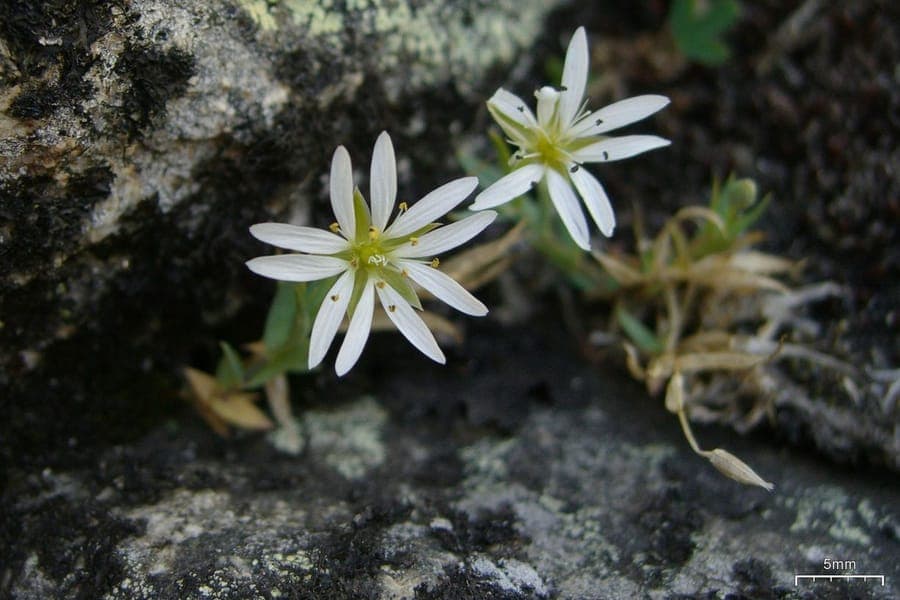
pellaea / CC BY 2.0, via Wikimedia Commons
Stellaria longipes: complete guide
Stellaria longipes
Want to see Stellaria longipes: complete guide in your garden?
1 minute, no credit card
Overview
Stellaria longipes, commonly known as long-stalk starwort or Goldie's starwort, is an elegant alpine plant belonging to the Caryophyllaceae family (carnation family). This hardy low-growing herb is native to subarctic and western mountainous regions of North America, where it thrives at elevations and cold conditions that challenge many gardens. The plant is renowned for its exceptional winter hardiness and ability to grow where many other plants cannot survive.
Thanks to its compact growth and delicate flowers, Stella longipes has become a favorite among alpine and rock garden enthusiasts. It is a frost-tolerant annual to biennial plant that readily self-seeds when conditions are right, allowing it to establish itself in the crevices between stones and other rock garden environments.
Appearance and Bloom
The long-stalk starwort grows as a low mat-forming plant, typically between 5 to 15 centimeters tall. The stems are thin, elegant, and often long-stalked, hence the name longipes (long foot). The leaves are small, linear, and acuminate, gray-green in color.
Flowers appear in late spring to early summer (May to August) as small, delicate white blooms with five deeply cleft petals. These give the graceful appearance characteristic of the Stellaria genus. The flowers are followed by small seed capsules that open in five teeth-like segments.
The plant forms dense mats of 10 to 30 centimeters in diameter, making it ideal as a groundcover in alpine gardens and rockeries.
Ideal Location
Stellaria longipes thrives in mountainous, cool climates. In temperate zones, it performs best in full sun to partial shade with well-draining soil. In mountainous regions, the plant can adapt to more shade.
The plant prefers high elevation and cold winters, so it performs best in northern regions of Europe or in mountainous areas of Belgium and France. If you live in a warmer climate, plant it in an east or north-facing exposure to provide afternoon shade.
Given this alpine plant's growth preference, the best results are achieved when grown in a rock garden or alpine container, where drainage is perfect and the plant doesn't experience excessive summer heat.
Soil
Drainage is absolutely critical for Stellaria longipes. The plant grows naturally in stony, well-draining soils on mountain slopes. In gardens, well-draining soil mixtures work perfectly. A mix of:
- 60% sand or fine gravel
- 30% peat-free potting mix or leaf mold
- 10% fine gravel for extra drainage
Slightly acidic to neutral pH (6.0-7.0) is ideal. Ensure the soil does not waterlog, especially in winter. If you live in a low-lying area with heavy clay soil, plant in raised beds or alpine troughs with amended soil.
For container growing, use alpine potting mix (such as John Innes Alpine or similar). These mixes are specifically designed for this purpose.
Free design
Want to see Stellaria longipes: complete guide in your garden? Make a free design now.
Watering
This is where Stella longipes demands caution. Alpine plants tolerate drought far better than wet conditions. Water moderately during the growing season (spring and early summer) and sparingly in autumn and winter.
In-ground: Water thoroughly after planting, then when the top layer feels dry. Once established, it requires minimal supplemental water.
In containers: Water when the potting mix feels dry, usually about once a week during the growing season. Avoid splashing water on the foliage.
Winter: Provide minimal water. The plant goes dormant and requires far less moisture. Ensure the soil stays dry enough to avoid puddles.
Pruning
Pruning is usually unnecessary for this compact plant. Remove dead or damaged stems in spring when new growth begins. Also remove spent seed heads to prevent excessive self-seeding in unwanted locations.
If the plant becomes overgrown, you may gently remove some old material from the center to improve air circulation, especially in humid climates.
Maintenance Calendar
February to March: Check for winter damage. Remove dead material. April to May: Watering begins as growth accelerates. Check for weeds around the plant. June to July: Enjoy the blooms. Allow self-seeding where desired. August: Seed pods mature. Remove or keep for dispersal. September to October: Reduce watering as growing season ends. November to January: Minimal maintenance. Protect against exceptional wet conditions.
Winter Hardiness
Stellaria longipes is exceptionally winter hardy, having evolved in subarctic regions where temperatures plummet to -40 degrees Celsius and below. It tolerates winter temperatures down to USDA zone 2 (-45 to -40 degrees Celsius) and higher.
In northern Europe, this plant is absolutely winter-hardy. Winter damage is rare, typically caused by wet conditions rather than cold. Ensure good drainage in winter to prevent rot.
In warmer climates, the plant may suffer from insufficient winter chill, so it might bloom less profusely or grow less vigorously.
Companion Plants
In alpine gardens, pair Stella longipes well with other alpine groundcovers:
- Saxifraga (Saxifrage): Various species share the same growing needs
- Phlox subulata (Creeping phlox): Pink and red flowers contrast with white
- Sedum: Succulents provide textural contrast
- Armeria maritima (Sea thrift): White or rose pompom flowers
- Sempervivum: Interesting rosette forms
- Dianthus alpinus: Small carnations in pink or red
Avoid plants that require much water, such as hostas or astilbe. These will cause rotting if positioned too close to your alpine plant.
Conclusion
Stellaria longipes is a beautiful secret for alpine gardeners. While it may not have the spectacular flowers of some other mountain plants, its delicate white blooms and elegant growth are absolutely charming. With proper drainage and preference for cool, hardy conditions, this plant will perform reliably for years.
For gardens with temperate to cool winter temperatures, this is a must-have for rock gardens and alpine containers. Seek seeds or small plants at local nurseries for best availability in your region. Read more about alpine gardening on gardenworld.app for more inspiration for your rock garden.
Perfect for small gardens, alpine troughs, and rock gardens where summer drought is not a problem. Stella longipes brings alpine elegance to any garden that can properly support the plant.
Want to see Stellaria longipes: complete guide in your garden? Make a free design now.
Upload a photo, pick a style, and get a photorealistic design with plant list in under a minute.
No credit card required


Similar plants
Dianthus karami: complete guide
Dianthus karami
Dianthus karami is a rare Lebanese mountain pink with fringed pink blooms on limestone cliffs, ideal for rock gardens and troughs.
Sicilian pink: complete guide
Dianthus siculus
Discover Dianthus siculus, an elegant purple bloomer from Sicily. Cultivation, June-September flowering and garden combinations.
Alpine mouse-ear chickweed: complete guide
Cerastium pedunculatum
Full growing guide for Cerastium pedunculatum: ideal location, soil, watering, winter hardiness, and companion plants for rock gardens.