
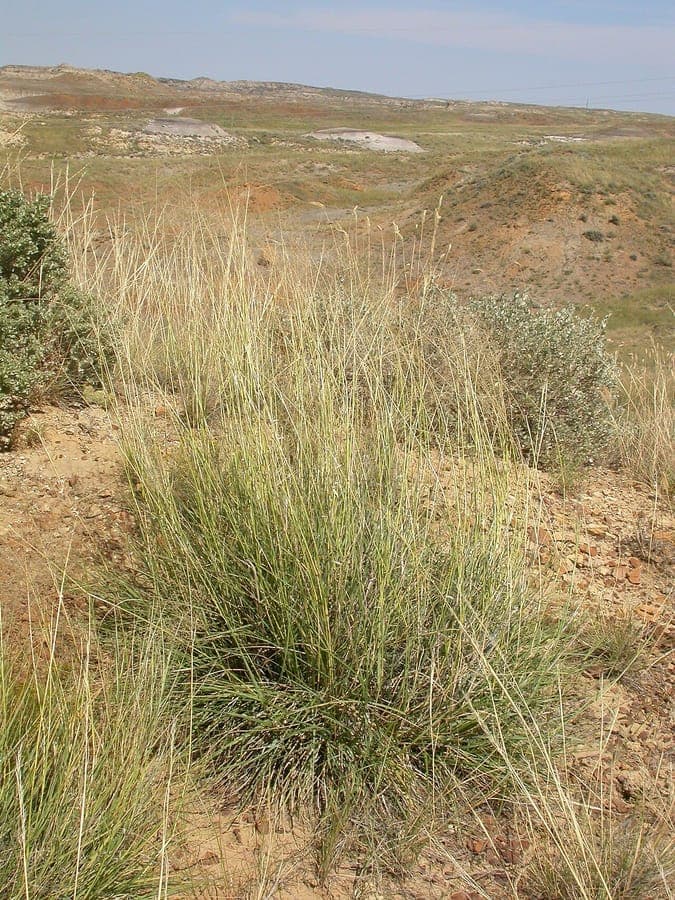
Matt Lavin / CC BY-SA 2.0, via Wikimedia Commons
Alkali sacaton: complete guide
Sporobolus airoides
Want to see Alkali sacaton: complete guide in your garden?
1 minute, no credit card
Overview
Alkali sacaton (Sporobolus airoides) is a tough, clump-forming ornamental grass in the family Poaceae, native to the dry steppes and prairies of North America and Mexico. Its common name reflects its remarkable ability to thrive in soils that challenge almost every other plant: strongly alkaline ground, salt flats, and dry river banks where water is scarce and conditions are harsh. In ornamental horticulture the species is prized for its fine texture, airy flower plumes, and exceptional drought tolerance.
As an ornamental grass for the garden, alkali sacaton delivers something rare: graceful, elegant form combined with true resilience in difficult conditions. From July to September the compact clumps are crowned by fine, purplish-grey flower plumes that catch light and movement. If you are designing a garden around low-water, climate-resilient plants, gardenworld.app offers design tools to help you integrate grasses like alkali sacaton into a cohesive planting scheme.
In Europe the species is still relatively uncommon, but interest among gardeners working with prairie-style and gravel garden planting has grown steadily. Specialist nurseries and some larger garden centres carry it; ask specifically for Sporobolus airoides if you cannot find it on the shelf.
Appearance and bloom cycle
Sporobolus airoides forms dense, upright clumps of fine, narrow stems reaching 60 to 120 cm in height. The foliage is stiff yet graceful, pale green to grey-green in colour, and remains tidy and compact throughout the season. The stems are finer than those of many other ornamental grasses, giving the plant a translucent, airy quality that is one of its main ornamental assets.
From July to September elegant flower plumes emerge - long, open panicles in violet-grey to light brown that extend well above the foliage. These plumes are delicate in structure and respond to the slightest breeze with rhythmic movement. In autumn the stems turn golden brown and the plumes hang heavy with tiny pearl-like seeds. Even in winter, when the plant holds its dried buff-coloured form, it remains a strong structural presence in the garden. Frost on the seed heads and stems creates a particularly beautiful effect.
Ideal location
Alkali sacaton thrives in full sun. Half-shade leads to a looser, less compact growth habit and significantly reduced flowering. The plant excels in:
- Dry, sunny borders in Mediterranean or prairie style
- Gravel gardens and xerophytic planting schemes
- Urban planting on warm, hard-paved sites with good drainage
- Slopes and erosion-prone banks where deep roots hold the substrate
- Combinations with low-growing perennials in colourful steppe-style borders
The plant is native to areas with continental climates - hot, dry summers and cold winters. It behaves differently from many European ornamental grasses: it prefers dry conditions over moisture. In sites with wet winters or heavy clay, extra attention to drainage is essential.
Soil
One of the most remarkable characteristics of Sporobolus airoides is its exceptional tolerance of difficult soil conditions. In nature it grows on strongly alkaline soils (pH up to 9.0) and salt-laden ground that is unsuitable for most crops. The optimal pH range in the garden is 6.6 to 9.0 - extremely wide by any measure.
The plant makes few demands on nutrient levels: lean, sandy, or calcareous soils suit it well. In rich, moist ground the plant becomes excessively lush and more prone to flopping. Good drainage is however critical: standing water at the roots is not tolerated. On heavy clay soils, incorporate coarse sand or grit to improve permeability.
The high salt tolerance of alkali sacaton also makes it suitable for gardens near the sea or for locations exposed to road de-icing salt in winter - a significant practical advantage in urban and coastal settings.
Free design
Want to see Alkali sacaton: complete guide in your garden? Make a free design now.
Watering
Once established, alkali sacaton needs little to no additional watering. Its deep, branching root system penetrates far into the soil and is highly efficient at locating moisture during dry periods. In the first spring and summer after planting, regular watering encourages root establishment; after that, the plant can rely primarily on rainfall.
During exceptionally dry summers, a monthly deep soak can help the plant maintain its green colour longer. Overwatering is always harmful: wet roots in summer lead to rot and weak growth. In winter, watering should cease entirely.
For gardeners aiming for a low-water garden, alkali sacaton is an outstanding choice. In comparative trials with drought-tolerant ornamental grasses, it performs comparably to the well-known blue oat grass (Helictochloa sempervirens) and outperforms most standard perennials in drought resilience.
Pruning
Sporobolus airoides is a low-maintenance plant. In early spring, around March, cut back the old stems to 10 to 15 cm above the ground. This clears winter residues and makes way for new fresh stems that emerge quickly. Use sharp garden scissors or hedging shears for larger clumps.
Pruning in summer or autumn is neither needed nor desirable: the plant is at its most beautiful during those seasons with its flowering plumes. Leave the plumes and stems standing through autumn and winter - they provide ornamental value and shelter for overwintering insects.
Loose dead material from previous seasons can be combed out with a coarse rake after winter, removing debris without damaging the new growth points.
Maintenance calendar
January-February: Dormancy period. Leave the clumps standing for winter structure and as insect habitat.
March: Cut back to 10-15 cm above ground. This is the most important maintenance task of the year.
April-May: New stems appear. Divide or replant overly large clumps if needed. Explore prairie-garden designs with ornamental grasses on gardenworld.app.
June: Rapid growth phase. No action needed.
July-September: Flowering period. Plumes emerge and give the garden a soft, moving character. Completely self-sufficient.
October-November: Autumn colouring. Stems and plumes dry to golden brown. Leave in place for ornamental value and wildlife.
December: Dormancy. No action needed.
Winter hardiness
Alkali sacaton is an extremely cold-tolerant grass. The species is native to regions with genuinely cold winters - from Montana to Kansas - and survives temperatures corresponding to USDA zone 4, meaning winter minima of around -35 degrees Celsius. In northwestern Europe, including the UK, the Netherlands, Belgium, and Germany, winters are nowhere near cold enough to threaten the plant.
The main risk factor is not cold but winter moisture: the combination of wet roots and low temperatures is more problematic for alkali sacaton than dry frost. On well-draining soil this is not an issue. On heavy, wet ground, planting on a slightly raised bed or improving drainage is a worthwhile precaution.
After a severe or wet winter, the clump may be slower to shoot in spring. Wait until April before intervening - new growth points appear later than in species from milder climates, but the plant is rarely truly dead.
Companion plants
Alkali sacaton combines beautifully with other drought-tolerant perennials and ornamental grasses. Excellent neighbours include:
- Lavender (Lavandula angustifolia) for fragrance and complementary purple colour
- Salvia nemorosa for blue spikes as a counterpoint to the airy plumes
- Bloody cranesbill (Geranium sanguineum) for low-growing pink below the stems
- Catmint (Nepeta x faassenii) for continuous flowering and silver foliage
- Agave or Yucca for a striking drought-garden statement
In larger prairie-style borders, alkali sacaton pairs well with sunflowers (Helianthus), mullein (Verbascum), and coneflowers (Rudbeckia). The combination of fine grass stems with broader-leaved perennials creates a rich, layered border with long seasonal interest from April through winter.
Closing
Alkali sacaton is a grass that deserves a wider audience. The combination of elegant airy plumes, exceptional drought and salt tolerance, and very low maintenance requirements makes it a smart choice for the modern climate-resilient garden. If you want to create a planting that thrives in warmer, drier summers with minimal intervention, this species belongs at the top of your list.
On gardenworld.app you can generate a custom garden design based on your own outdoor space, showing how ornamental grasses like alkali sacaton can transform a dry, challenging area into a beautiful, low-maintenance planting.
Want to see Alkali sacaton: complete guide in your garden? Make a free design now.
Upload a photo, pick a style, and get a photorealistic design with plant list in under a minute.
10,000+ gardens designed already
No credit card required


Similar plants
Sporobolus pungens: complete guide
Sporobolus pungens
Sporobolus pungens is a stoloniferous Mediterranean coastal grass with outstanding salt and drought tolerance, perfect for seaside and dry gardens.
Mediterranean aegilops: complete guide
Aegilops biuncialis
Everything about Aegilops biuncialis, a Mediterranean annual grass with ornamental spikes and outstanding drought tolerance for dry gardens.
Silver bluestem: complete guide
Bothriochloa saccharoides
Full guide to Bothriochloa saccharoides (silver bluestem): site, soil, watering, winter hardiness, pruning, and garden companions.