
Stan Shebs / CC BY-SA 3.0, via Wikimedia Commons
Gooseberryleaf globemallow: complete guide to Sphaeralcea grossulariifolia
Sphaeralcea grossulariifolia
Want to see Gooseberryleaf globemallow: complete guide to Sphaeralcea grossulariifolia in your garden?
1 minute, no credit card
Overview
Sphaeralcea grossulariifolia, commonly known as gooseberryleaf globemallow or currant-leaf globemallow, is a drought-tolerant subshrub native to the western United States. Its natural range spans Arizona, Idaho, Nevada, New Mexico, Oregon, Utah and Washington, where it colonises dry slopes, sandy riverbanks, open steppe grasslands and sagebrush desert at elevations up to 2500 m. As a member of the Malvaceae family, it is related to the hollyhock and hibiscus, and its cup-shaped flowers clearly show that kinship. The botanical epithet grossulariifolia refers directly to the leaf shape: the deeply lobed, three-to-five-partite leaves closely resemble those of a gooseberry or currant bush. At gardenworld.app you can build a complete dry garden design that showcases this species alongside other low-water perennials.
Appearance and bloom cycle
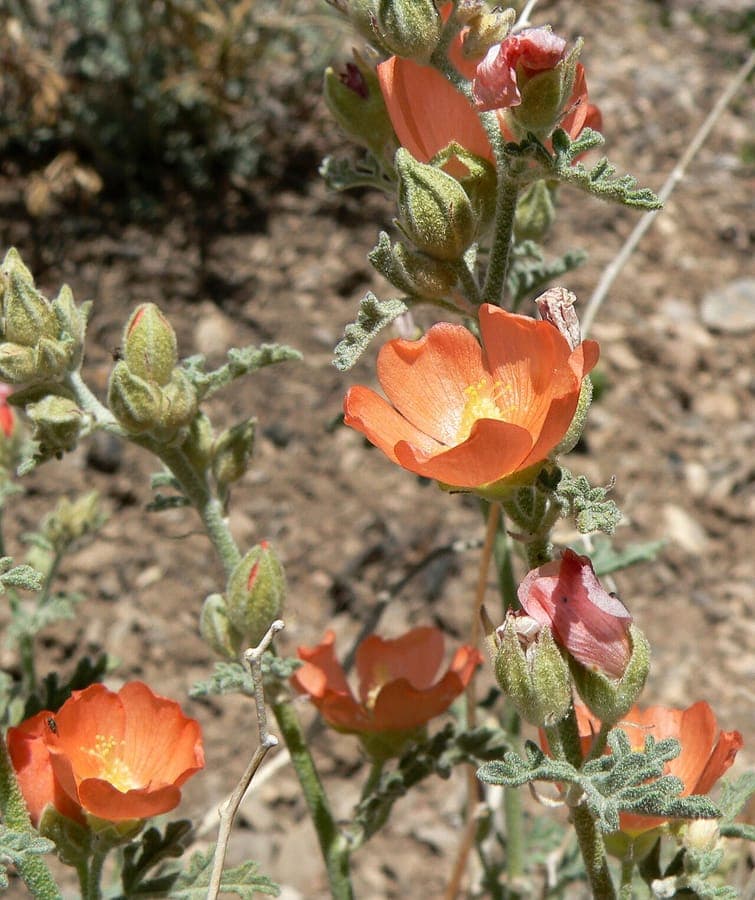
Sphaeralcea grossulariifolia forms an upright single-crowned subshrub reaching 50 to 90 cm in height. The stems are lightly woody at the base and carry a fine coating of stellate hairs that give the whole plant a soft grey-green appearance. The distinctive gooseberry-like leaves are deeply cut into three to five irregular lobes, providing ornamental value through the full growing season, not only during flowering.
Flowers are 2 to 3.5 cm across, saucer-shaped, and borne in dense elongated racemes along the stems. Colour ranges from warm orange through salmon-pink to deeper coral-red. The main flowering period runs from May to July, with a secondary flush possible in September when cooler temperatures and autumn moisture arrive. The blooms attract bumblebees, honeybees and a range of native solitary bee species.
After flowering, the plant produces small round fruits - the source of the name globemallow - which provide food for seed-eating birds and remain decorative into autumn.
Ideal location
Full sun all day is non-negotiable. In its native habitat this plant grows in open, sun-exposed situations with no overhead tree cover. In garden settings it performs best in south-facing positions well away from the shade of walls or fences. Some shelter from cold northerly or easterly winds is beneficial in exposed sites.
In northern European gardens, positioning close to a heat-retaining stone wall, a gravel path or a sun-warmed terrace markedly improves performance. The residual warmth radiating from masonry on cool evenings extends the growing season and improves winter survival. Gravel gardens, rock gardens and raised beds in sunny courtyards are ideal settings.
Soil
Excellent drainage is the single most important soil requirement. In nature Sphaeralcea grossulariifolia grows on poor, fast-draining soils with a pH of 5 to 7 - somewhat more acid-tolerant than Sphaeralcea ambigua but still needing a light, open texture. Clay or compacted soils that hold winter moisture around the root neck will cause root rot within a season.
When planting in heavier garden soil, incorporate a minimum of 30 to 40 percent coarse sharp sand or fine horticultural grit. Raised beds and gravel gardens are ideal without modification. Avoid heavy compost additions; while they encourage rapid early growth, they produce soft stems more susceptible to cold damage and fungal disease. The plant rewards lean conditions with compact, floriferous growth that overwinters more reliably.
Watering
Once established, Sphaeralcea grossulariifolia behaves as a true steppe plant adapted to long dry periods punctuated by occasional heavy rain events. In average northern European summers with reasonable rainfall, an established plant needs no regular supplemental watering.
During the establishment year, water deeply once a week, always allowing the soil to dry out completely between sessions. This encourages roots to penetrate deeply, building the drought resistance that makes the plant so reliable in later seasons. Water at the base of the plant at all times; overhead watering of the foliage in warm conditions promotes fungal problems. Once the plant is settled, brief heavy soakings during extended dry spells of three weeks or more are sufficient.
Free design
Want to see Gooseberryleaf globemallow: complete guide to Sphaeralcea grossulariifolia in your garden? Make a free design now.
Pruning
The most important pruning task is a hard cut back in late winter. In February or early March, reduce all stems to 10 to 15 cm above ground level. This removes winter-damaged or woody growth, stimulates a flush of vigorous new shoots from the base, and keeps the plant compact and productive. A plant that is not cut back regularly becomes leggy and less floriferous over time.
During the growing season, removing the upper third of spent flower spikes encourages a prolonged bloom period and possible secondary flowering. Allowing some spikes to remain and set seed gives the plant a chance to naturalise gently in suitable garden spots. Avoid heavy autumn pruning; the standing stems protect the crown through winter.
Maintenance calendar
February - March: Hard cut back to 10 to 15 cm. Remove dead or frost-damaged wood. Begin watching for new basal growth.
April - May: New shoots develop quickly. No feeding needed on poor soils; a light application of low-nitrogen fertiliser is optional on richer soils.
June - July: Main flowering period. Remove spent spikes partially to encourage further blooms.
August: Resting phase in prolonged heat. Minimal watering. Light tidying optional.
September - October: Autumn moisture may trigger a secondary flowering. Fruits become ornamentally interesting.
November - January: Winter dormancy. Leave stems in place for crown protection and bird food. Clear away only in spring.
Winter hardiness
Sphaeralcea grossulariifolia originates from regions with significant temperature extremes, including mountain habitats where winter temperatures drop well below -20 degrees Celsius. It is rated for USDA hardiness zones 4 through 8, which comfortably covers the Netherlands, Belgium and most of the UK. In practice the critical factor is not cold tolerance but winter moisture management. Wet, poorly drained soil in combination with frost is the main threat to successful overwintering.
A well-draining, gritty soil is the primary protection. A 5 to 10 cm deep gravel mulch spread around the crown keeps the root neck dry and provides modest insulation without trapping moisture against the stem. Avoid bark mulches, which hold water. In very cold winters with prolonged frost, a drape of horticultural fleece over the standing stems adds worthwhile protection. Look for this plant in the dry perennial or western native section at specialist nurseries and garden centres.
Companion plants
Sphaeralcea grossulariifolia combines naturally with other dry-loving perennials and subshrubs. Effective pairings include:
- Artemisia 'Powis Castle': silver-grey finely cut foliage that sets off the orange flowers perfectly
- Salvia nemorosa: blue-purple spikes providing cool colour contrast
- Penstemon digitalis or P. strictus: similarly drought-adapted with complementary flower form
- Lavandula angustifolia: matching site requirements with aromatic bonus
- Echinacea purpurea: bold late-season colour partner
For a complete planting scheme incorporating Sphaeralcea grossulariifolia, visit gardenworld.app to design your own personalised dry garden layout.
Closing
Sphaeralcea grossulariifolia is a plant for the discerning gardener who appreciates ornamental foliage alongside reliable summer bloom. Its deeply lobed, gooseberry-like leaves give it a distinctive character that stands apart from the more commonly grown mallows. Given full sun, lean well-drained soil and an annual hard pruning in late winter, it will reward its grower with months of warm-toned flowering and many years of reliable performance in a dry sunny border.
Want to see Gooseberryleaf globemallow: complete guide to Sphaeralcea grossulariifolia in your garden? Make a free design now.
Upload a photo, pick a style, and get a photorealistic design with plant list in under a minute.
10,000+ gardens designed already
No credit card required


Similar plants
Desert globemallow: complete guide to growing Sphaeralcea ambigua
Sphaeralcea ambigua
Everything about Sphaeralcea ambigua: location, soil, watering, pruning and winter care for this sun-loving drought-tolerant perennial.
Scarlet globemallow: complete guide
Sphaeralcea coccinea
Scarlet globemallow (Sphaeralcea coccinea) is a drought-tolerant perennial with vivid copper-red blooms, perfect for sunny borders and dry gardens.