
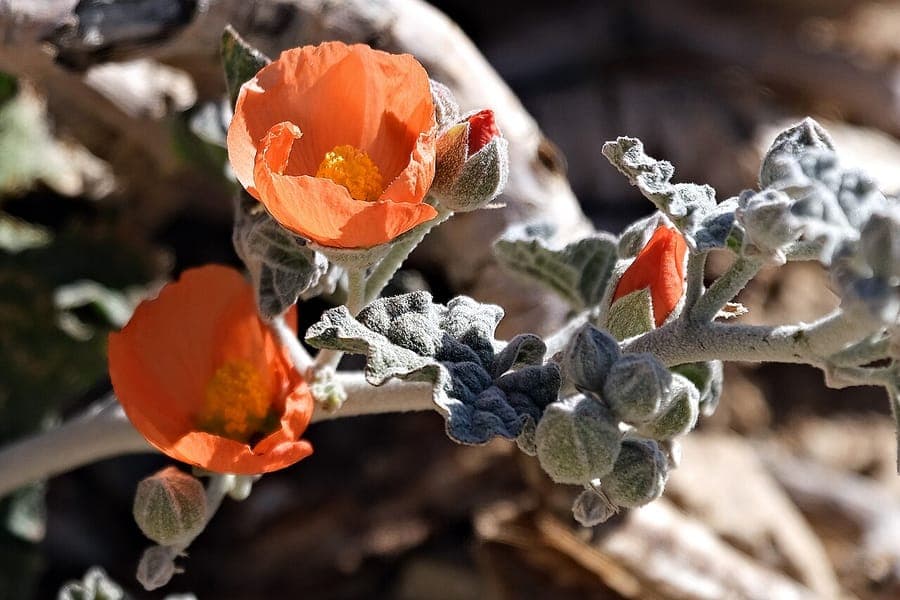
Kevin Gepford / CC BY-SA 4.0, via Wikimedia Commons
Desert globemallow: complete guide to growing Sphaeralcea ambigua
Sphaeralcea ambigua
Want to see Desert globemallow: complete guide to growing Sphaeralcea ambigua in your garden?
1 minute, no credit card
Overview
Sphaeralcea ambigua, commonly called desert globemallow or apricot mallow, is one of the most spectacular drought-tolerant perennials of the American Southwest. Native to the desert regions of Arizona, California, Nevada, Utah and northwestern Mexico, this member of the Malvaceae family produces cup-shaped blooms in shades of apricot, copper and coral orange that can transform a barren slope into a vivid tapestry of colour. For gardeners seeking a plant that thrives on neglect, demands almost no water once established, and delivers weeks of cheerful bloom, the desert globemallow is an outstanding choice. You can explore how to incorporate it into a complete front garden design at gardenworld.app.
Appearance and bloom cycle
Sphaeralcea ambigua is a multi-stemmed subshrub growing from a woody base. In ideal conditions it reaches 60 to 120 cm in height and spreads to a similar width. The stems and leaves are coated with fine star-shaped hairs called stellate trichomes. These microscopic structures reflect intense sunlight, reduce water loss through transpiration, and give the plant its characteristic silvery-grey appearance - a beautiful contrast to the warm-toned blooms.
The flowers are saucer-shaped, 2.5 to 4 cm across, and arranged in elongated clusters along the stems. Colour varies by subspecies from pale apricot through rich copper-orange to deep rose-red. Blooming typically begins in late February or March in mild climates and continues through May or June. A partial reflowering often occurs in autumn when temperatures drop and moisture arrives. Under the heat of July and August, plants may enter a semi-dormant resting state, saving energy for the cooler months ahead.
Leaves are lobed, rough-textured and greyish green, somewhat resembling small grape leaves. They form an attractive low-water foliage backdrop that remains reasonably presentable even outside of the flowering period.
Ideal location
This plant wants full sun and plenty of it. A south-facing position that receives direct sunlight throughout the day is ideal. Sphaeralcea ambigua thrives in reflected heat from walls and paved surfaces, making it an excellent candidate for courtyard gardens, gravel front gardens and dry borders. It will bloom less freely in partial shade and will decline in full shade.
In northern European gardens, plant against a south-facing wall to capture stored warmth. The heat that radiates from masonry overnight extends the plant's comfort zone well beyond what open ground could provide during a cool summer.
Soil
In its native habitat, desert globemallow grows on alkaline, rocky, fast-draining soils with a pH of 7.5 to 8.5. This points directly to its requirements in cultivation: excellent drainage above all else. Heavy clay or water-retentive soils will kill the plant through root rot within a single wet season.
When planting, mix standard garden soil with at least 30 to 50 percent coarse sharp sand or fine gravel. A raised bed or gravel garden is ideal. Avoid rich compost amendments; too much fertility produces lush but weak stems that flop over and become more vulnerable to cold and disease. The leaner the soil, the tougher and longer-lived the plant.
Watering
Once established, Sphaeralcea ambigua needs remarkably little supplemental watering. In its native range it survives on less than 300 mm of annual rainfall. In a typical northern European garden with reasonable summer precipitation, an established plant requires no regular watering at all.
During the first year after planting, water deeply once a week while the plant establishes its root system, allowing the soil to dry out completely between sessions. From the second year onward, water only during extended droughts lasting more than three to four weeks. Always water at the base of the plant rather than overhead - wet foliage in hot weather encourages fungal issues.
The plant signals stress through wilting foliage, but recovers rapidly once water is applied to a dry-rooted plant. A single thorough soaking is preferable to frequent light sprinklings.
Free design
Want to see Desert globemallow: complete guide to growing Sphaeralcea ambigua in your garden? Make a free design now.
Pruning
Prune desert globemallow hard in late winter or early spring, cutting stems back to 15 to 20 cm above ground level. This removes frost-damaged or woody growth, encourages fresh shoots from the base, and keeps the plant compact and well-branched. In gardens where self-seeding is not desired, deadheading spent flower spikes before seed dispersal will limit volunteer seedlings.
A light trim of the longest stems in midsummer, when the plant often pauses blooming in the heat, helps maintain a tidy appearance without sacrificing the autumn reflowering. Avoid heavy pruning in autumn, as the standing stems provide some insulation to the crown through winter.
Maintenance calendar
February - March: Cut back to 15 to 20 cm. Remove dead wood. Watch for the first new growth.
April - May: First bloom wave. Apply a low-nitrogen, potassium-rich feed if soil is very poor.
June: Peak bloom. Remove spent spikes if desired.
July - August: Possible summer dormancy. Withhold all but the most urgent watering. Light trim optional.
September - October: Autumn rains trigger renewed growth and sometimes a second flush of flowers.
November - January: Dormancy. Leave stems standing to protect the crown. Remove truly dead material only in spring.
Winter hardiness
Sphaeralcea ambigua is rated for USDA hardiness zones 5 through 9, tolerating temperatures down to approximately -25 degrees Celsius under ideal conditions. In practice, the limiting factor in European gardens is not cold but winter wet: waterlogged soil combined with frost damages or kills the root system. On a sharply draining, gritty site, plants often overwinter without issue even in the UK and Benelux region.
A gravel mulch spread around the crown (not bark, which retains moisture) keeps the root neck dry and provides modest insulation. In exceptionally cold winters, a layer of horticultural fleece draped over the plant offers additional protection. Garden centres across northern Europe occasionally stock this plant in the drought-tolerant or Mediterranean section - it is worth asking for if not immediately visible.
Companion plants
Desert globemallow suits dry gardens, gravel gardens and Mediterranean-style plantings. Effective combinations include:
- Lavender (Lavandula angustifolia): matching water needs, complementary grey-silver foliage
- Sage (Salvia officinalis): structural grey mound with edible bonus
- Russian sage (Perovskia atriplicifolia): tall blue spikes contrasting with warm orange flowers
- Echinacea purpurea: bold late-season colour with similar drought tolerance
- Sedum (Hylotelephium) varieties: succulent texture against the soft hairy foliage of Sphaeralcea
For a complete planting plan incorporating Sphaeralcea ambigua with other drought-tolerant species, visit gardenworld.app and create your own design.
Closing
Sphaeralcea ambigua is a rewarding choice for gardeners who want long-lasting colour with minimal upkeep. Its requirements are straightforward: full sun, lean well-drained soil, occasional deep watering and a hard spring cut. In return it offers weeks of vibrant orange-apricot bloom, attractive silver foliage through the season, and exceptional resilience in the face of drought and heat. Look for it at specialist nurseries or in the Mediterranean perennial range at garden centres, and give it a prominent spot in your sunniest border.
Want to see Desert globemallow: complete guide to growing Sphaeralcea ambigua in your garden? Make a free design now.
Upload a photo, pick a style, and get a photorealistic design with plant list in under a minute.
10,000+ gardens designed already
No credit card required


Similar plants
Gooseberryleaf globemallow: complete guide to Sphaeralcea grossulariifolia
Sphaeralcea grossulariifolia
Full guide to Sphaeralcea grossulariifolia: ideal site, soil preparation, watering, pruning and overwintering of this drought-tolerant western mallow.
Scarlet globemallow: complete guide
Sphaeralcea coccinea
Scarlet globemallow (Sphaeralcea coccinea) is a drought-tolerant perennial with vivid copper-red blooms, perfect for sunny borders and dry gardens.