
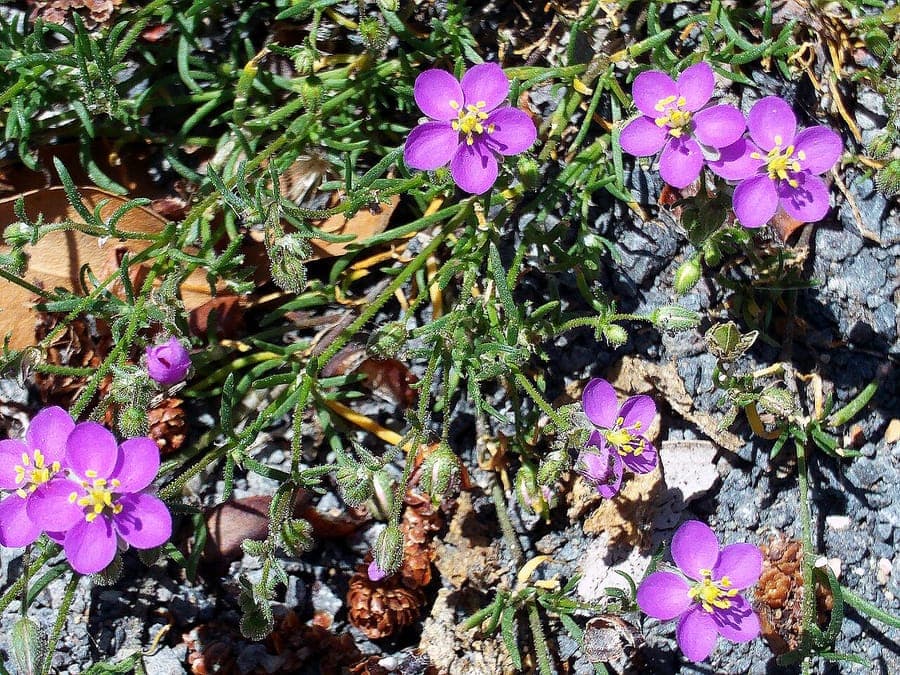
Javier martin / Public domain, via Wikimedia Commons
Spergularia rubra: complete guide
Spergularia rubra
Want to see Spergularia rubra: complete guide in your garden?
1 minute, no credit card
Overview
Spergularia rubra, commonly known as red sandspurry, is an attractive plant from the Caryophyllaceae family. This low-growing plant grows naturally in dry, marginal habitats from Europe to the Russian Far East, extending distribution to Africa and the Arabian Peninsula.
The plant is recognized for its red flowers and characteristic red-tinged stems, providing strong ornamental value. For inspiration regarding rock gardens and drought-tolerant planting schemes, visit gardenworld.app.
This makes starwort an interesting study for botanists and plant collectors. The plant is not toxic and can be safely enjoyed in households with children and animals. The evolutionary adaptation to diverse climates shows the resilience of plants.
The distribution of this plant across so many continents demonstrates how efficient seed dispersal mechanisms can be. Seeds are carried by birds, insects, and water, allowing the plant to spread without human intervention.
Appearance and Bloom Cycle
Spergularia rubra grows as a low, spreading herb, typically 10-20 centimeters in height, with spread up to 30 centimeters. The leaves are fine, needle-like, and dark green in color. The stems possess characteristic red tinting, especially in young growth.
The flowers are small yet highly decorative, appearing in red to bright red color, although some plants may also display pink blooms. Flowers appear over an extended period, from June through September. Following blooming, small seed capsules develop.
The flowers also attract small insects and can play a role in the food chain of small garden inhabitants. This makes starwort not only decorative but also ecologically valuable. A garden with such plants supports natural ecosystems.
The seeds are very small, contributing to their dispersal. They can remain viable in the soil for years and germinate only when conditions are favorable. This is a survival strategy that has proven highly effective in wild habitats.
Ideal Location
Spergularia rubra thrives best in fully sunny spots where the plant receives at least 6 hours direct sunlight daily. Even in light shade the plant grows, though it becomes less compact and produces fewer flowers.
The plant is highly suitable for rock gardens, gravel gardens, dry borders, and even between paving stones. The plant tolerates windy conditions well. For rock garden design, see gardenworld.app.
The success of starwort on lean soils lies in its efficient nutrient use. The plant does not demand much, but makes optimal use of what is available. This makes it a sustainable choice for ecological gardening.
Soil Requirements
Spergularia rubra makes very limited soil demands. The plant grows well in lean, sandy, and gravelly soils. Nutrient-rich garden soils are actually less suitable; the plant would grow too lushly and flower less.
Excellent drainage is essential; waterlogging must be prevented. The pH can be neutral to slightly alkaline (pH 6.5-8.0). In containers, the plant grows well in standard potting mix with added sand.
The pH value affects nutrient availability. Although starwort is tolerant, it grows optimally on acidic to neutral soils. In very alkaline soils, iron deficiencies can occur, though this is rarely problematic.
When examining wild populations, starwort has been found growing on soils containing more than 50% sand. This indicates strong selection for well-draining soils in this plant's evolution.
Watering
Once established, Spergularia rubra requires very little water. The plant is excellent at drought tolerance thanks to its fine needle-like leaves. Water only minimally, ideally no more than once every 2-3 weeks during growing season.
During dry summers, you may water somewhat more frequently, but always maintain moderation. After blooming, provide virtually no water. The plant tolerates dryness better than wetness.
Free design
Want to see Spergularia rubra: complete guide in your garden? Make a free design now.
Pruning
Minimal pruning is necessary. The plant naturally forms a compact shape. Remove spent flowers to encourage more blooms. After blooming, dead stems can be removed.
After several years, the plant can be kept more compact with gentle pruning in early spring, but this is not essential.
Maintenance Calendar
April-May: Plant in dry, well-draining soil. Position in full sun.
June-September: Extended bloom period. Minimal watering. Remove spent flowers to encourage more blooms.
October-November: Post-bloom. Remove dead stems. Prepare for winter.
December-March: Winter rest. Plant is winter hardy. No special maintenance needed.
Winter tasks actually require minimal effort. In most temperate zones, the plant can overwinter without any protection. In areas with extremely cold winters, you can apply a thin layer of mulch, though this is usually unnecessary.
The plant is highly frost-resistant because it has experienced freeze-thaw cycles in its natural habitat. Generations of selection have favored plants with genes that can withstand frost.
Winter Hardiness
Spergularia rubra is winter hardy to approximately -15 degrees Celsius in well-draining soils. The plant overwinters without problems in Europe. Wet feet during winter is the primary danger.
In very wet winters with high water drainage, protection from rainwater is recommended. Otherwise, no special protection is needed.
Companion Plants
Spergularia rubra combines beautifully with other drought-tolerant low-growing plants. Suitable companions include:
- Thyme species (Thymus) - comparable drought tolerance
- Sedum species - succulents with same dry-soil preference
- Flox subulata - pink flowers with comparable requirements
- Mouse-ear chickweed (Cerastium) - white-flowering companion
- Sea lavender (Limonium) - small pink-purple flowers
Compose combinations on gardenworld.app.
Plant Combinations in Practice
When composing plant combinations with Spergula arvensis, it is important to consider bloom periods and colors. The white flowers of starwort contrast beautifully with pink and red flowers of other plants. The distribution of flowers over three months (April through June) ensures prolonged bloom.
Frequently Asked Questions About This Plant
Do I need to prune the plant? In most cases no, but carefully removing dead parts helps. Can I propagate the plant? Yes, via seeds sown in moist soil. How long does a plant live? Usually 3-5 years in good conditions.
What are the benefits of this plant in ecological gardens? They provide nectar for insects, stabilize slopes, and require minimal maintenance. This makes them perfect for sustainable garden design.
Seasonal Care Tips
In spring: ensure good drainage and remove dead parts from previous season. In summer: minimal watering is sufficient. In autumn: check the plant for diseases. In winter: no special maintenance needed.
The plant grows optimally at temperatures between 15-25 degrees Celsius. In extremely hot summers, some shade can be beneficial.
Conclusion
Spergularia rubra is a practical and decorative choice for gardens seeking drought-tolerant, low-maintenance plants with vibrant red flowers. The red stems add winter interest, and the extended bloom period provides years of ornamental value.
Need more inspiration for drought-tolerant garden design? Visit gardenworld.app for professional guidance. The app helps you compose dry-climate planting schemes that thrive.
Searching for Spergularia rubra? This plant is reasonably standard at most garden centers. Check with local garden centers for availability.
Want to see Spergularia rubra: complete guide in your garden? Make a free design now.
Upload a photo, pick a style, and get a photorealistic design with plant list in under a minute.
No credit card required


Similar plants
Dianthus karami: complete guide
Dianthus karami
Dianthus karami is a rare Lebanese mountain pink with fringed pink blooms on limestone cliffs, ideal for rock gardens and troughs.
Sicilian pink: complete guide
Dianthus siculus
Discover Dianthus siculus, an elegant purple bloomer from Sicily. Cultivation, June-September flowering and garden combinations.
Alpine mouse-ear chickweed: complete guide
Cerastium pedunculatum
Full growing guide for Cerastium pedunculatum: ideal location, soil, watering, winter hardiness, and companion plants for rock gardens.