
Anton / CC BY-SA 4.0, via Wikimedia Commons
Apple Mangrove: complete guide
Sonneratia caseolaris
Want to see Apple Mangrove: complete guide in your garden?
1 minute, no credit card
Overview
Sonneratia caseolaris, commonly called apple mangrove, crabapple mangrove, or pidada merah (in Indonesian), is one of the most widespread and economically valuable mangrove species in Asia. This tree ranges from Hainan, China to tropical Asia and the southwest Pacific, including northern Australia. Belonging to the Lythraceae family, this halophytic species is distributed across mangrove ecosystems of India, Bangladesh, Indonesia, Malaysia, Thailand, Philippines, Cambodia, and Vietnam.
As a true halophyte, Sonneratia caseolaris thrives exclusively in saline and brackish waters where ordinary plants cannot survive. In many Asian cultures, the edible fruits hold significant economic and culinary value. The tree also provides essential fish nursery habitat and coastal protection benefits.
Appearance and Bloom
Sonneratia caseolaris is a medium to large mangrove reaching 10 to 30 meters in height, with a spreading crown and grayish bark marked by vertical scars. The opposite, oval to lance-shaped leaves measure 4-8 centimeters long with glossy green texture providing salt tolerance.
Flowers are conspicuous, measuring 2-4 centimeters across, typically white though some populations display pink to rose tinges. Numerous prominent stamens create delicate, feathery appearance. Flowers develop in terminal clusters, blooming primarily from May through September in many regions. Bat pollination is primary, though insects also visit the flowers.
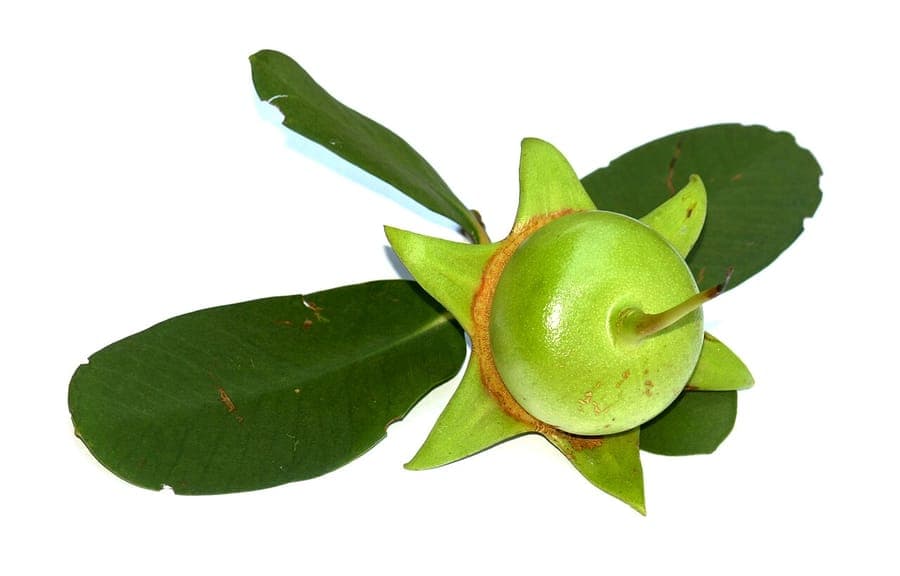
Following pollination, conical fruits develop, each 2-3 centimeters long and fleshy. These fruits are consumed by humans and wildlife, particularly large flying foxes. Each fruit contains numerous water-dispersed seeds capable of surviving long ocean voyages.
Ideal Location
Sonneratia caseolaris occupies specific coastal mangrove zones:
- Muddy, salt-saturated substrates with regular tidal exchange
- Full sunlight exposure (8-10 hours minimum daily)
- Protected locations buffered from heavy wave action
- Tropical regions with high precipitation and humidity
- Intertidal zones where it often forms pure stands
The species frequently dominates monoculture mangrove forests across its range. In temperate climates like the Netherlands, only botanical institutions can maintain this species in controlled greenhouse environments.
Free design
Want to see Apple Mangrove: complete guide in your garden? Make a free design now.
Soil Requirements
Like all mangroves, Sonneratia caseolaris demands unique edaphic conditions:
- Muddy, saline to brackish sediments (10-30 ppt salinity)
- Acidic to neutral pH (5.5-7.0) in most natural habitats
- Water-saturated anaerobic soil profiles
- High organic matter content from plant detritus
- Regular tidal water exchange preventing stagnation
Wild populations tolerate extremely acidic muds with pH as low as 4.0. Cultivated specimens require managed saltwater systems simulating natural conditions.
Watering
Watering follows mangrove protocols:
- Daily immersion in brackish to saline water
- Tidal-like wet-dry cycles are optimal
- Saltwater must remain clean and well-oxygenated
- Stagnation causes anoxia and fungal disease
- Freshwater exposure is harmful to salt-adapted tissues
- Saltwater spraying helps during dry periods
Pruning
Minimal pruning is required in natural settings:
- Remove dead or damaged branches
- Prune to encourage denser growth in cultivation
- Sterilize tools between cuts to prevent disease
- Maintain adequate air circulation within dense forests
- Remove insect pests as observed
Maintenance Calendar
May-August: Peak flowering period September-March: Fruit maturation and growth April-May: Preparation for next flowering June-July: Maximum fruit production
Winter Hardiness
Sonneratia caseolaris cannot survive temperate zones:
- Minimum temperature requirement: 15-20 degrees Celsius
- Frost intolerant below 0 degrees Celsius
- High humidity requirement (80-90 percent)
- Stable temperatures without major fluctuations
The tree thrives only in tropical conditions or heated greenhouses.
Companion Plants
In mangrove forests, Sonneratia caseolaris coexists with:
- Other Sonneratia species
- Rhizophora species with distinctive aerial roots
- Avicennia marina (gray mangrove)
- Bruguiera species
- Xylocarpus moluccensis
- Salt-tolerant herbaceous vegetation
Concluding Thoughts
Sonneratia caseolaris is a fascinating mangrove with profound cultural, ecological, and economic significance throughout Asia. While cultivation in Netherlands-based gardens is impossible without specialized facilities, understanding this species deepens appreciation for mangrove ecosystems and the sophisticated adaptations allowing plant survival in extreme saline environments. For botanical enthusiasts, growth is possible only in institutional settings, making it a valuable subject for research and education about tropical coastal ecosystems.
Want to see Apple Mangrove: complete guide in your garden? Make a free design now.
Upload a photo, pick a style, and get a photorealistic design with plant list in under a minute.
No credit card required

