
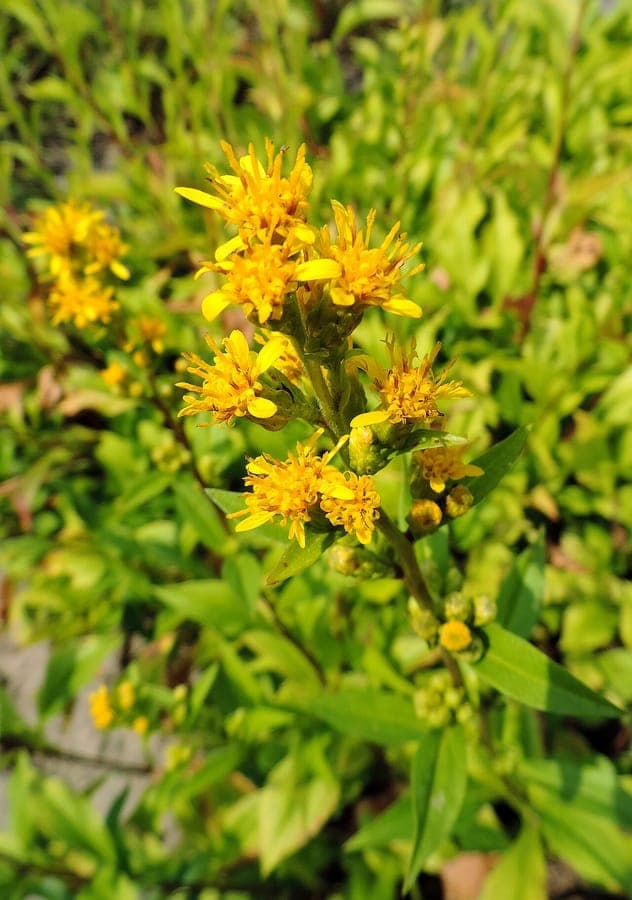
Krzysztof Ziarnek, Kenraiz / CC BY-SA 4.0, via Wikimedia Commons
Bog goldenrod: complete guide
Solidago uliginosa
Want to see Bog goldenrod: complete guide in your garden?
1 minute, no credit card
Overview
Bog goldenrod (Solidago uliginosa) occupies a niche that most goldenrods cannot fill: genuinely wet, acidic soil. While Solidago canadensis and its relatives prefer dry to moderately moist ground, bog goldenrod is a plant of marshes, fens, bog edges, wet meadows, and stream banks where the water table stays high throughout the growing season. Its species name "uliginosa" comes directly from the Latin for boggy or marshy, which tells you everything you need to know about its preferred conditions. Native to eastern Canada and the northeastern United States, it grows from Labrador and Manitoba south to Georgia and Wisconsin, always in wetland or waterside habitats. For gardeners with a pond margin, a rain garden, or a persistently damp corner that resists most planting attempts, this is a plant worth knowing. On gardenworld.app you can explore planting ideas for wet gardens and pond margins where species like Solidago uliginosa play a leading role.
Appearance and bloom cycle
Solidago uliginosa is an upright, slender plant that grows between 60 and 120 cm tall, sometimes reaching 150 cm in rich, wet conditions. The stems are straight and firm, the leaves narrow-lanceolate, smooth-margined or very slightly toothed, and a clear mid-green. Basal leaves are larger and can be slightly broader. The flower arrangement differs from the broadly spreading panicles of common goldenrod: in bog goldenrod the flowers are held in narrower, more densely clustered plumes at the tops of the stems, giving the plant a neater, more upright silhouette in flower. The colour is a warm, clear golden yellow. Flowering runs from August through October, sometimes extending into early November in mild seasons. After flowering, fluffy white seed heads persist into late autumn, extending the decorative season and providing food for small birds.
Ideal location
Full sun to light part shade in a genuinely wet position is what bog goldenrod asks for. The margin of a pond or stream, a rain garden that regularly holds standing water, a bog garden, or a low-lying area of the garden that stays wet through summer are all ideal. The plant is adapted to high water tables and can tolerate brief periods of flooding, which makes it particularly valuable as a marginal plant at the edge of a garden pond. It will not do well in dry or well-drained soils, regardless of how much you water. This is not a plant to put in a normal border - the wet conditions are non-negotiable for long-term success. In a rain garden or bioswale context, it combines excellently with other wet-tolerant native species.
Soil requirements
Solidago uliginosa is the most particular of the three goldenrods in this series when it comes to soil. It needs a moist to wet, acidic soil with a pH between 4.5 and 5.7. Peat-based soils, acid clay, or the natural waterside soils of moorland and fen margins are ideal. Garden soil with a higher pH is much less suitable unless you actively acidify it with sulphur chips or ericaceous compost before planting. Do not add lime or general fertiliser. Mulching with acidic materials such as pine bark, pine needle mulch, or ericaceous compost helps maintain the right pH over time. Avoid rich, nutrient-heavy soils: bog goldenrod is adapted to low-fertility conditions and excess nutrients can cause lax, floppy growth.
Watering
On a genuinely wet site, Solidago uliginosa needs no supplemental watering at all. The key is to plant it where the soil stays consistently moist. At a pond margin, the roots can access water at all times, which is the ideal situation. If planted in a rain garden or a spot with a variable water table, water deeply and regularly during dry spells in summer. This plant is not drought-tolerant and will show stress quickly when the soil dries out - leaves become limp and the plant may not flower well. A deep mulch of 8 to 10 cm of ericaceous compost or composted pine bark applied in late spring helps retain moisture during drier months and simultaneously maintains the acidic pH the plant needs.
Free design
Want to see Bog goldenrod: complete guide in your garden? Make a free design now.
Pruning
Cut the stems of Solidago uliginosa down to about 10 cm above ground level in November or December after the seed heads have dispersed, or leave them standing until late February. The fluffy seed heads are attractive through the winter months and provide food for finches. On very moist, fertile sites the plant can self-seed generously - if you want to control this, remove the flower heads before the seeds fully ripen in October. The plant also spreads via underground rhizomes, producing new shoots around the parent plant each year. Divide congested clumps every three to four years in March to keep the colony vigorous and prevent it from crowding out neighbours.
Maintenance calendar
January to February: leave stems for birds and wildlife; the fluffy seed heads are still decorative. March: cut back old stems if not already done; divide congested clumps by lifting and splitting rhizomes; check soil pH if growth has been weak. April to May: apply ericaceous compost mulch to a depth of 8 cm; ensure the growing site remains reliably moist. June to July: active growth phase; monitor water availability during any dry spells. August to October: flowering season; enjoy the golden plumes and the visiting bees, butterflies, and hoverflies. November: cut back or leave for wildlife. December: full dormancy in the roots.
Winter hardiness
Solidago uliginosa is fully cold-hardy in USDA zones 3 to 8. The top growth dies back completely in autumn and the rhizomes overwinter in the soil. Wet winter conditions present no problem - this plant is accustomed to saturated soil and even brief flooding. Cold-hardiness is excellent, as the plant's natural range extends to Labrador and Manitoba where winters are far more severe than anything in western Europe. No winter protection is needed in the Netherlands, Belgium, or the UK. Even when the soil freezes around the rhizomes, the plant returns reliably in spring. The bog garden planting guides on gardenworld.app include companion plant pairings and layout ideas for wet zones where this species performs at its best.
Companion plants
In a bog garden or pond margin, Solidago uliginosa pairs naturally with Iris pseudacorus (yellow flag iris) for early-season colour in the same golden tones. Lythrum salicaria (purple loosestrife) provides a striking pink vertical accent through summer. Filipendula ulmaria (meadowsweet) adds creamy white plumes in June and July. For late summer, Eupatorium cannabinum (hemp agrimony) in pink or white complements the goldenrod well. Structural grasses like Molinia caerulea or Carex acuta work as year-round framework plants. The royal fern (Osmunda regalis) makes an impressive backdrop in a larger planting. At garden centres in the UK, look in the aquatic and bog plant sections where these wetland companions are usually stocked alongside marginal grasses and irises.
Closing thoughts
Bog goldenrod is a specialist plant for a specialist spot, and in that spot it excels. If you have a reliably wet, acidic corner of the garden that has resisted planting, or a pond margin that needs something tall and golden in autumn, Solidago uliginosa is the answer. Its narrow flower plumes, strong upright habit, and late-season bloom make it a standout plant for the wetland garden. Once settled in the right conditions, it is genuinely low-maintenance, spreading gradually and flowering reliably year after year without any special attention.
Want to see Bog goldenrod: complete guide in your garden? Make a free design now.
Upload a photo, pick a style, and get a photorealistic design with plant list in under a minute.
10,000+ gardens designed already
No credit card required


Similar plants
Woodland goldenrod: complete guide
Solidago caesia
Woodland goldenrod (Solidago caesia) brings golden autumn colour to shaded gardens with its distinctive blue-green stems and axillary flower clusters.
Zig-zag goldenrod: complete guide
Solidago flexicaulis
Zig-zag goldenrod (Solidago flexicaulis) is a distinctive shade-tolerant perennial with broad leaves and golden autumn flowers on characteristically zigzagging stems.