
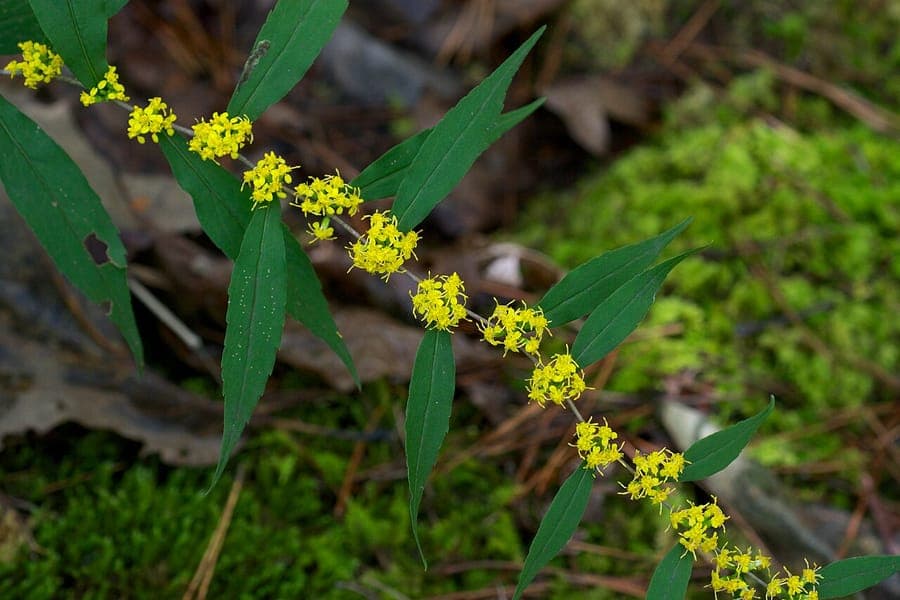
Eric Hunt / CC BY-SA 4.0, via Wikimedia Commons
Woodland goldenrod: complete guide
Solidago caesia
Want to see Woodland goldenrod: complete guide in your garden?
1 minute, no credit card
Overview
Woodland goldenrod (Solidago caesia) is one of the most distinctive members of the goldenrod family and a welcome surprise for gardeners who struggle with shaded spots. Native to the deciduous forests of eastern North America, from Quebec and Ontario south to Florida and Texas, this rhizomatous perennial has carved out a niche that few goldenrods can claim: it genuinely thrives in shade. The epithet "caesia" refers to the blue-grey waxy bloom on the stems, a feature that sets it apart at a glance. If you want to plan a planting that makes the most of this plant alongside other shade-tolerant species, gardenworld.app offers design tools to help you visualise combinations before you dig.
Appearance and bloom cycle
The stems of Solidago caesia grow between 40 and 90 cm tall, slender and arching slightly, with a distinctive blue-green colouring that becomes more pronounced as summer advances. The leaves are lance-shaped, toothed, and arranged alternately up the stem. What makes this plant truly special is the flowering habit: rather than producing a terminal panicle like most goldenrods, the small golden-yellow flower heads emerge from the leaf axils along the length of the stem, clothing it in bloom from top to bottom. This gives the plant a graceful, cascading appearance quite unlike the typical goldenrod silhouette. Flowering runs from August through October, making it invaluable for late-season colour in the border. Bees, hoverflies, and small butterflies visit the flowers reliably.
Ideal location
The defining quality of Solidago caesia is its tolerance for shade. Give it a spot with dappled light under deciduous trees, the north-facing side of a building, or the edge of a shrub border where it receives three to five hours of indirect light per day. It will also grow in full sun, though in such positions it may need more water during dry spells and the stems can become less graceful. The ideal setting is a woodland edge or a naturalistic border where it can spread gradually via its rhizomes to form a weed-suppressing clump. In a formal border, plant it towards the middle or back, where its height of up to 90 cm works well behind lower groundcovers.
Soil requirements
Solidago caesia is adaptable but prefers a well-drained soil with a pH between 5.5 and 7.0. It does well in average to moderately fertile ground - overly rich soils tend to produce floppy stems that need staking. Sandy loam or loamy soil suits it well. On heavy clay, improve drainage by working in grit or composted bark before planting. A 5 cm mulch of garden compost applied in autumn keeps moisture levels steady and adds slow-release nutrients without overfeeding. Avoid waterlogged conditions, particularly in winter when the roots are dormant.
Watering
In the first growing season after planting, water Solidago caesia thoroughly twice a week during dry periods to help it establish a good root system. Once established, it is relatively drought-tolerant, especially in shaded positions where soil moisture is more stable. During prolonged dry spells in summer, a deep weekly watering at the base of the plant is enough to keep it looking its best. Avoid overhead watering as this can encourage fungal issues on the foliage. Water early in the morning when temperatures are lower. In a well-mulched border, established plants often need no supplemental watering at all during average summers.
Free design
Want to see Woodland goldenrod: complete guide in your garden? Make a free design now.
Pruning
You have two main options for managing Solidago caesia through the year. The first is to cut the stems down to about 10 cm above ground level in November after the flowers have finished and the seeds have dispersed. This keeps the border tidy through winter. The second option is to leave the stems standing until late February or early March, as the dried seed heads provide food for birds and the hollow stems offer shelter for overwintering insects. A third approach, useful if you want a more compact plant with later and sturdier flowering, is to cut the stems back by half in late May - a technique sometimes called the "Chelsea chop" after the timing of the RHS Chelsea Flower Show.
Maintenance calendar
January to February: leave stems standing for wildlife; plan any divisions for spring. March: cut back old stems if not already done; divide congested clumps by digging and splitting the rhizomes. April to May: apply a 5 cm layer of compost around the base; optional Chelsea chop in late May for a more compact plant. June to July: active growth; check for aphids or slugs on young shoots. August to October: flowering period - enjoy the golden display and the visiting pollinators. November: cut back after flowering or leave for wildlife. December: dormancy.
Winter hardiness
Solidago caesia is reliably cold-hardy in USDA zones 3 to 8, meaning it will survive winters far colder than anything seen in western Europe. The top growth dies back to the ground each autumn, and new shoots emerge reliably from the roots in spring. No winter protection is needed in the Netherlands, Belgium, or most of the UK. Even after unusually cold winters with extended periods of frost, established plants return without difficulty. This makes it a low-maintenance choice for the winter months - simply leave it alone and let it do its own thing. The plant selection section on gardenworld.app lets you filter by hardiness zone if you want to find similarly robust companions for your shaded border.
Companion plants
Woodland goldenrod works beautifully alongside other shade-tolerant plants. Astilbe cultivars provide feathery contrasting flower forms in summer before the goldenrod takes over in autumn. Actaea (formerly Cimicifuga) adds bold vertical interest with its white or purple spikes. Japanese anemones (Anemone hupehensis) in pink or white complement the yellow perfectly in September and October. Male ferns (Dryopteris filix-mas) give a reliable evergreen backdrop. In a wilder planting, Rudbeckia triloba and Aster divaricatus make excellent neighbours. For garden centres in the UK, look in the "natives" or "wildlife" sections where these companion plants are increasingly stocked alongside goldenrods.
Closing thoughts
Woodland goldenrod is a plant that rewards the patient gardener. It takes a season or two to settle in and spread, but once established it becomes a reliable, low-maintenance presence in the border. It solves the perennial problem of dry, shaded areas where little else will flower in autumn. For wildlife gardeners, its late season nectar and seed production is genuinely valuable. For design-minded gardeners, the combination of blue-green stems, arching habit, and axillary yellow flowers is quietly beautiful in a way that few goldenrods can match.
Want to see Woodland goldenrod: complete guide in your garden? Make a free design now.
Upload a photo, pick a style, and get a photorealistic design with plant list in under a minute.
10,000+ gardens designed already
No credit card required


Similar plants
Zig-zag goldenrod: complete guide
Solidago flexicaulis
Zig-zag goldenrod (Solidago flexicaulis) is a distinctive shade-tolerant perennial with broad leaves and golden autumn flowers on characteristically zigzagging stems.
Bog goldenrod: complete guide
Solidago uliginosa
Bog goldenrod (Solidago uliginosa) thrives in wet, acidic soils near ponds and bogs. Golden autumn flowers and high wildlife value make it ideal for moist gardens.