
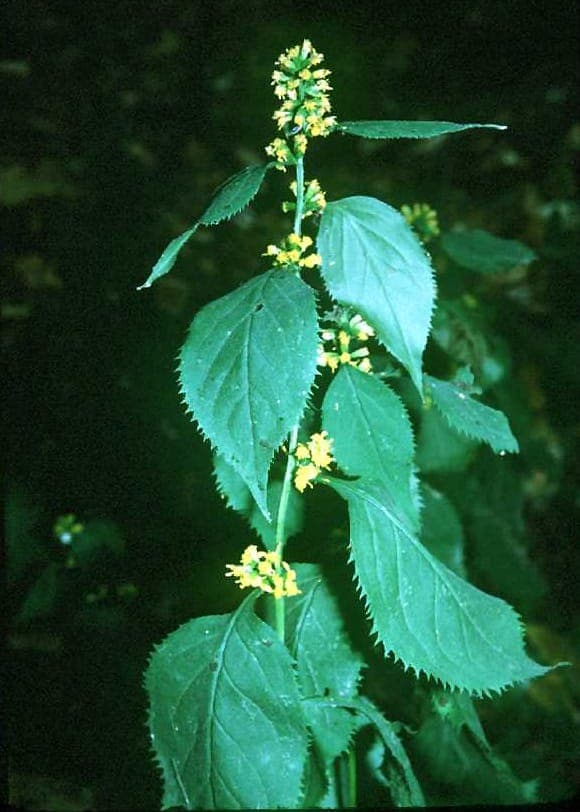
Wikimedia Commons / Public domain, via Wikimedia Commons
Zig-zag goldenrod: complete guide
Solidago flexicaulis
Want to see Zig-zag goldenrod: complete guide in your garden?
1 minute, no credit card
Overview
Zig-zag goldenrod (Solidago flexicaulis) is one of the most immediately recognisable members of the goldenrod genus, thanks to its stems that visibly zigzag from node to node rather than growing in a straight line. This distinctive habit, combined with broader leaves than most goldenrods, gives the plant a relaxed, naturalistic quality that suits woodland and informal garden settings well. Native to the deciduous woodlands and forest edges of eastern North America - from Nova Scotia and Quebec west to North Dakota and south to Georgia and Alabama - it is a true shade-tolerant goldenrod that brings autumn colour to spots where most summer-flowering plants have long since finished. If you want to build a planting scheme around this plant and its shade-loving companions, gardenworld.app can help you visualise how different species work together before you commit to digging.
Appearance and bloom cycle
The stems grow to between 30 and 80 cm tall and are visibly angled at each leaf node, creating the characteristic zigzag outline that gives the plant its common name. The leaves are broadly ovate to heart-shaped with toothed margins, noticeably wider than those of most other goldenrods - hence the alternative common name broadleaf goldenrod. The foliage is fresh green and provides reasonable ground cover during the spring and summer months. From August through October, clusters of bright golden-yellow flower heads appear along the stem and at its tip, with individual heads compact and richly coloured. The overall display is exuberant, drawing in bees, hoverflies, and small butterflies from considerable distances. Yellow flowers and brown seed heads extend the interest well into October and even early November.
Ideal location
Solidago flexicaulis is at its best in part shade to light shade. A position at the edge of a tree canopy, in the dappled light of a mixed shrub border, or on the shaded side of a fence or wall suits it well. It needs at least three to five hours of indirect or filtered light per day. In deep shade it will grow but may flower sparsely. Full sun is also possible, especially in cooler climates, but the broad leaves can scorch in high summer heat and the plant will need more water. The natural habitat of a woodland edge also tells us that the plant tolerates soils that stay slightly moist in summer, unlike many other goldenrods which insist on dry, fast-draining ground. It spreads gradually via rhizomes to form a colony over several years, making it useful as a weed-suppressing groundcover.
Soil requirements
A moderately fertile, well-drained soil with a pH between 5.3 and 7.0 gives the best results. Solidago flexicaulis does well in humus-rich loam, the kind of soil naturally found in woodland gardens. Avoid excessively rich or heavily fertilised soils, which produce lush, floppy growth that may need staking. On clay-heavy soils, work in composted bark or grit before planting to improve drainage. An annual mulch of garden compost applied in autumn at a depth of 5 cm provides enough nutrition to keep the plant growing strongly without overfeeding. On sandy soils that dry out quickly, the mulch layer is particularly important for retaining moisture during summer.
Watering
In the first season after planting, water twice a week during dry spells to encourage a good root system. Once established - usually by the second growing season - the plant needs much less attention. In a shaded, humus-rich soil it can often go through average summers without supplemental watering at all. During extended dry spells, a deep weekly watering at the base is enough to keep the plant looking good. Avoid wetting the foliage to minimise the risk of fungal spots on the broad leaves. Water in the morning whenever possible. A generous mulch layer of 5 to 8 cm around the base of the plant in June helps to retain soil moisture through the driest months and reduces the need to water by hand.
Free design
Want to see Zig-zag goldenrod: complete guide in your garden? Make a free design now.
Pruning
You can cut the stems of Solidago flexicaulis down to 10 cm above ground in November after flowering, or leave them standing until late February or early March. The standing stems provide seed for finches and goldfinches, and the hollow bases shelter small overwintering insects. For a more compact plant with stronger stems that do not need staking, try cutting the stems back by half in late May. This delays flowering by a few weeks and results in a more branched, bushy plant. The trade-off is that you lose some of the characteristic zigzag stem profile during the growing season. In practice, a mix of approaches - cutting some plants and leaving others - gives the most interesting results.
Maintenance calendar
January to February: leave stems in place for wildlife; plan any divisions. March: cut back old stems, divide congested clumps by lifting and splitting rhizomes. April to May: apply 5 cm of compost around the base; cut stems back by half in late May if a compact plant is wanted. June to July: active growth phase; watch for aphids or slugs on young shoots, particularly in shaded positions. August to October: flowering season; enjoy the golden display and the wildlife it attracts. November: cut back after flowering or leave for winter interest and wildlife. December: full dormancy.
Winter hardiness
Solidago flexicaulis is fully cold-hardy in USDA zones 3 to 8, making it suitable for all but the most extreme European climates. The top growth dies back to the ground in autumn, and the rhizomes overwinter safely in the soil without any protection. New shoots emerge reliably in March or April. Even after very cold winters with prolonged frost, established plants return without difficulty. This is one of the low-maintenance qualities that makes it such a good choice for a naturalistic or low-input garden. The perennial selection section on gardenworld.app lets you filter by hardiness zone if you want to find companions that will survive the winter with equally little fuss.
Companion plants
The broad leaves of Solidago flexicaulis create an interesting textural contrast with finer-leaved plants. Pair it with Japanese anemones (Anemone hupehensis) for a complementary pink and gold combination in September and October. Male fern (Dryopteris filix-mas) provides a stable evergreen backdrop. Astilbe cultivars cover the summer months with their feathery plumes before the goldenrod takes over in autumn. Aster divaricatus, the white wood aster, is a classic companion from the same eastern North American woodlands. For structural interest, Actaea simplex adds tall spikes of white flowers in autumn. At garden centres, look in the shade perennial and native plant sections - these companion plants are increasingly available alongside goldenrods in specialist outlets.
Closing thoughts
Zig-zag goldenrod is a plant that rewards closer inspection. The zigzag stems are genuinely unusual, the broad leaves are architecturally interesting, and the late-season flowering fills a gap that few shade-tolerant perennials can manage. For gardeners working with difficult spots under trees or in north-facing borders, it offers a reliable solution that also happens to support significant wildlife value. Once established, it asks very little while delivering consistent colour and character from August right through to October or beyond.
Want to see Zig-zag goldenrod: complete guide in your garden? Make a free design now.
Upload a photo, pick a style, and get a photorealistic design with plant list in under a minute.
10,000+ gardens designed already
No credit card required


Similar plants
Woodland goldenrod: complete guide
Solidago caesia
Woodland goldenrod (Solidago caesia) brings golden autumn colour to shaded gardens with its distinctive blue-green stems and axillary flower clusters.
Bog goldenrod: complete guide
Solidago uliginosa
Bog goldenrod (Solidago uliginosa) thrives in wet, acidic soils near ponds and bogs. Golden autumn flowers and high wildlife value make it ideal for moist gardens.