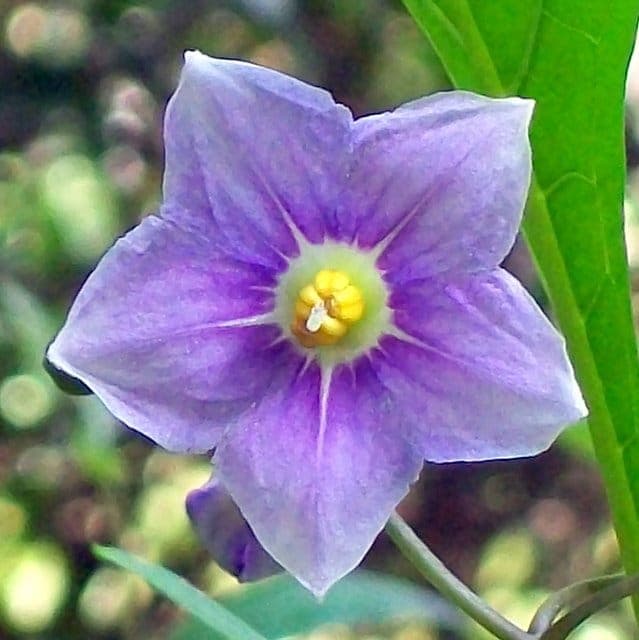
Poyt448 Peter Woodard / CC0, via Wikimedia Commons
Solanum aviculare: complete guide
Solanum aviculare
Want to see Solanum aviculare: complete guide in your garden?
Full design in HD: €7.99
Look after your Solanum aviculare with the GardenWorld app
Identify plants with your camera and get a care calendar with reminders for this plant.


Overview
Solanum aviculare, commonly known as Kangaroo-apple or Red kangaroo-apple, is a shrub native to New Zealand and nearby islands. This member of the Solanaceae (nightshade) family is distinguished by striking purple flowers, characteristic bird-shaped fruits, and fine foliage structure. Though tropical in origin, Solanum aviculare grows in many temperate climates with suitable protection.
This semi-woody plant reaches 2 to 4 meters tall and forms an upright, branching shrub. It offers long-season interest with flowers from spring through autumn. Solanum aviculare is suitable for borders, mixed plantings, and protected gardens.
Appearance and Bloom
Solanum aviculare grows as an open, branching shrub with large, pinnately lobed leaves. Foliage can reach 15 to 40 cm long, creating dramatic, tropical texture. Growing color varies from green to yellow-green.
Flowers are the main highlight. They are purple or deep purple with yellow centers. Individual flowers measure approximately 3 to 4 cm diameter and grow in clusters. Blooming occurs from April through September in temperate climates. Fruits form later in season as orange to red, bird-shaped fruits approximately 2 to 3 cm large, which are highly ornamental.
Ideal Location
Solanum aviculare thrives in full sun to partial shade. Select a protected location with minimum 6 to 8 hours direct sunlight daily. In very hot climates, light afternoon shade can be beneficial.
Ensure protection from strong winds, as this plant has slender branches. This plant performs poorly in very cold locations. Solanum aviculare works perfectly in borders, against walls or screens, and in containers in temperate climates. Avoid very wet or very dry locations.
Soil
Provide well-drained, airy soil. Solanum aviculare grows well in standard soils but prefers neutral to slightly acidic soils (pH 6.0 to 7.5). This plant tolerates heavier soils than many tender plants, provided good drainage.
Add sand or perlite to heavy, clayey soils to improve structure and drainage. This plant is not heavily nutrient-demanding and grows well in standard soils. Avoid adding large amounts of compost, as this can lead to excessive leaf growth and reduced flowering.
Watering
Once established, Solanum aviculare is moderately drought-tolerant, though regular watering improves blooming. Water regularly in first growing period. Water mature plants when soil feels dry. Avoid standing water and very wet soils, which cause root rot.
During growing season (spring through autumn), check soil moisture regularly. In winter, reduce watering. In wet winters, supplementary drainage around plant base can be beneficial.
Free preview
Want to see Solanum aviculare: complete guide in your garden? Make a free preview of your design.
Pruning
Solanum aviculare can be shaped through pruning. In early spring, cut back straggly stems to encourage more open form. Remove dead or damaged wood anytime. Prune faded flowers to encourage continued blooming.
This plant tolerates pruning well and can be reduced to desired size. After severe winters, additional pruning may be needed to remove damaged growth. Check for pests like whitefly or spider mite, especially in warm conditions.
Maintenance Calendar
Spring (March to May): Perform pruning in early spring. Water regularly. Check for pests. Enjoy flowering period.
Summer (June to August): Water as needed. Remove faded flowers. Monitor for drought stress. Fruits appear.
Autumn (September to November): Feed lightly. Reduce watering. Fruits become ripe and decorative.
Winter (December to February): Minimal water. Protect from frost. Check and prune damaged growth.
Winter Hardiness
Solanum aviculare is semi-hardy in many temperate climates. Depending on cultivar and location, this plant can tolerate temperatures to approximately -5 to -10 degrees Celsius, though many specimens will be damaged at these temperatures. In very cold climates (below -10 degrees Celsius), protect against frost or grow in containers that can be moved indoors in winter.
In temperate maritime climates (such as southwest England), Solanum aviculare grows outdoors against protected walls. In continental climates, warmer protection needed. Mulch protects plant base.
Companion Plants
Solanum aviculare works excellently in tropical-like mixed borders with other semi-hardy plants. Excellent companions include:
Solanum jasminoides (Jasmine nightshade) Myrrhis odorata (Sweet cicely) Fatsia japonica (Japanese aralia) Abelia grandiflora (Glossy abelia) Choisya ternata (Mexican orange blossom)
This grouping creates exotic texture and color mixes that remain interesting throughout the growing season.
Closing
Solanum aviculare is an attractive choice for gardeners seeking dramatic flowers and bird-shaped fruits in temperate climates. With its spectacular purple flowers, bird-shaped fruits, and fine foliage, it offers long-season interest. Suitable for borders, against walls, and in containers, Solanum aviculare deserves greater attention in temperate gardens. Gardenworld.app provides expert plant advice and design services.
Available at specialized nurseries. Visit gardenworld.app for more information.
Frequently asked questions about Solanum aviculare
Is Solanum aviculare winter hardy?
Solanum aviculare is semi-hardy in many temperate climates. Depending on cultivar and location, this plant can tolerate temperatures to approximately -5 to -10 degrees Celsius, though many specimens will be damaged at these temperatures.
When and how do you prune Solanum aviculare?
Solanum aviculare can be shaped through pruning. In early spring, cut back straggly stems to encourage more open form.
How much water does Solanum aviculare need?
Once established, Solanum aviculare is moderately drought-tolerant, though regular watering improves blooming. Water regularly in first growing period.
Where does Solanum aviculare grow best?
Solanum aviculare thrives in full sun to partial shade. Select a protected location with minimum 6 to 8 hours direct sunlight daily.
What soil does Solanum aviculare need?
Provide well-drained, airy soil. Solanum aviculare grows well in standard soils but prefers neutral to slightly acidic soils (pH 6.0 to 7.5).

See it in your garden
See Solanum aviculare in your garden
One photo of your garden and a few questions. You see the result in about a minute.
Try it with a photoIdentify this plant in your own garden. Identify a plant
Similar plants
Petunia (Petunia × atkinsiana): complete guide
Petunia × atkinsiana
Everything about garden petunias (Petunia × atkinsiana): sowing, position, compost, watering, feeding and pruning for containers in bloom until autumn.
Chinese lantern: complete guide
Physalis alkekengi
Everything about the Chinese lantern (Physalis alkekengi): position, drying the orange lanterns, keeping its spread in check, toxicity and winter hardiness.
Solanum dolichosepalum: complete guide
Solanum dolichosepalum
Discover Solanum dolichosepalum, an Andean nightshade with striking long sepals. Growing tips, hardiness, and companion planting for your patio.
