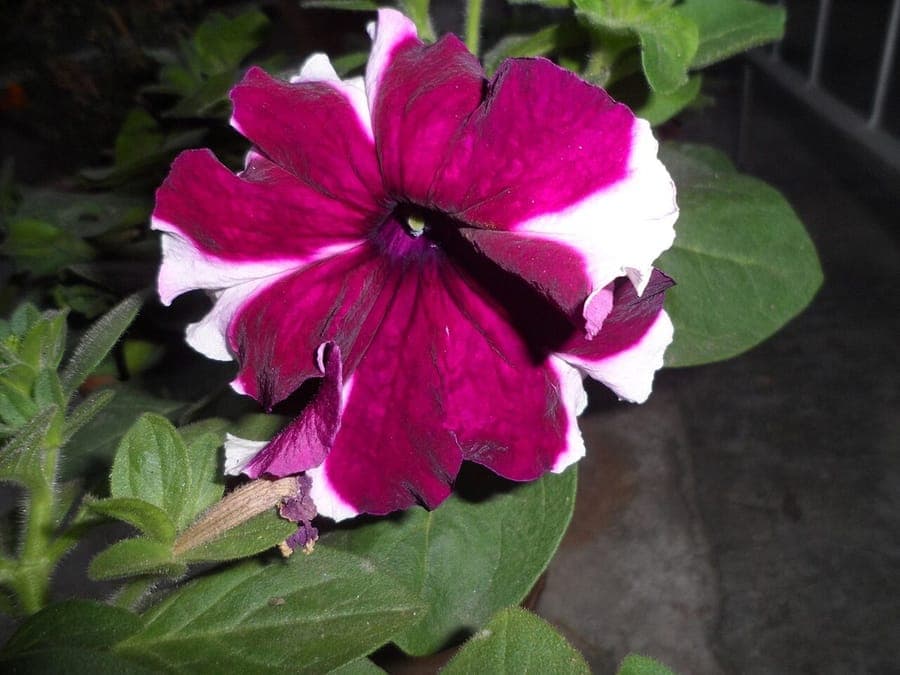
Rocksmoker 007 / CC BY-SA 3.0, via Wikimedia Commons
Petunia (Petunia × atkinsiana): complete guide
Petunia × atkinsiana
Want to see Petunia (Petunia × atkinsiana): complete guide in your garden?
Full design in HD: €7.99
Look after your Petunia with the GardenWorld app
Identify plants with your camera and get a care calendar with reminders for this plant.


Overview
The garden petunia (Petunia × atkinsiana) is, alongside the geranium, the best-known summer flower for window boxes, pots and hanging baskets. Its trumpet-shaped blooms appear from May until the first frost in almost every colour, from pure white to velvety purple, plain, striped, veined or edged in white. Few plants give a sunny balcony so much colour for so little money and effort.
The garden petunia is a hybrid of two South American species: the white, evening-scented Petunia axillaris and the purple Petunia integrifolia. The first hybrids were raised in England in the 1830s, partly by the nurseryman Atkins, after whom the plant is named. You will still often see the older name Petunia × hybrida. It belongs to the nightshade family (Solanaceae), alongside tomatoes and tobacco.
There are roughly four groups. Grandiflora petunias have flowers 8 to 10 cm across, spectacular but easily damaged by rain. Multiflora types have smaller flowers, but many more of them, and cope much better with bad weather. Millifloras carry tiny blooms. Trailing petunias, such as the familiar Surfinia range, produce stems up to a metre long and are perfect for baskets and balcony boxes. Wondering how to fill your patio or balcony with summer colour? gardenworld.app can create a garden design that includes your pots and containers too.
Appearance and bloom cycle
Petunias grow 20 to 40 cm tall; trailing varieties spread sideways and hang 60 to 100 cm over the edge of a container. The leaves are oval, 3 to 8 cm long, soft and stickily hairy. The whole plant feels slightly tacky to the touch, which is typical of petunias.
The flowers are funnel or trumpet-shaped with five fused petals. Besides plain colours, there are varieties with a white star, dark veining, a contrasting throat or a white margin, like the flower in the photo: deep wine red with a white rim. Double varieties look more like small carnations. White and purple forms in particular have a light evening scent, inherited from the wild Petunia axillaris, which is pollinated by moths.
Flowering starts in May and continues into October as long as the plant gets enough food and water. Petunias are not considered toxic to cats or dogs. They are not dangerous to people either, but they are not meant for eating.
Ideal location
Petunias need sun. A position with at least six hours of direct sunlight gives the most flowers; in shade they produce long, floppy stems and hardly any buds. A south or west-facing balcony, a window box or a sunny patio is ideal.
Where possible, choose a spot sheltered from strong wind and driving rain. The thin petals of large-flowered types tear easily and turn soggy after a downpour. On an open, windy site, multifloras or trailing varieties are a better choice, as they recover much faster after rain.
Only plant petunias outside once the risk of frost has passed, usually from mid-May. Below 5 °C growth stops and frost kills them.
Soil requirements
Use fresh multi-purpose or container compost, ideally slightly acidic with a pH between 5.5 and 6.5. Petunias are prone to iron deficiency: in limy compost or with hard tap water, young leaves turn yellow with green veins. Special petunia compost with added iron is available, and an iron-rich feed or rainwater also helps.
Good drainage is essential, with holes in the base of every container. A layer of clay pebbles at the bottom stops the roots sitting in water.
Petunias are hungry plants. Starting two weeks after planting, give a liquid feed for flowering plants every week, or mix slow-release granules into the compost at planting time and top up in summer. Without feeding, flowering stops as early as July.
Free preview
Want to see Petunia (Petunia × atkinsiana): complete guide in your garden? Make a free preview of your design.
Watering
In summer, container petunias need plenty of water. On warm days water every day, and in a heatwave sometimes morning and evening. Hanging baskets dry out fastest. Water thoroughly until it drains from the bottom, but never leave water standing in the saucer.
Water in the morning and at the base rather than over the flowers: wet blooms become spotty and more prone to grey mould. Hard tap water can cause iron deficiency over time, so rainwater is better. A self-watering container makes summer much easier.
Pruning
Many modern varieties are self-cleaning, meaning old flowers simply drop. With other varieties, pinch or snip off faded flowers together with the small green seed pod underneath. The plant then makes new buds rather than seed.
In spring, pinch out the tips of young plants so they branch. If a plant turns bare and leggy in midsummer, cut the stems back by a third to a half and give an extra feed. Within two to three weeks it will flower again, more compact and fuller.
You can sow petunias yourself in February or March, indoors at 20 to 24 °C. The seed is dust-fine and needs light to germinate: scatter it on moist seed compost and do not cover it. Buying young plants in spring is easier. Surfinias and other trailing types are propagated from cuttings, so they do not come from seed.
Maintenance calendar
February-March: Sow indoors in a bright, warm spot. Prick out seedlings once they have two true leaves.
April: Pinch out the tips of young plants and harden them off outside on mild days.
Mid-May: Plant out in boxes, pots or borders once frost is no longer a risk. Start feeding two weeks later.
June-August: Water daily in warm weather, feed weekly and remove faded flowers. Watch for aphids, whitefly, thrips and red spider mite.
July: Cut untidy plants back by a third for a second flush.
September-October: Flowering continues until the first frost. Then the plants go on the compost heap.
The planting calendar on gardenworld.app shows month by month when to sow, plant out and feed, so your containers stay full all summer.
Winter hardiness
Botanically, Petunia × atkinsiana is a short-lived perennial, but in our climate it is grown as an annual. It cannot tolerate frost; at 0 °C the leaves and flowers freeze and the plant dies.
If you want to keep a special trailing variety, cut it back hard in October and overwinter it somewhere bright and cool at 5 to 10 °C with very little water. In practice this does not always work: plants often become weak and prone to whitefly and mould. Taking cuttings in August and growing them on indoors is usually more successful.
Petunias do not naturalise in northern Europe and are not known as invasive anywhere in Europe.
Companion plants
Petunias are the heart of many summer containers. For a fresh look, pair purple or pink petunias with white sweet alyssum (Lobularia maritima), which is also beautifully scented. Blue lobelia (Lobelia erinus) fills the edges and trails gracefully.
For height, place an upright flower such as mealy sage (Salvia farinacea), with slender blue spikes, at the back of the container. Silver foliage such as Helichrysum petiolare brings calm between bright colours. Geraniums, verbenas and foliage plants such as ornamental sweet potato also work well. Only combine plants that share the same needs for sun, water and feeding.
Final thoughts
The petunia is an honest plant: give it sun, fresh compost, a weekly feed and enough water, and it will flower non-stop from May to October. A trim in July keeps it young, and the right choice of variety lets you play with colour, shape and even scent.
Choose multifloras or trailing types for a windy balcony and large-flowered ones for a sheltered patio, then combine them with sweet alyssum, lobelia or sage. With a single plant, you can transform an entire summer.
Frequently asked questions about Petunia
Is Petunia winter hardy?
Botanically, Petunia × atkinsiana is a short-lived perennial, but in our climate it is grown as an annual. It cannot tolerate frost; at 0 °C the leaves and flowers freeze and the plant dies.
When and how do you prune Petunia?
Many modern varieties are self-cleaning, meaning old flowers simply drop. With other varieties, pinch or snip off faded flowers together with the small green seed pod underneath.
How much water does Petunia need?
In summer, container petunias need plenty of water. On warm days water every day, and in a heatwave sometimes morning and evening.
Where does Petunia grow best?
Petunias need sun. A position with at least six hours of direct sunlight gives the most flowers; in shade they produce long, floppy stems and hardly any buds.
What soil does Petunia need?
Use fresh multi-purpose or container compost, ideally slightly acidic with a pH between 5.5 and 6.5. Petunias are prone to iron deficiency: in limy compost or with hard tap water, young leaves turn yellow with green veins.

See it in your garden
See Petunia in your garden
One photo of your garden and a few questions. You see the result in about a minute.
Try it with a photoIdentify this plant in your own garden. Identify a plant
Similar plants
Large white petunia: complete guide
Petunia axillaris
Master the cultivation of large white petunia (Petunia axillaris), an elegant annual with pure white fragrant blooms.
Lobelia erinus: complete guide
Lobelia erinus L.
Lobelia erinus is popular trailing plant with blue or red flowers, perfect for hanging baskets and containers. Flowers continuously all summer long.
Sweet alyssum: complete guide
Lobularia maritima
Sweet alyssum (Lobularia maritima) is an elegant trailing plant with fragrant blooms. Complete growing and care information here.
