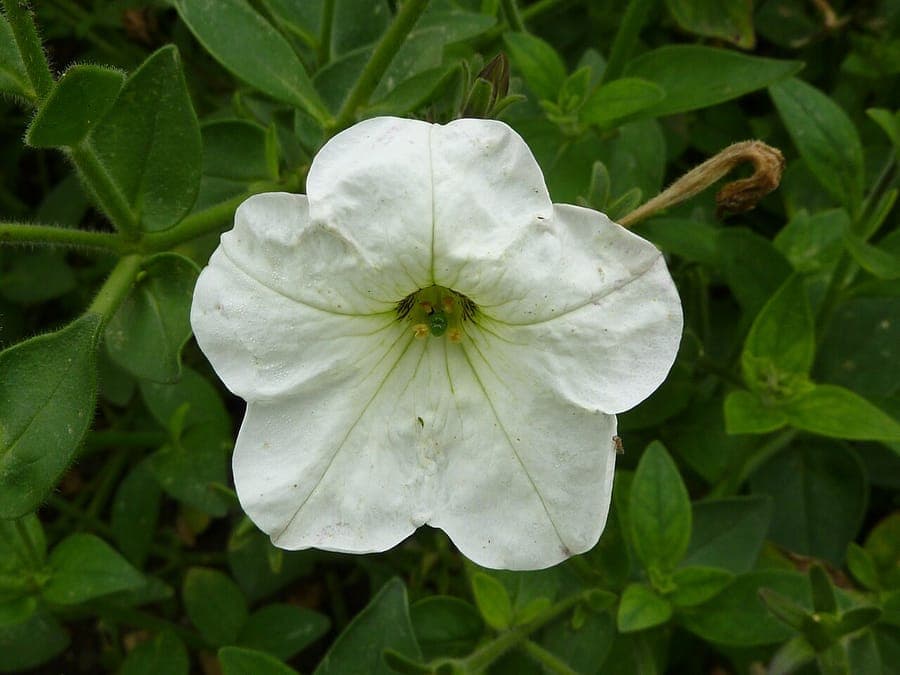
Magnus Manske / CC BY-SA 3.0, via Wikimedia Commons
Large white petunia: complete guide
Petunia axillaris
Want to see Large white petunia: complete guide in your garden?
Full design in HD: €7.99
Look after your Large white petunia with the GardenWorld app
Identify plants with your camera and get a care calendar with reminders for this plant.


Overview
Petunia axillaris, commonly called large white petunia or white moon petunia, is an elegant annual flowering plant celebrated for its pristine white blooms and sweet fragrance. This member of the Solanaceae originates from southern Brazil to central Argentina and has become a beloved garden staple across Europe and North America. With continuous flowering from May to October, it excels in borders, containers, baskets, and mixed plantings.
Appearance and bloom time
Large white petunia grows as a branching herb reaching 30-45 cm tall under standard conditions. The plant develops numerous side stems bearing linear to lanceolate foliage. Flowers are the showpiece: pure white, funnel-shaped, 5-6 cm across. Blooms emerge in clusters at leaf axils, creating a profusion of white throughout the growing season. Flowering extends from June through October in temperate climates, with peak bloom in July-August.
Ideal location
For best performance, plant large white petunia in full sun with a minimum of 6-8 hours of direct daily light. Southwest-facing positions maximize flower production. Shelter from strong midday wind is beneficial, particularly for container specimens. Half-shade (4-6 hours sun) shifts the plant toward foliage at the expense of flowers. Avoid positions under roof edges where foliage remains damp.
Soil
This plant thrives in well-draining, humus-rich soil with a pH range of 6.5 to 7.0. For garden beds, amend heavy clay or sandy soils with compost or peat moss. For containers, use quality potting mix blended with 20-30 percent perlite to ensure drainage. Waterlogging is the primary enemy. Always provide drainage holes.
Watering
Large white petunias require moderate, consistent moisture. Water at soil level in the morning to prevent fungal leaf diseases. Allow the top 1-2 cm of soil to dry between waterings. During peak summer heat (July-August), daily watering is often necessary, especially for container-grown specimens. Consistent moisture fuels sustained flowering.
Free preview
Want to see Large white petunia: complete guide in your garden? Make a free preview of your design.
Pruning
Regular pruning creates compact, densely branched plants with abundant flowers. Once seedlings reach 4-5 leaf pairs, pinch the main tip to stimulate side branching. Pinch back mid-June to establish full bloom through season. After July, cut back leggy or long shoots to 10-15 cm to restore compactness. Remove spent flowers consistently.
Maintenance calendar
May: Sow seed indoors or purchase bedding plants. June: Set out after last frost. Pinch main tip for branching. July-August: Weekly watering, bi-weekly feeding, regular deadheading. September: Flowering usually remains strong. October: First frost threatens; cover plants.
Winter hardiness
Large white petunia is not winter-hardy in temperate zones. It is grown as a tender annual. USDA zones 10-11 (minimum -5 to 0 degrees C) permit overwintering. In northern Europe, frost below -2 degrees C kills the plant. To preserve plants: sow seed indoors March, take cuttings August-September and maintain under glass.
Companion plants
Large white petunias pair beautifully with purple, red, or pink blooms. Combine with Salvia Victoria Blue, red Geranium, or pink Diascia. For monochromatic white schemes, team with white Alyssum, white Vinca, or white Impatiens. Silver-foliaged companions provide elegant backdrops.
Conclusion
Large white petunias are essential for luminous summer gardens. Their pure white blooms glow in twilight, and their fragrance perfumes evening air. Easy to grow, perpetually blooming, and versatile in placement - these plants justify their century-long popularity. Consistent attention to pinching, watering, and feeding rewards you with full, continuously flowering specimens from May through October.
Frequently asked questions about Large white petunia
Is Large white petunia winter hardy?
Large white petunia is not winter-hardy in temperate zones. It is grown as a tender annual.
When and how do you prune Large white petunia?
Regular pruning creates compact, densely branched plants with abundant flowers. Once seedlings reach 4-5 leaf pairs, pinch the main tip to stimulate side branching.
How much water does Large white petunia need?
Large white petunias require moderate, consistent moisture. Water at soil level in the morning to prevent fungal leaf diseases.
Where does Large white petunia grow best?
For best performance, plant large white petunia in full sun with a minimum of 6-8 hours of direct daily light. Southwest-facing positions maximize flower production.
What soil does Large white petunia need?
This plant thrives in well-draining, humus-rich soil with a pH range of 6.5 to 7.0. For garden beds, amend heavy clay or sandy soils with compost or peat moss.

See it in your garden
See Large white petunia in your garden
One photo of your garden and a few questions. You see the result in about a minute.
Try it with a photoIdentify this plant in your own garden. Identify a plant
Similar plants
Petunia (Petunia × atkinsiana): complete guide
Petunia × atkinsiana
Everything about garden petunias (Petunia × atkinsiana): sowing, position, compost, watering, feeding and pruning for containers in bloom until autumn.
Chinese lantern: complete guide
Physalis alkekengi
Everything about the Chinese lantern (Physalis alkekengi): position, drying the orange lanterns, keeping its spread in check, toxicity and winter hardiness.
Solanum dolichosepalum: complete guide
Solanum dolichosepalum
Discover Solanum dolichosepalum, an Andean nightshade with striking long sepals. Growing tips, hardiness, and companion planting for your patio.
