Wikimedia Commons / CC BY-SA 3.0, via Wikimedia Commons
Yacon: complete guide
Smallanthus sonchifolius
Want to see Yacon: complete guide in your garden?
Full design in HD: €7.99
Look after your Yacon with the GardenWorld app
Identify plants with your camera and get a care calendar with reminders for this plant.


Overview
Yacon (Smallanthus sonchifolius) is a root crop from the Andes that is turning up in more and more European vegetable gardens. It belongs to the daisy family (Asteraceae) and is related to the sunflower and the Jerusalem artichoke. In Peru, Bolivia and Ecuador it has been grown for centuries for its large, juicy storage roots. They taste sweet and fresh, somewhere between apple, pear and watermelon, and stay crisp even after a quick stir-fry.
What sets yacon apart is the kind of sugar in its roots. Most of it consists of fructooligosaccharides (FOS), sugars the body barely digests and which mainly feed beneficial gut bacteria. The roots therefore taste sweet but supply few calories. In our climate yacon is not a hardy perennial, so you grow it much as you would dahlias: plant out the crowns in spring, lift the roots in autumn and keep the crowns frost-free over winter. On gardenworld.app you can have a garden design made that includes a generous vegetable bed with room for large, eye-catching crops like this one.
Appearance and flowering
Yacon grows into a substantial herbaceous plant 1.5 to 2 metres tall. The stems are sturdy, hairy and often flushed with purple. The leaves are large, triangular to heart-shaped, up to 30 cm long and softly hairy underneath.
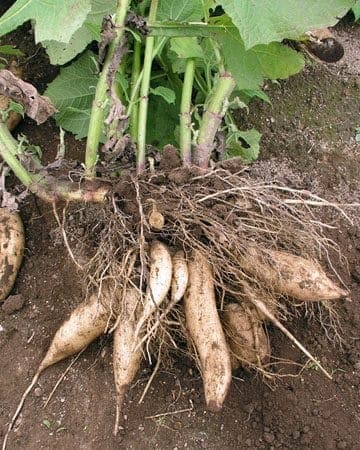
Below ground the plant forms two kinds of organ. At the top is a knobbly rhizome, the crown, with pink to purple buds. Next year's shoots grow from this crown, so it is your planting stock. Below it hang the edible storage roots: elongated, spindle-shaped tubers 10 to 25 cm long, with pinkish-brown to light brown skin and white to yellowish flesh. The photo above shows a freshly lifted plant with just such a bunch of roots beneath the stems.
Flowers appear only late in the season: small yellow to orange daisy flowers a few centimetres across. In north-west Europe the first frost often arrives before they open, which makes no difference to the harvest.
Ideal location
Give yacon a sunny or lightly shaded spot. Full sun gives the biggest crop, but the plant tolerates a few hours of shade. As it grows tall, place it on the north side of the vegetable bed so it does not shade lower crops. Shelter from wind is a bonus, because the big leaves and tall stems can snap in a storm.
Allow 80 to 100 cm between plants. That looks generous for a small plant in May, but by September yacon fills the space completely. It can also be grown in a large container of at least 50 litres, although the harvest will be smaller.
Soil requirements
Yacon likes deep, loose, fertile soil. The looser the ground, the longer and better shaped the roots. Dig the bed deeply beforehand and work in plenty of garden compost or well-rotted manure, around 5 to 10 litres per square metre. A pH between 6 and 7.5 is ideal.
On heavy clay the roots stay shorter and break more easily when you lift them. Improve clay with compost and perhaps some grit, or grow in a slightly raised bed. Yacon does well on sandy soil, provided you add enough organic matter and water in summer.
Watering
Yacon produces a great deal of foliage in a short time and needs plenty of water to do so. In dry summers, give a thorough soaking of 10 to 15 litres per plant once or twice a week. Regular watering matters most in August and September, when the roots are swelling. Too little water gives smaller, more fibrous roots.
A mulch of straw, grass clippings or leaf mould keeps the soil cool and moist and suppresses weeds. Yacon does not like waterlogging, though: water must be able to drain away, or the roots will rot.
Planting and care
Yacon is almost never grown from seed. Instead, you plant pieces of crown with at least one or two buds. The separate edible roots have no buds and will not sprout.
Pot up the crown pieces in late March or April in moist compost and keep them in a bright, frost-free place indoors or in a cold greenhouse. After a few weeks the first shoots appear. Plant out from mid-May, once there is no further risk of frost. No pruning is needed. At most, remove damaged leaves and, on an exposed site, tie the stems to a strong stake. If you like, draw some soil up around the base in June for extra stability.
Yacon suffers little from disease. Slugs may nibble young shoots, and in sheltered spots aphids or whitefly sometimes appear.
Free preview
Want to see Yacon: complete guide in your garden? Make a free preview of your design.
Harvesting and uses
Harvest in October or November, once the first frost has blackened the foliage. Do not wait too long after that, and certainly not until the ground freezes. Cut the stems off about 20 cm above the ground, dig widely around the plant and lift the whole clump carefully with a fork. The roots are brittle and snap easily; broken ones are perfectly edible but keep less well. A healthy plant in our climate easily yields 2 to 4 kg of roots.
Break the edible roots away from the crown. Leave them for a few days to a week in a dry, airy place, ideally somewhere sunny behind glass. During this time part of the FOS turns into ordinary sugars and the roots become sweeter. Then store them cool and frost-free, between 2 and 8 °C, in a crate of slightly damp sand or in a cellar. That way they keep for months.
In the kitchen, peel the roots, as the skin is slightly resinous. The flesh discolours quickly, so drop it into water with a squeeze of lemon. Yacon is delicious raw in salads, as a crunchy snack or grated into coleslaw. A quick stir-fry works too, and it stays crisp. In the Andes it is also boiled down into a dark syrup. Start with small portions: in large amounts the FOS can cause wind or a laxative effect. In South America the leaves are sometimes brewed as tea, but their safety has not been properly studied, so stick to the roots. Yacon is not known to be toxic to dogs or cats.
Maintenance calendar
March–April: Take the crowns out of winter storage, divide them and pot them up somewhere bright and frost-free.
May: Loosen the bed deeply and work in compost. Plant out from mid-May, 80 to 100 cm apart.
June–July: Weed, mulch and water in dry spells. Stake the stems on exposed sites.
August–September: The roots swell. Water regularly and thoroughly.
October–November: Harvest after the first frost. Let the roots cure and store them cool; store the crowns separately.
December–February: Keep crowns and roots frost-free. Check now and then for rot or drying out.
Overwintering
Smallanthus sonchifolius is not hardy. The foliage dies at 0 °C, and the crown does not survive hard frost in the ground either. In very mild areas it sometimes pulls through under a thick layer of straw, but in most of the British Isles and the Low Countries that is a gamble. The safest approach is to lift the crowns and overwinter them indoors.
After harvesting, let the crowns dry off for a few days, then bed them in a crate or bucket of slightly moist compost or sand. Keep them somewhere dark and frost-free between 5 and 10 °C, such as a cellar or frost-free garage. Every few weeks, check that nothing is rotting and that the medium has not dried out completely. In March or April the cycle begins again.
Companion plants
In the vegetable bed, yacon pairs well with other tall or exuberant crops. Courgettes and squashes (Cucurbita pepo) can sprawl between the young yacon plants and cover the soil until yacon takes over the space. Climbing beans (Phaseolus vulgaris) and sweetcorn (Zea mays) form a tall mixed planting together with yacon. If you enjoy root crops, combine yacon with Jerusalem artichoke (Helianthus tuberosus) and sweet potato (Ipomoea batatas). Be careful, though: Jerusalem artichoke spreads vigorously, so give it its own contained bed.
Do not plant low, sun-loving vegetables such as lettuce or carrots on the south side of yacon, as they will end up in its shade once it reaches full height.
Final thoughts
Yacon is a surprising addition to any vegetable garden. It grows fast, is rarely troubled by disease and rewards you in autumn with sweet, crunchy roots you can eat raw. Treat it like a dahlia, planting out after the last frost, lifting after the first frost and overwintering frost-free, and you can start again year after year with your own planting stock.
Want to know the best time to start, plant out and harvest? The plant calendar on gardenworld.app lines it all up for you, so your yacon goes into the ground and comes out again at exactly the right moment.
Frequently asked questions about Yacon
How much water does Yacon need?
Yacon produces a great deal of foliage in a short time and needs plenty of water to do so. In dry summers, give a thorough soaking of 10 to 15 litres per plant once or twice a week.
Where does Yacon grow best?
Give yacon a sunny or lightly shaded spot. Full sun gives the biggest crop, but the plant tolerates a few hours of shade.
What soil does Yacon need?
Yacon likes deep, loose, fertile soil. The looser the ground, the longer and better shaped the roots.

See it in your garden
See Yacon in your garden
One photo of your garden and a few questions. You see the result in about a minute.
Try it with a photoIdentify this plant in your own garden. Identify a plant
Similar plants
Jerusalem-artichoke: complete guide
Helianthus tuberosus
Learn how to grow and care for Jerusalem-artichoke: a hardy, edible tuber plant with bright yellow flowers. Perfect for permaculture and low-maintenance gardens.
Sweetpotato: complete guide
Ipomoea batatas
Discover sweetpotato (Ipomoea batatas), a productive vine with nutritious tubers. Learn all about cultivation, harvest, and nutrition.
Pumpkin and courgette: complete guide
Cucurbita pepo
Growing pumpkins and courgettes: practical guide to cultivating these popular summer vegetables in your garden.
