
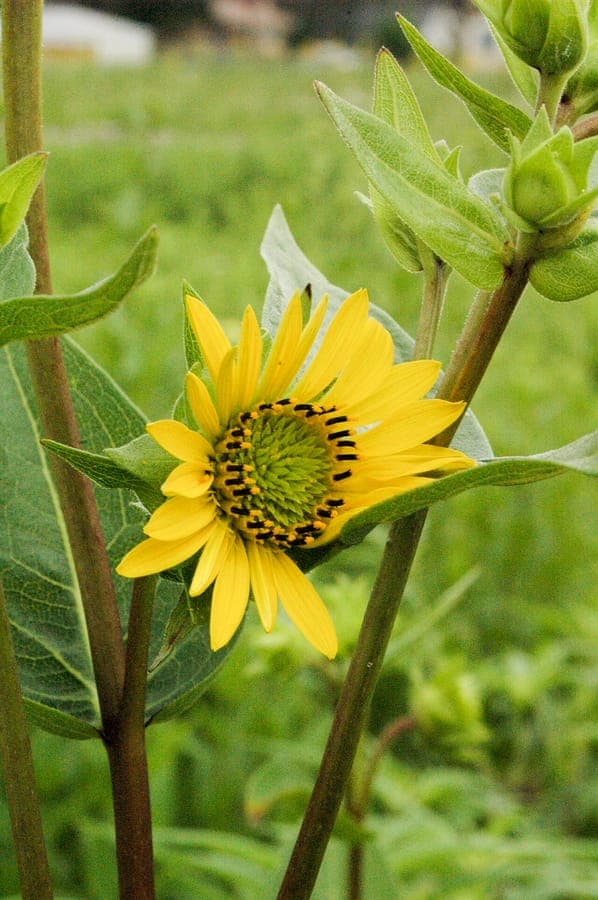
Frank Mayfield / CC BY-SA 2.0, via Wikimedia Commons
Rosinweed (Silphium integrifolium): complete guide
Silphium integrifolium
Want to see Rosinweed (Silphium integrifolium): complete guide in your garden?
1 minute, no credit card
Overview
Silphium integrifolium, commonly known as rosinweed or whole-leaf rosinweed, is an impressive perennial belonging to the Asteraceae, the daisy family. Native to the tallgrass and mixed-grass prairies of central North America - from Kansas and Nebraska east to Indiana, Michigan and Ontario - it is a true prairie giant that brings drama, ecological value and summer-long colour to larger garden plantings.
The name "integrifolium" refers to the entire, undivided leaves, distinguishing this species from other silphiums with more divided foliage. The common name "rosinweed" comes from the resinous sap released when the leaves or stems are bruised or broken. In recent years, Silphium integrifolium has attracted growing attention from naturalistic gardeners and landscape designers seeking robust, drought-tolerant perennials that also benefit wildlife. On gardenworld.app you can explore how rosinweed fits into a naturalistic front garden design alongside other prairie plants.
Appearance and bloom cycle
Silphium integrifolium is a genuinely large plant. Established specimens reach between 100 and 200 cm in height with a spread of 60 to 90 cm, forming substantial clumps over time. The stems are robust, upright and lightly rough-hairy. The leaves are large, oval to lance-shaped, noticeably rough to the touch on their upper surface and somewhat resinous-sticky - the source of the plant's evocative common name.
From July through to September, the plant is covered in cheerful bright yellow daisy-like composite flowers. Each flowerhead has ray florets around 2 to 3 cm long surrounding a compact yellow disc. The flowers are produced in open clusters at the tips of the branches and are magnets for bees, bumblebees, butterflies and other pollinators throughout the entire blooming period.
After flowering, flat seeds develop that are eagerly eaten by finches, goldfinches and other seed-eating birds in autumn. The tall, upright dead stems remain attractive through winter, providing structure in the border and shelter for overwintering insects.
Ideal location
Silphium integrifolium is a full-sun plant that needs at least six hours of direct sunlight daily. It comes from the wide-open prairie where sunshine and wind are constant, and it thrives in warm, open, well-ventilated positions. In partial shade the plant tends to lean towards the light and may need staking; in full shade it will not perform well.
Given its size, rosinweed is best suited to the back of a large border, as a bold solitary accent in a prairie planting, or alongside fences and walls on south or west-facing aspects. Allow plenty of room: at least 60 to 90 cm between this plant and its neighbours, as it develops extensive root systems over time.
The plant is particularly valuable for sites that are too dry for many other perennials - a sunny bank, a strip beside a south-facing wall, or an extensively managed front garden strip where irrigation is not practical.
Soil
In its native habitat, Silphium integrifolium grows in the deep, rich prairie soils of the American Midwest, but it adapts well to a range of garden conditions. A free-draining, moderately fertile soil is ideal. On sandy or lightly loamy soils it flowers prolifically.
It also grows on heavier clay soils, but drainage is essential. On poorly draining ground, incorporate coarse grit to improve the structure. The plant tolerates pH values from slightly acid to slightly alkaline, avoiding extremes at either end.
One of the most remarkable features of Silphium integrifolium is its extraordinary root system. The plant can form roots reaching 3 to 4 metres deep, giving it exceptional drought tolerance once established after its second year. In the first season, supplementary watering is needed while the roots settle in. Thereafter the plant is largely self-sufficient.
Feed sparingly. On overly fertile ground the plant produces lush, heavy stems that may require staking. A light annual top-dressing of compost in early spring is ample.
Watering
After the establishment period in its first year, Silphium integrifolium is notably drought tolerant. Its deep root system allows it to access soil moisture far below the surface, even during hot, dry summers. This makes it an excellent choice for urban gardens with warm microclimates or for areas where irrigation is impractical.
Throughout the first growing season, weekly deep watering is important to encourage the root system to go deep. Frequent shallow watering is less effective. From the second year onwards, the plant needs little or no supplementary water under typical British conditions.
In prolonged drought spanning several weeks without rain, a deep watering at the base of the plant can be beneficial, but this is rarely necessary for established specimens. Waterlogging is more harmful than drought to this plant: standing water around the roots, especially in winter, can cause root rot in younger plants.
Free design
Want to see Rosinweed (Silphium integrifolium): complete guide in your garden? Make a free design now.
Pruning
Silphium integrifolium needs very little attention in this regard. The plant grows upright and maintains its shape naturally. In late winter or early spring - February or March - cut the previous year's dead stems back to ground level before the new shoots emerge.
No summer cutting is needed unless you want to modify the plant's behaviour. If you cut the stems back by half in mid-June, you will delay flowering by two or three weeks but encourage a more branched, slightly more compact plant. This technique is useful if the plant is growing in a smaller border where its full height might be overwhelming.
Otherwise, simply allow the plant to flower, set seed and stand through winter. The dead flowering heads and stems add structure to the winter garden and provide food for birds and shelter for insects. On gardenworld.app you can see how tall prairie perennials like Silphium integrifolium can be integrated into naturalistic front garden designs.
Maintenance calendar
January - February: Rest period. The dead stems stand upright and remain decorative. Birds visit to eat the last seeds. No action required.
March - April: Cut previous year's stems back to ground level as soon as fresh shoots are visible. The plant re-emerges slowly but reliably.
May - June: Strong vegetative growth. No feeding needed on normal soils. One deep watering if conditions are very dry.
July - August: Full flower, intense activity of bees and butterflies. Enjoy and leave alone.
September - October: Flowering fades gradually. Seed heads develop. Leave stems in place for birds and overwintering insects.
November - December: Tall dead stems provide winter structure. No intervention needed until spring.
Winter hardiness
Silphium integrifolium is outstandingly winter hardy. Native to the North American prairie - a climate of harsh winters and hot summers - the species is rated USDA zones 4 to 9. In practice it tolerates temperatures down to around -30 degrees Celsius on a well-drained site.
In the British Isles and north-western Europe, winters are rarely severe enough to threaten this plant. After a hard winter it reliably reappears in spring, though it can be slow to show the first shoots - sometimes not until April or May. Do not be concerned: the plant survives underground through its extensive root system.
In its first year, before the root system is fully established, the plant is slightly more vulnerable to a combination of hard frost and wet conditions. If your soil has poor drainage, incorporate grit at planting time to improve it, and this will safely see the plant through its first winter.
Companion plants
Silphium integrifolium is an ideal partner for other large prairie perennials. At the back of a border it combines well with Vernonia noveboracensis (ironweed), tall coneflowers such as Rudbeckia maxima, Echinacea purpurea and blazing star Liatris spicata.
For the middle ground, compact Echinacea varieties, Agastache foeniculum, Monarda fistulosa and Penstemon digitalis make good companions. All these plants share similar requirements - full sun, free-draining soil, minimal irrigation after establishment - and flower mainly in the same summer window, creating a long-lasting, dynamic prairie border.
For a purple-blue colour accent, pair Silphium integrifolium with Verbena hastata or Salvia azurea. Prairie switch-grass (Panicum virgatum) or big bluestem (Andropogon gerardii) create a beautiful textural contrast with its bright yellow flowers and can be found at specialist garden centres across the UK.
Closing
Silphium integrifolium is one of the most spectacular and reliable perennials for large, naturalistic garden plantings. Drought tolerant, winter hardy, superb for pollinators and birds - this prairie giant deserves far wider recognition among British and European gardeners. Look for it at specialist perennial nurseries and prairie plant suppliers across the UK.
Plant it once, give it time to establish, and it will reward you for decades with its cheerful yellow flowers and its role as a wildlife hub in your garden. Few perennials offer so much for so little effort once they are settled in.
Want to see Rosinweed (Silphium integrifolium): complete guide in your garden? Make a free design now.
Upload a photo, pick a style, and get a photorealistic design with plant list in under a minute.
10,000+ gardens designed already
No credit card required


Similar plants
Silphium laciniatum: complete guide
Silphium laciniatum
Discover the Compass Plant (Silphium laciniatum), a dramatic native perennial with large yellow flowers and unique leaf orientation.
Purple coneflower: complete guide
Echinacea purpurea
Everything about Purple Coneflower (Echinacea purpurea): planting, care, pruning and combinations. Expert tips for a thriving prairie-style garden.
Black-eyed-susan: complete guide
Rudbeckia hirta
Black-eyed-susan (Rudbeckia hirta) is a hardy annual or short-lived perennial with bright yellow blooms. Perfect for sunny borders and pollinator gardens. 150-160 chars.