
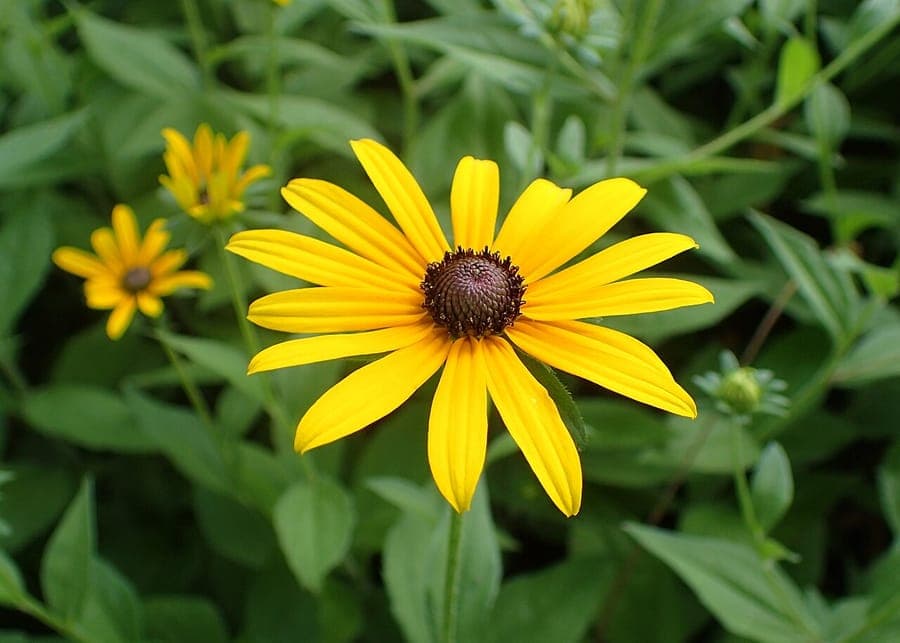
Krzysztof Ziarnek, Kenraiz / CC BY-SA 4.0, via Wikimedia Commons
Black-eyed-susan: complete guide
Rudbeckia hirta
Want to see Black-eyed-susan: complete guide in your garden?
1 minute, no credit card
Overview
Black-eyed-susan, or Rudbeckia hirta, is one of those no-fuss plants that brings big color with minimal effort. Technically a short-lived perennial or biennial, it often behaves as an annual in cooler zones but reliably self-seeds, so you'll likely see it come back year after year. Native to central and eastern North America-from Alabama to Alberta-it thrives in USDA hardiness zones 3 to 9. Mature plants typically reach 30 to 90 cm in height, making them ideal for mid-border placement or wildflower meadows.
This member of the Asteraceae family is a go-to for gardeners who want cheerful, long-lasting color without constant upkeep. It's also a magnet for pollinators. Whether you're designing a structured border or a relaxed cottage garden, Black-eyed-susan fits right in. On gardenworld.app, you can create a custom planting plan that layers Rudbeckia with complementary heights and bloom times.
Appearance & bloom cycle
The flowers are unmistakable: golden-yellow ray florets surround a dark, domed central cone that gives the plant its common name. Each flower head is 5 to 10 cm wide and appears from early summer through fall-typically June to October, especially if you deadhead regularly. The foliage is coarse, hairy (true to its species name hirta), and deep green, often with a silvery underside.
Plants sown in spring (April–May) usually bloom the same year. The seeds need light to germinate, so scatter them on the soil surface and press lightly. Seedlings often pop up naturally in spring where parent plants stood the year before. With proper care, the blooming period can last 12 to 14 weeks, sometimes longer in mild climates.
Ideal location
Black-eyed-susan loves full sun-aim for at least 8 hours of direct light daily (a light score of 8/10). It tolerates light shade (5–6 hours), but growth becomes leggy and flowering sparse. Plant it in open areas: middle of a sunny border, along a gravel path, or in a wildflower patch. Avoid overcrowding, as poor air circulation can lead to fungal issues. Keep in mind the stems are rough-don't plant too close to delicate-leaved companions or high-traffic zones.
Use gardenworld.app to map sun exposure in your garden and find the perfect spot for Rudbeckia, ensuring it gets the light it needs without competing with taller plants.
Soil requirements
Rudbeckia hirta isn't picky, but it prefers well-drained soil with a pH between 6.0 and 7.0. It handles sandy soils well and even tolerates clay if amended with compost to improve drainage. Avoid waterlogged or overly rich soils-too much nitrogen promotes leafy growth at the expense of flowers and can cause floppy stems. No fertilizer needed; in fact, poor to average soil often yields better blooms.
Free design
Want to see Black-eyed-susan: complete guide in your garden? Make a free design now.
Watering
Once established, this plant is moderately drought-tolerant. Young plants need consistent moisture for the first 4–6 weeks-about 1 inch of water per week. After that, water deeply every 10–14 days during dry spells. Overhead watering should be avoided to prevent powdery mildew. Let the soil dry out between waterings-this mimics its natural prairie habitat.
Pruning
No pruning is needed during active growth. Deadhead spent flowers regularly to extend blooming and prevent excessive self-seeding if you want to control spread. In late fall, leave the seed heads standing-birds like goldfinches feed on the seeds, and the dried stems add winter texture. Cut back old growth in early spring (March) to make room for new shoots.
Maintenance calendar
- February–March: Cut back last year's stems to 10–15 cm. Check for early seedlings.
- April–May: Sow seeds on the surface or transplant seedlings. Water lightly until established.
- June–August: Enjoy peak bloom. Deadhead weekly. Monitor for pests like aphids.
- September–October: Reduce deadheading to allow seed set. Let some flowers go to seed for wildlife.
- November–January: Leave garden standing. Minimal intervention-just occasional cleanup if needed.
Winter hardiness
Hardy in USDA zones 3–9, Rudbeckia hirta often dies back in winter but returns via self-seeding. The seeds germinate in spring when soil temperatures exceed 15°C. In wet, cold winters, crown rot can occur in heavy soils-ensure good drainage to prevent this. Mulching isn't required and may even encourage rot in moist conditions.
Companion plants
Pair Black-eyed-susan with plants that share its sun and moisture needs:
- Purple coneflower (Echinacea purpurea) – similar bloom time, pollinator magnet
- Ornamental grasses (e.g., Panicum virgatum) – adds movement and structure
- Lavender (Lavandula angustifolia) – scent contrast and drought tolerance
- Russian sage (Perovskia atriplicifolia) – airy texture and silver foliage
- Autumn joy sedum (Hylotelephium 'Herbstfreude') – extends fall interest
Space plants 30–40 cm apart to allow airflow and prevent mildew.
Closing
Black-eyed-susan is a backbone plant for low-maintenance, wildlife-friendly gardens. It's tough, adaptable, and brings weeks of golden color. You'll find starter plants or seeds at most garden centres, including major chains like Homebase or local independents. Because it self-seeds freely, it can pop up in unexpected places-sometimes a nuisance, often a delight. On gardenworld.app, you can sketch out a full border design that includes Rudbeckia as a focal point, with seasonal color and texture in mind.
Want to see Black-eyed-susan: complete guide in your garden? Make a free design now.
Upload a photo, pick a style, and get a photorealistic design with plant list in under a minute.
No credit card required


Similar plants
Calendula stellata: complete guide
Calendula stellata
Complete guide to Calendula stellata, the star-flowered marigold from Sicily: location, soil, watering and companion planting tips.
Korean chrysanthemum: complete guide
Chrysanthemum x rubellum
Chrysanthemum x rubellum is a hardy autumn perennial with single pink to copper flowers from August to November. Care and combinations.
Helianthus divaricatus: complete guide
Helianthus divaricatus
Helianthus divaricatus is a North American woodland sunflower with yellow summer blooms, ideal for naturalistic borders and shady edges.