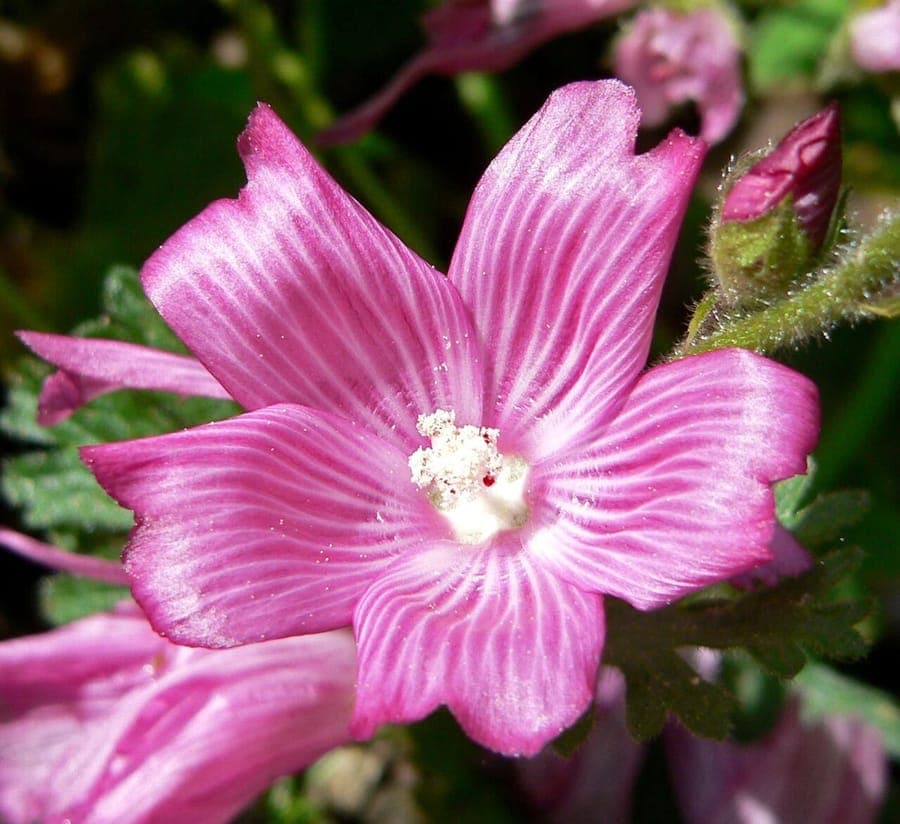
Stan Shebs / CC BY-SA 3.0, via Wikimedia Commons
Checkerbloom (Sidalcea malviflora): complete guide
Sidalcea malviflora
Want to see Checkerbloom (Sidalcea malviflora): complete guide in your garden?
Full design in HD: €7.99
Look after your Checkerbloom with the GardenWorld app
Identify plants with your camera and get a care calendar with reminders for this plant.


Overview
Checkerbloom (Sidalcea malviflora), also known as prairie mallow or checker mallow, is a graceful perennial that looks like a small, slender hollyhock. From June into August it carries upright spires packed with satiny pink flowers. Where a hollyhock is broad and heavy, checkerbloom stays airy and restrained, so it suits smaller gardens and narrow borders too.
Despite the name prairie mallow, it does not come from the Great Plains but from western North America, from Oregon down through California into Baja California. There it grows in grassland, open woodland and damp meadows along the coast and in the hills. The common name checkerbloom refers to the fine veining on the petals, clearly visible in the photograph. It belongs to the mallow family (Malvaceae), alongside hollyhocks and common mallow.
Garden centres mostly offer cultivars derived from or crossed with Sidalcea malviflora, such as 'Elsie Heugh' (pale pink with fringed petals), 'Party Girl' (bright pink), 'Rosanna' (deep pink) and 'Croftway Red' (rich rose-red). Most grow 70 to 120 cm tall. Wondering how it would fit into your border? On gardenworld.app you can have a garden design made in which checkerbloom takes its place among other summer perennials.
Appearance and bloom cycle
The plant first forms a low clump of rounded, shallowly lobed basal leaves. Higher up the flower stems the leaves look quite different: deeply cut, hand-shaped, with narrow segments. That contrast is typical of the genus Sidalcea.
The flowers are 3 to 5 cm across, with five petals that are sometimes slightly notched at the tip. Colours range from soft shell pink to deep pink and carmine, often with white veins and a white eye. They are carried in loose spires that open from the bottom upwards. Flowering starts in June and runs into August; cut back after the first flush and you will often get a second round in September. Bees and bumblebees love it.
Checkerbloom is not known to be poisonous to people or pets, which makes it a good choice for a family garden.
Ideal location
Give it a spot in full sun or light shade. In sun it flowers most freely and the stems stay sturdier; in too much shade they stretch and flop. Very dry, baking sites are a struggle, though: it comes from regions with cool coastal air and likes a cool root run.
In a border, place it in the middle, between low front-of-border plants and taller ones behind. Plant in groups of three or five, 40 to 50 cm apart, to create a drift of pink spires. Shelter from strong winds helps keep the stems upright.
Soil requirements
Sidalcea malviflora wants fertile soil that stays moist in summer but drains well in winter. A humus-rich loam is ideal. Neutral to slightly acid soil is preferred, though mildly alkaline ground is tolerated.
On sandy soil, dig compost into the top 30 cm at planting time to help it hold moisture. On heavy clay that stays wet in winter, mix in coarse grit or plant slightly raised, because wet feet in winter rot the rootstock. A spring mulch of compost keeps the soil moist and supplies the nutrients the plant needs.
Watering
In the first year, water weekly in dry weather so the roots establish well. Even later, checkerbloom benefits from a drink in dry summers: without it, flowering is shorter and the lower leaves wither. A thorough soak once a week is better than a little every day.
Water at the base rather than over the leaves. Wet foliage encourages rust, a fungal disease common in mallows. No extra water is needed in winter.
Free preview
Want to see Checkerbloom (Sidalcea malviflora): complete guide in your garden? Make a free preview of your design.
Pruning
Pruning really pays off with checkerbloom. After the first flush, usually at the end of July, cut the spent flower stems back to just above the basal leaves. The plant then produces new stems and often flowers again in September. It also stops the plant exhausting itself by setting seed.
In late autumn or early spring, cut all stems down to a few centimetres above ground. Taller varieties need support in an open site: put a grow-through support over the clump in May.
Every three to four years it is worth dividing the clump in spring. This rejuvenates the plant and improves flowering. Discard the old, woody centre and replant the young outer pieces.
Pests and diseases
The best-known problem with checkerbloom is mallow rust (Puccinia malvacearum), the same fungus you see on hollyhocks. You can recognise it by small orange-brown pustules on the undersides of the leaves and yellow spots on the upper surface. In wet summers a plant can suffer quite badly, although it rarely dies from it. Remove affected leaves straight away and put them in the household waste rather than on the compost heap. Leave enough space between plants so the foliage dries quickly, and avoid growing hollyhocks right next to your checkerbloom, as the rust spreads easily from one to the other.
In spring, slugs and snails like to nibble the young shoots. A ring of coarse grit, or picking them off on damp evenings, helps a great deal. Aphids sometimes appear on the flower buds, but ladybirds, lacewings and parasitic wasps usually deal with them quickly. Healthy, well-fed plants in a sunny, airy position are always the best defence against all of these problems.
Maintenance calendar
March–April: Cut away old stems if not done already. Apply compost. Divide older clumps.
May: Put supports in place for tall varieties. Watch for slugs on young shoots.
June–July: First flush. Water in dry spells. Check the leaves for rust and remove affected ones.
Late July–August: Cut back spent stems for a second flush.
September: Repeat flowering. You can also plant new specimens now.
October–February: Cut the stems down in autumn or leave them until spring. Dormant period.
The plant calendar on gardenworld.app shows you each month which jobs are due in your garden.
Winter hardiness
Checkerbloom is reliably hardy and tolerates frost down to about -20 °C and below. Anywhere in Britain it needs no protection in the open ground.
The main danger in winter is waterlogged soil. A rootstock sitting in cold, wet clay for months can rot, so make sure drainage is good. A loose layer of leaves or compost over the crown protects young plants in their first winter.
Companion plants
The soft pink of checkerbloom looks lovely with blues and purples. Cranesbill (Geranium 'Rozanne') carpets the front of the border with blue flowers all summer. Woodland sage (Salvia nemorosa) adds deep violet spikes that contrast well with the pink.
For a lavish summer border, combine it with garden phlox (Phlox paniculata) and purple coneflower (Echinacea purpurea), which reach roughly the same height. At the back, delphiniums (Delphinium elatum) provide a blue backdrop. Ornamental grasses add a loose, natural feel.
Final thoughts
Sidalcea malviflora brings the charm of a hollyhock to any border, without the size or the fuss. With a sunny spot, moist but free-draining soil and a trim after the first flush, you can enjoy satin-pink spires from June into September. Plant it in groups, divide it every few years, and you have a dependable summer performer that draws bees and bumblebees into your garden.
Frequently asked questions about Checkerbloom
Is Checkerbloom winter hardy?
Checkerbloom is reliably hardy and tolerates frost down to about -20 °C and below. Anywhere in Britain it needs no protection in the open ground.
When and how do you prune Checkerbloom?
Pruning really pays off with checkerbloom. After the first flush, usually at the end of July, cut the spent flower stems back to just above the basal leaves.
How much water does Checkerbloom need?
In the first year, water weekly in dry weather so the roots establish well. Even later, checkerbloom benefits from a drink in dry summers: without it, flowering is shorter and the lower leaves wither.
Where does Checkerbloom grow best?
Give it a spot in full sun or light shade. In sun it flowers most freely and the stems stay sturdier; in too much shade they stretch and flop.
What soil does Checkerbloom need?
Sidalcea malviflora wants fertile soil that stays moist in summer but drains well in winter. A humus-rich loam is ideal.

See it in your garden
See Checkerbloom in your garden
One photo of your garden and a few questions. You see the result in about a minute.
Try it with a photoIdentify this plant in your own garden. Identify a plant
Similar plants
Geranium 'Rozanne': complete guide
Geranium 'Rozanne'
Everything about Geranium 'Rozanne' (Rozanne cranesbill): planting, care, bloom time and combinations. Practical tips for the longest-flowering perennial.
Woodland sage: complete guide
Salvia nemorosa
Everything about Woodland Sage (Salvia nemorosa): planting, care, pruning and combinations. Expert tips for months of blue-violet flower spikes.
Purple coneflower: complete guide
Echinacea purpurea
Everything about Purple Coneflower (Echinacea purpurea): planting, care, pruning and combinations. Expert tips for a thriving prairie-style garden.
