
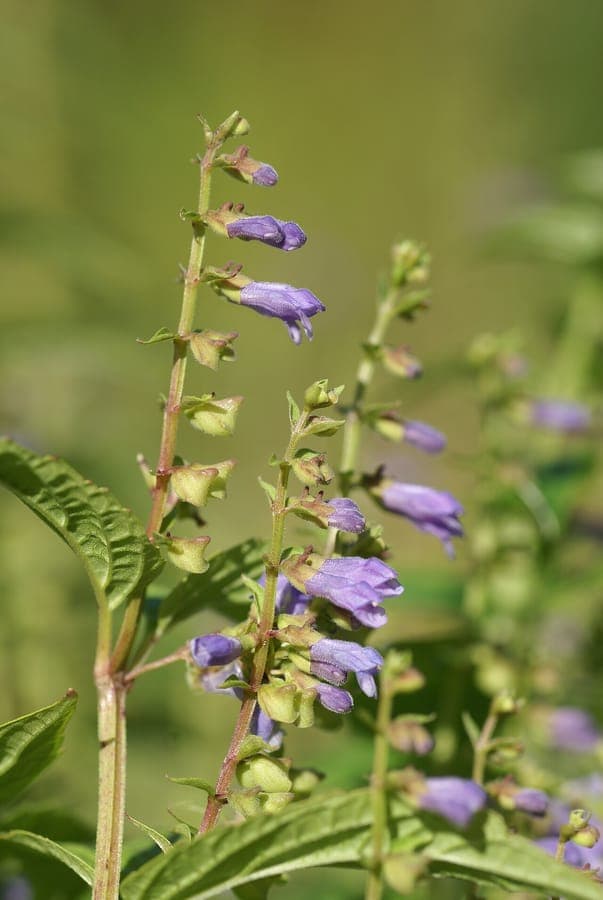
Rolf Engstrand / CC BY-SA 3.0, via Wikimedia Commons
Scullcap: complete guide
Scutellaria lateriflora
Want to see Scullcap: complete guide in your garden?
1 minute, no credit card
Overview
Side-Flowering Skullcap (Scutellaria lateriflora), also called Mad-Dog Scullcap or Blue Skullcap, is an herbaceous plant native to North America. This plant grows wild from Canada to the southern United States and has traditional use in indigenous medicine.
With its compact growth, delicate purple flowers, and robust nature, this plant is ideal for gardeners wanting something unique and functional. It attracts butterflies and bees and forms a valuable addition to herb gardens.
Appearance & bloom
Side-Flowering Skullcap grows as an herbaceous plant reaching 30-60 cm in height, usually more compact in cultivation. The structure is upright to slightly spreading, with thin, rough-textured stems.
Leaves are small, oval to lance-shaped, arranged oppositely, with fine texture. The flowers are the highlight: small, purple to blue flowers that remarkably appear along the stems (laterally), explaining the name 'lateriflora'.
Bloom progresses from early summer to early fall, with persistent flowering if spent blooms are removed. Small seeds form in capsule-like structures and self-sow readily.
Ideal location
Side-Flowering Skullcap is flexible in placement and thrives in varied conditions.
Optimal placement:
- Half sun to partial shade (truly ideal)
- Full sun is possible but may encourage drying
- Full shade results in weaker growth
- Protected environment not essential
Unlike many other salvias, this plant tolerates moister soils.
Soil
Side-Flowering Skullcap is very flexible regarding soil type.
Ideal soil composition:
- Moderately moist garden soil
- pH range: neutral to slightly acidic (6-7)
- Tolerant enough for varied soils
- Can grow in wet soils (not ideal, but tolerable)
- Can also grow in drier soils
This plant naturally inhabits moister habitats, so regular moisture is beneficial.
Watering
Side-Flowering Skullcap needs regular water, especially during growing seasons.
At planting:
- Water thoroughly at planting
- Keep consistently moist for 4 weeks (not waterlogged)
Established plant:
- Regular water in spring and summer essential
- Less water in fall and winter
- Plant tolerates some drought but doesn't truly thrive
- Can also grow in wetter soils
Tip: This plant prefers moisture over drought.
Free design
Want to see Scullcap: complete guide in your garden? Make a free design now.
Pruning
Side-Flowering Skullcap responds well to pruning.
Pruning techniques:
- Late winter/early spring: cut back to approximately one-third height
- Post-bloom: removing spent flowers stimulates more blooms
- Summer topping possible for bushier growth
Tip: This plant regrows after pruning and blooms more prolifically if spent flowers are removed.
Maintenance calendar
Spring (March-May)
- Perform light pruning
- Regular watering
- Growth and bloom begin
Summer (June-August)
- Regular water essential
- Remove spent flowers
- Possible summer topping
Fall (September-October)
- Continuing bloom possible
- Less water needed
- Begin dormancy
Winter (November-February)
- Plant dies back in colder climates
- In mild climates possibly evergreen
- Minimal pruning
Winter hardiness
Side-Flowering Skullcap is hardy in many climates:
- Survives to approximately -15 to -20 degrees Celsius
- In much of northern Europe, plant dies back to ground
- Regrows in spring
- In very mild climates, possibly evergreen
Winter protection normally unnecessary except in far northern regions.
Traditional uses
Side-Flowering Skullcap has traditional use:
- Calming properties (traditional use)
- For educational purposes only
- Consult health experts for medicinal applications
Note: This article is informational and not medical advice.
Butterfly and pollinator attraction
The plant attracts:
- Bees (especially wild bees)
- Butterflies (especially small species)
- Hoverflies
It is excellent for pollinator gardens.
Companion plants
Side-Flowering Skullcap combines well with:
- Other moisture-loving herbs (Mentha, Lemon Balm)
- Herbal plants (Tisane crops)
- Moisture-loving perennials (Pulmonaria, Hellebore)
- Ferns (in moist environments)
- Hostas and other shade plants
Together they create functional, pollinator-friendly herb and medicinal gardens.
Propagation
Side-Flowering Skullcap can be propagated via:
- Seed (self-sows readily)
- Stem cuttings (summer cuttings successful)
- Plant division in spring
Propagation is very easy.
Closing
Side-Flowering Skullcap is a valuable plant for modern gardens, especially for those wanting to grow herbs or having moister soils. With its purple flowers, winter hardiness, and pollinator appeal, it is a versatile plant that adapts to many garden specifications.
For more herb and medicinal plant ideas, visit gardenworld.app for inspiration and design suggestions.
Want to see Scullcap: complete guide in your garden? Make a free design now.
Upload a photo, pick a style, and get a photorealistic design with plant list in under a minute.
No credit card required


Similar plants
Purple Sage: complete guide
Salvia leucophylla
Discover Salvia leucophylla, a striking California native with silvery foliage and lavender-purple flowers. This drought-tolerant shrub is perfect for sunny, low-maintenance gardens in Mediterranean and xeriscape designs.
Cedar Sage: complete guide
Salvia roemeriana
Salvia roemeriana, the Cedar Sage, produces striking scarlet-red flowers that hummingbirds adore. This compact, hardy shrub blooms generously from spring through fall with minimal care, making it perfect for sunny gardens and wildlife borders.