
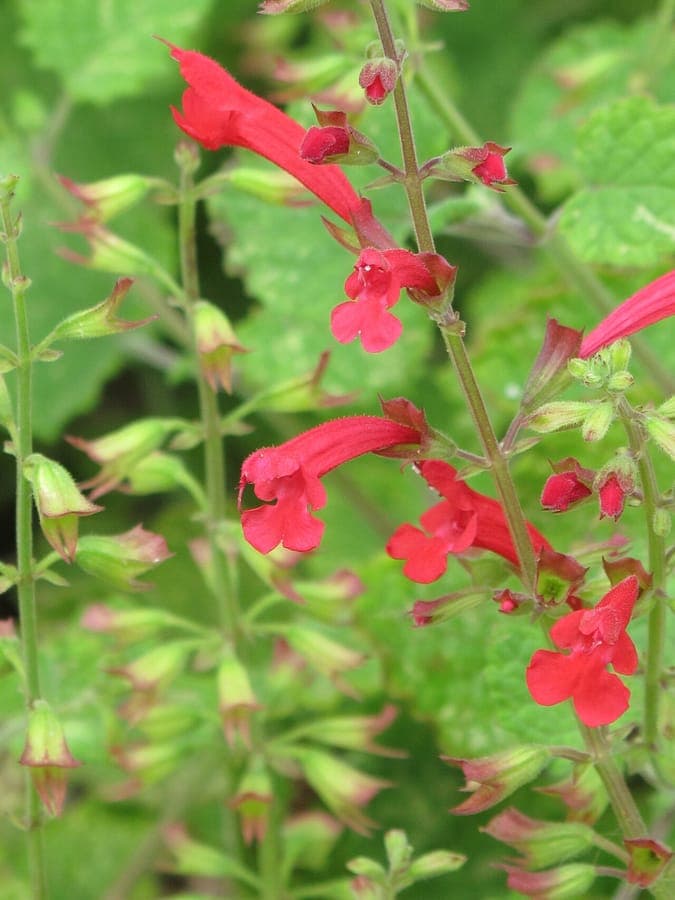
Scott Zona / CC BY 2.0, via Wikimedia Commons
Cedar Sage: complete guide
Salvia roemeriana
Want to see Cedar Sage: complete guide in your garden?
1 minute, no credit card
Overview
Cedar Sage (Salvia roemeriana), also called Roemer's Sage, is a compact herbaceous plant native to Texas and northeastern Mexico. With its striking scarlet-red flowers that attract hummingbirds and butterflies, this plant brings vitality and movement to the garden throughout an extended spring-to-fall bloom season.
Growing naturally in dry, rocky areas along waterways, Cedar Sage is remarkably adaptable and resilient. It is prized by bird-watchers for the hummingbirds it attracts and by gardeners for its lengthy, successive flowering habit.
Appearance & bloom
Cedar Sage grows as a herbaceous plant reaching 45-75 cm in height, making it more compact than many other salvias. Leaves are dark green, lance-shaped, and rough-textured.
The flowers are the absolute highlight: scarlet to fire-red, angular and tubular in form, exactly the shape hummingbirds seek. They emerge in loose racemes along the stems from May through October in mild climates. Flowers persist attractively after pollination, enabling successive bloom flushes rather than single flowering events.
Seed matures in small capsular structures and self-sows readily under favorable conditions.
Ideal location
Cedar Sage thrives in full sun to light partial shade. Aim for 5-6 hours of direct sunlight daily; more sun promotes denser growth and more intense flower color.
This plant excels in:
- Hummingbird gardens (specially designed for hummingbirds)
- Sunny borders and shrub plantings
- Dry slopes and xeriscape designs
- Container cultivation (excellent choice)
- Reinforced plantings against walls or hedges
Note: In very hot climates, afternoon shade helps prevent wilting.
Soil
Cedar Sage is flexible regarding soil type but thrives in well-draining ground.
Ideal soil composition:
- Moderately draining garden soil (avoid heavy clay)
- pH neutral to slightly acidic (6-7.5)
- Not excessively moist
The plant is tolerant enough to grow in varied soils, even poorer earth, making it extremely flexible for different garden conditions.
Free design
Want to see Cedar Sage: complete guide in your garden? Make a free design now.
Watering
Cedar Sage is drought-tolerant and handles dry spells well.
At planting (spring/fall):
- Water thoroughly at planting
- Keep consistently moist for 4 weeks (not waterlogged)
Established plant:
- In average rainfall areas, supplemental water often unnecessary
- Water during extreme dry spells exceeding 3 weeks
- Regular water promotes better bloom and vigor
Tip: Better underwatered than overwatered; this plant tolerates drought better than wetness.
Pruning
Cedar Sage responds beautifully to pruning, improving form and stimulating bloom.
Pruning techniques:
- Late winter/early spring: cut back to approximately one-third height
- Post-bloom: remove spent flowers for neater appearance
- Summer pruning: tip back stems for bushier growth
Tip: This plant flowers on new wood, so pruning promotes bloom.
Maintenance calendar
Spring (March-May)
- Perform light pruning
- Remove dead wood
- Flowers begin
Summer (June-August)
- Keep consistently moist
- Remove spent flowers
- Possible second pruning for extra bloom
Fall (September-October)
- Continuing bloom
- Light pruning
- Begin winter preparation
Winter (November-February)
- In mild climates, possible continued bloom
- Minimal pruning
Winter hardiness
Cedar Sage is moderately hardy:
- Survives to approximately -5 to -7 degrees Celsius
- In mild winter climates (northwest Europe) often overwinters but twig damage likely
- In harsh climates, significant frost damage occurs
In cold regions, grow in containers (overwinter under protection).
Companion plants
Cedar Sage combines beautifully with:
- Other red-flowering plants (Asclepias, Monarda)
- Yellow bloomers (Coreopsis, Rudbeckia)
- Silver-foliaged plants (Artemisia, Santolina)
- Purple bloomers (Salvia nemorosa, Catananche)
- Ornamental grasses (Muhly grass, Festuca)
Together they create vibrant, hummingbird-attracting borders.
Closing
Cedar Sage is perfect for gardeners wanting to attract hummingbirds or simply seeking a long-blooming, low-maintenance plant. With its brilliant red flowers and compact habit, it enlivens every sunny garden.
For more planting ideas and designs, visit gardenworld.app to discover how to create blooming borders and wildlife gardens.
Want to see Cedar Sage: complete guide in your garden? Make a free design now.
Upload a photo, pick a style, and get a photorealistic design with plant list in under a minute.
No credit card required


Similar plants
Purple Sage: complete guide
Salvia leucophylla
Discover Salvia leucophylla, a striking California native with silvery foliage and lavender-purple flowers. This drought-tolerant shrub is perfect for sunny, low-maintenance gardens in Mediterranean and xeriscape designs.
Scullcap: complete guide
Scutellaria lateriflora
Scutellaria lateriflora, the Side-Flowering Skullcap, is a hardy North American herb with delicate purple flowers. Drought-tolerant once established and attractive to pollinators, this versatile plant thrives in both sun and partial shade gardens.