
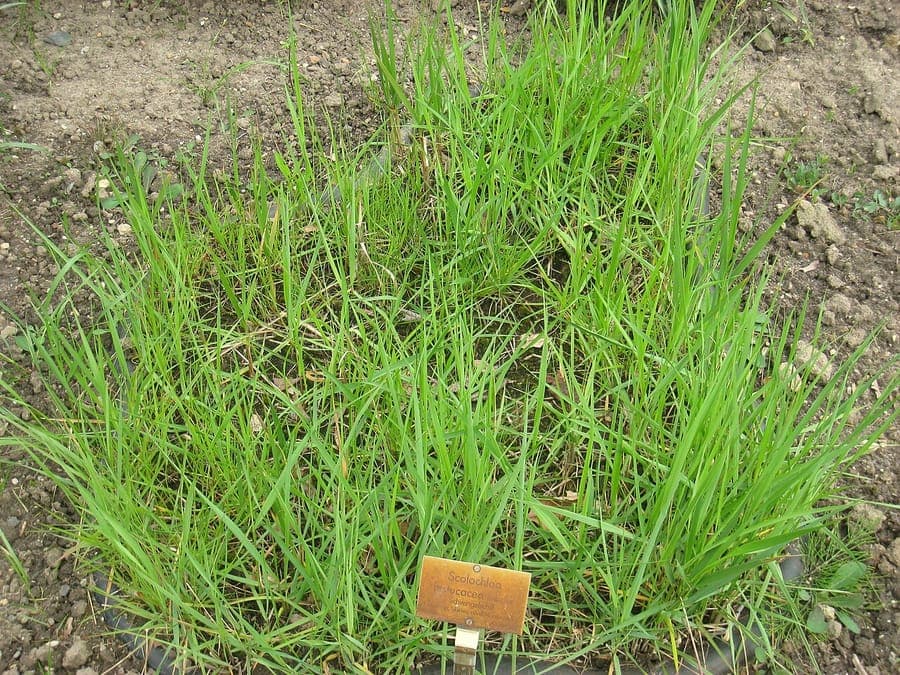
Daderot / Public domain, via Wikimedia Commons
Common rivergrass: complete guide to Scolochloa festucacea
Scolochloa festucacea
Want to see Common rivergrass: complete guide to Scolochloa festucacea in your garden?
1 minute, no credit card
Overview
Scolochloa festucacea, known in English as common rivergrass, sprangletop or whitetop, is a rhizomatous grass in the family Poaceae. It is native to an enormous range stretching from northern and central Europe through Siberia and Kazakhstan to Mongolia, and across the Pacific to Alaska, subarctic Canada and the northern United States. In Europe, wild populations are found in Germany, Poland, the Baltic States, Finland and Sweden, growing along river banks, lake shores and wetland margins.
For the garden, Scolochloa festucacea is a robust choice for wet, boggy spots at the edge of a pond or along a watercourse. It is not as well known as common reed (Phragmites australis) or bulrush (Typha), but it is every bit as structural and, in many ways, easier to manage in a smaller garden setting. On gardenworld.app you can upload a photo of your pond or garden and receive tailored design ideas incorporating native water plants and wetland grasses.
Appearance and bloom cycle
Scolochloa festucacea is a tall, upright grass reaching 100 to 180 cm under good conditions. The stems are sturdy, hollow and erect, similar in structure to common reed but slightly narrower and more graceful. The leaves are long, narrow and dark green with a fine texture that sways attractively in the breeze. The ligule (the junction between leaf blade and sheath) is a useful identifying feature.
Flowering occurs from June to August. The inflorescence is an open, loosely spreading panicle, initially light green and becoming brownish as the seeds ripen. The panicles are less showy than those of miscanthus or Phragmites but have a light, airy quality that blends well with other marginal plants.
As a rhizomatous grass, Scolochloa festucacea spreads vegetatively via its root system. In an open, unrestricted pond margin it can expand into large, dense colonies over several years. In a smaller pond garden, a rhizome barrier is advisable to keep it in check.
Ideal location
Full sun is optimal. The plant thrives in open, unshaded positions and grows naturally in exposed wetland habitats far from any tree canopy. Semi-shade is tolerated but results in less vigorous growth and fewer flowering stems. Avoid deeply shaded sites.
In terms of water depth, Scolochloa festucacea is flexible: it grows well in wet soil right at the water's edge and also in shallow water up to 30 cm deep. Its rhizomes spread through both wet and moist soil. Do not plant in dry conditions - this grass is not drought-tolerant and will decline quickly if the soil dries out for extended periods.
Soil requirements
Scolochloa festucacea is undemanding in terms of soil composition. It grows in clay-rich, silty bank soils as well as in sandier substrates along rivers. The soil pH tolerance is wide: 5 to 8, making it adaptable to both acidic and alkaline conditions. Nutrient-rich soil - such as fertile pond mud or clay-heavy bank substrate - promotes the most vigorous growth.
No special soil preparation is needed when planting at a pond margin or along a watercourse. Anchoring in bankside soil or in mesh planting baskets with aquatic compost works well. Use clay-based aquatic compost without added fertiliser: excessive nutrients in pond water encourage algal growth, which is counterproductive.
Free design
Want to see Common rivergrass: complete guide to Scolochloa festucacea in your garden? Make a free design now.
Watering
As a true aquatic marginal grass, Scolochloa festucacea needs no separate watering when planted at or in a pond or watercourse. Ensure the roots have continuous access to water throughout the year. During dry spells in summer, when water levels drop, the plant can temporarily stand in drier conditions, but prolonged drought is harmful.
When grown in a moist garden bed away from open water, water as soon as the top layer of soil begins to dry out. In dry summer periods this may mean watering twice a week. A thick mulch of organic material helps retain moisture and keeps the root zone cool.
Pruning
In early spring, when new green growth begins to emerge from the base, cut back last season's dead brown stems to 10 to 15 cm above the soil or water surface. The standing brown stems do have some winter ornamental value: they sway in the wind and provide rustic structure during the colder months. They also serve as shelter and nesting material for overwintering insects and birds.
If the plant spreads too aggressively via rhizomes, cut back the outer runners in autumn or early spring using a sharp spade. Remove the severed rhizome sections completely - any piece left in the ground can regrow.
Maintenance calendar
- January - February: Winter rest. Brown stems standing. No maintenance needed.
- March: New green growth emerges. Cut back old stems to 10 to 15 cm.
- April - May: Rapid growth. Check that the plant is not spreading beyond its intended zone.
- June - August: Flowering period. Light green panicles visible. Full growth.
- September: Panicles ripen. Seeds disperse. Trim back overly wide runners if needed.
- October - November: Growth stops. Plant ready for winter. Leave old stems standing.
- December: No maintenance. Stems provide structure and wildlife habitat.
Winter hardiness
Scolochloa festucacea is exceptionally cold-hardy. It is native to arctic and subarctic regions - from Alaska and Yakutia to Scandinavia - and survives the coldest European winters without difficulty. USDA hardiness zones 3 to 7 apply. In UK, Belgian and Dutch gardens there are no winter problems whatsoever: the plant dies back to ground level after the first hard frosts but regrows vigorously from the rootstock in spring. Submerged roots remain intact even under ice.
Companion plants
Scolochloa festucacea combines naturally with other marginal and wetland plants. Yellow flag iris (Iris pseudacorus), purple loosestrife (Lythrum salicaria), marsh sedge (Carex acuta) and bulrush (Typha latifolia or Typha angustifolia) are all good companions that tolerate identical water conditions. Together they create a varied, naturalistic marginal planting that is valuable for birds, insects and amphibians.
For a wilder, more naturalistic effect, combine with common reed (Phragmites australis) and great reedmace. Bear in mind that all these plants are vigorous spreaders and will eventually compete for space without some form of containment.
On gardenworld.app you can get a personalised design based on a photo of your pond or garden, with specific recommendations for native water plants and decorative grasses suited to your exact situation.
Final thoughts
Scolochloa festucacea is not a plant you will find in the average garden centre section - look for it at specialist aquatic plant nurseries or through online retailers focused on native water plants. It rewards the gardener with robust, winter-hardy structure that demands very little care once established. For pond margins, wet ditch edges or bog gardens, it is one of the most reliable choices available: strong-growing, tolerant of both wet winters and summer dry spells, and providing year-round structure and ecological value.
Want to see Common rivergrass: complete guide to Scolochloa festucacea in your garden? Make a free design now.
Upload a photo, pick a style, and get a photorealistic design with plant list in under a minute.
10,000+ gardens designed already
No credit card required


Similar plants
Sporobolus pungens: complete guide
Sporobolus pungens
Sporobolus pungens is a stoloniferous Mediterranean coastal grass with outstanding salt and drought tolerance, perfect for seaside and dry gardens.
Mediterranean aegilops: complete guide
Aegilops biuncialis
Everything about Aegilops biuncialis, a Mediterranean annual grass with ornamental spikes and outstanding drought tolerance for dry gardens.
Silver bluestem: complete guide
Bothriochloa saccharoides
Full guide to Bothriochloa saccharoides (silver bluestem): site, soil, watering, winter hardiness, pruning, and garden companions.