
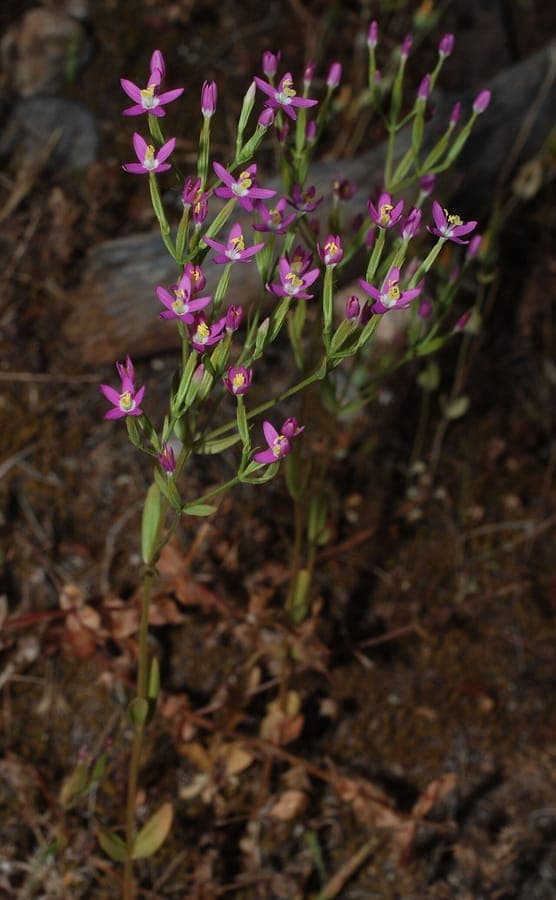
Tigerente / CC BY-SA 3.0, via Wikimedia Commons
Spiked centaury: complete guide
Schenkia spicata
Want to see Spiked centaury: complete guide in your garden?
1 minute, no credit card
Overview
Schenkia spicata, commonly known as spiked centaury or branched centaury, is a slender annual or biennial plant belonging to the gentian family (Gentianaceae). Native to the Mediterranean basin, the Caucasus, Central Asia and as far east as Pakistan and Afghanistan, this wild flower has been quietly admired by botanists and enthusiastic gardeners for its intense purple-pink star-shaped blooms and its ability to thrive in the harshest, driest conditions. If you enjoy planting authentic wildflower meadows or dry Mediterranean gardens, gardenworld.app offers design tools to help you find the ideal composition for your outdoor space.
The plant was reclassified from Centaurium to Schenkia in 2004, following molecular studies that distinguished it from the more familiar common centaury (Centaurium erythraea). Its most widely used former name, Centaurium spicatum, is still encountered in older horticultural literature. The specific epithet spicata refers to the spike-like flower arrangement - a distinctive feature that sets it apart from its rounded-clustered relatives. In the wild it grows on coastal dunes, dry hillsides, rocky limestone pastures and salt-influenced flats across a vast geographic range spanning from Portugal to Uzbekistan.
Appearance and bloom cycle
Spiked centaury reaches a height of 10 to 40 cm, forming a slender erect stem that branches in its upper section. The leaves are oblong-ovate, stalkless and bright green with a slight gloss. The flowers are small, five-petalled stars in a vivid rose-purple to magenta colour, arranged in a narrow spike-like inflorescence that gives the plant its name. Individual flowers open for only a few hours each day - typically in the morning sunshine - but the plant continuously produces fresh buds from June through September.
The bloom period peaks in July and August. The flowers are attractive to bees, butterflies, hoverflies and other pollinators. After flowering, small oblong seed capsules develop, each containing numerous minute seeds. In suitable conditions the plant self-seeds generously and returns season after season without any intervention.
In autumn the plant dries to a warm brown, leaving upright stems with decorative seed heads that provide subtle winter structure in the garden.
Ideal location
Spiked centaury demands full sun and performs poorly in shade. It thrives in open, warm positions: rock gardens, gravel beds, dry limestone banks, Mediterranean herb gardens and wildflower borders. The plant is well suited to south-facing slopes where reflected heat creates the warm, dry micro-climate it evolved for.
Avoid planting it in sheltered corners where moisture lingers or in positions shaded by taller plants. Competition from vigorous neighbours can quickly overwhelm this relatively small plant. An open planting arrangement with generous spacing allows airflow around the stems and keeps the root zone from becoming too moist.
In temperate north-western Europe (the Netherlands, Belgium, northern France, the UK) the species benefits from a sheltered south-facing position close to a wall or stone paving, which stores heat and ensures faster spring drying after rain.
Soil
Schenkia spicata thrives on poor, sharply drained soils with a pH between 6.5 and 7.0. It grows naturally on calcareous (limestone-derived), sandy and stony substrates. Clay-rich, nutrient-dense or poorly drained soils cause root rot and should be amended significantly or avoided altogether.
When planting in average garden soil, mix in a generous amount of coarse sand, fine grit and gravel to improve drainage. A surface mulch of gravel or crushed stone around the base of the plant helps maintain the dry conditions it prefers and prevents the stem from sitting in moisture after rainfall.
Do not add fertiliser. Excess nitrogen promotes lush leafy growth at the expense of flowering and reduces the plant's natural resistance to disease. Lean soil is the key to abundant blooms.
Free design
Want to see Spiked centaury: complete guide in your garden? Make a free design now.
Watering
Once established, spiked centaury is highly drought tolerant and typically requires no irrigation beyond rainfall in most temperate climates. During the first few weeks after planting or germination, water regularly to help the roots establish, then reduce watering sharply.
The number-one cause of failure with this plant is overwatering. Waterlogged soil - particularly in autumn and winter - leads rapidly to crown rot. As a rule of thumb: if in doubt, do not water. Even during prolonged summer dry spells of three to four weeks, established plants usually cope without irrigation. In container culture, use a gritty, fast-draining potting mix and wait until the top few centimetres are completely dry before watering again.
Pruning
Little pruning is needed. After the main flowering period you can cut spent stems back by half in August to encourage a second flush of smaller blooms in September. Alternatively, leave the dried stems standing through winter for seed dispersal and decorative effect.
If you want to limit self-seeding, remove the stems before the seed capsules split, in late August or early September. In spring, pull out any dead stems and lightly loosen the soil surface to give space to self-sown seedlings.
Maintenance calendar
January - February: No action needed. Leave dry stems for winter interest.
March: Remove dead stems. Identify and thin self-sown seedlings if there are too many.
April: Direct sow seeds on prepared, raked ground or transplant young pot-grown plants.
May: Growth accelerates. No feeding required. Check for slug damage on young plants.
June: First flowers open. Begin enjoying the display.
July - August: Peak flowering. Minimal watering during extreme drought only. Optional light trim to stimulate further blooms.
September: Bloom ends. Seed capsules ripen. Decide whether to leave for self-seeding or remove stems.
October - November: Plant dies back. Leave stems for winter structure.
December: No action needed.
Winter hardiness
Schenkia spicata behaves as an annual or biennial. As a flowering adult plant it is not reliably frost hardy, but its seeds survive winter in the ground without difficulty. Young basal rosettes formed in autumn can sometimes survive mild winters in sheltered positions.
In USDA hardiness zones 6 and warmer the plant may behave as a short-lived perennial. In zone 5 and colder, treat it as an annual and allow self-seeding or collect and sow seeds each spring. A light protective mulch of dry grit or gravel over young rosettes in November helps increase winter survival rates.
In Atlantic coastal climates - southern England, the Belgian and Dutch coast - the plant sometimes persists through mild winters and re-sprouts from the base in spring.
Companion plants
The slender upright habit and purple-pink flowers of spiked centaury pair beautifully with:
- Lavandula angustifolia (English lavender): identical cultural requirements, complementary purple colour range.
- Salvia officinalis (common sage): grey-green foliage forms a soft backdrop for the intense flower colour.
- Thymus vulgaris (thyme): low-growing ground cover that protects the dry soil surface.
- Stachys byzantina (lamb's ears): silver-felted leaves provide a cool contrast to the vivid blooms.
- Dianthus carthusianorum (Carthusian pink): similar dry-meadow habitat requirements, warm rose tones.
- Sedum acre (biting stonecrop): tough succulent for rocky and gravelly spots alongside the centaury.
Avoid vigorous, spreading plants that will overshadow the small centaury. Spare, low planting gives it the light and space it needs to perform. Visit gardenworld.app to explore garden designs tailored to dry, sunny positions.
Closing
Schenkia spicata is a quietly remarkable plant - small in stature but generous in bloom and ecological value. Its intense purple-pink flowers bring weeks of colour to the rock garden, gravel bed or dry wildflower border from June to September, while its minimal maintenance requirements make it a gift to the busy gardener. It asks only for full sun, lean well-drained soil and the occasional admirer. Allow it to self-seed and it will reward you with an ever-expanding colony that becomes more impressive each year. For personalised garden design featuring drought-tolerant Mediterranean plants, gardenworld.app can help you create a space that looks beautiful and thrives with minimal intervention.
Want to see Spiked centaury: complete guide in your garden? Make a free design now.
Upload a photo, pick a style, and get a photorealistic design with plant list in under a minute.
10,000+ gardens designed already
No credit card required


Similar plants
European centaury: complete guide
Centaurium erythraea
Grow European centaury (Centaurium erythraea) in full sun with well-drained soil. A delicate annual herb with purple summer blooms, perfect for dry gardens and gravel beds.
Gentiana acaulis: complete guide
Gentiana acaulis
Stemless gentian offers spectacular deep-blue trumpet flowers close to the ground. An alpine jewel for rock gardens and shaded borders.
Sage: complete guide
Salvia officinalis
Everything you need to grow and care for Salvia officinalis: ideal spot, soil needs, pruning, and winter hardiness for gardens in temperate climates.