
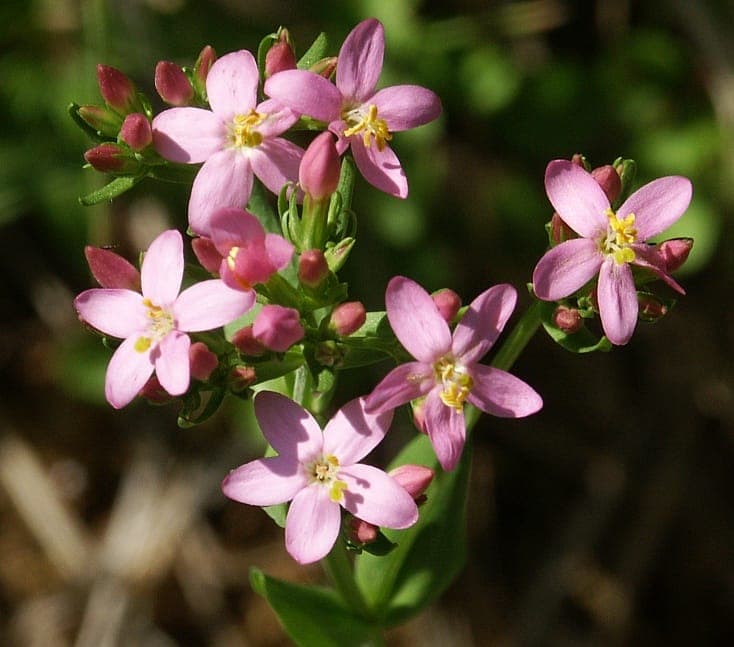
Picture taken by BerndH / CC BY-SA 3.0, via Wikimedia Commons
European centaury: complete guide
Centaurium erythraea
Want to see European centaury: complete guide in your garden?
1 minute, no credit card
Overview
European centaury (Centaurium erythraea) is a dainty, short-lived annual herb that brings a splash of colour to dry, sunny corners of the garden. Native across southern and central Europe, North Africa, and parts of western Asia, it naturally colonises grasslands, roadside banks, and stony fields. In UK and northern European gardens, it thrives in well-drained, low-fertility soils where many other plants struggle. Standing 10–30 cm tall, it's perfect for the front of borders, rock gardens, or gravel schemes.
On gardenworld.app, you can design a drought-friendly planting plan that integrates European centaury with other sun-loving, low-water species for a resilient, seasonal display. Its compact form and long bloom period make it a reliable performer in informal or wildlife-focused gardens.
Appearance & bloom cycle
This herb forms upright, branching stems with narrow, lance-shaped green leaves arranged in opposite pairs. The real show begins in June, when clusters of small, star-like flowers emerge at the top of the stems. Each bloom is about 1 cm wide, featuring five vivid purple petals with a contrasting dark central eye. They open only in direct sunlight - closing at dusk or under cloud cover - which adds a dynamic, responsive element to your garden.
Flowering continues from June through September, peaking in July and August. The plant is self-seeding, so if you leave some seed heads intact, you'll often see new plants appear the following spring. Deadheading encourages more blooms, but leaving a few plants to set seed ensures natural regeneration.
Ideal location
European centaury demands full sun - a solid 8 out of 10 on the light scale. Choose a south- or southwest-facing spot that receives at least 6–8 hours of direct sunlight daily. It performs exceptionally well in hot, sheltered microclimates, such as against stone walls, in rock crevices, or in raised beds with good exposure.
Avoid shady or damp areas. In partial shade, the stems become leggy, flowering is sparse, and the plant may rot. For urban gardens, it works beautifully in gaps between paving stones or in container arrangements with other drought-tolerant plants like sedums or thymes.
Soil requirements
Well-drained, sandy, or gravelly soil is essential. Heavy clay soils must be amended with horticultural grit or sharp sand to improve drainage. The ideal pH range is 6.5 to 7 - slightly acidic to neutral. Avoid rich, compost-heavy soils; European centaury actually blooms better in poor, lean conditions. Too much fertility leads to lush foliage but fewer flowers.
For containers, use a mix of 60% loam, 30% sand, and 10% perlite. Ensure pots have drainage holes, and add a base layer of gravel to prevent waterlogging.
Free design
Want to see European centaury: complete guide in your garden? Make a free design now.
Watering
Once established, European centaury is highly drought-tolerant. Water only during prolonged dry spells in the first four weeks after sowing or transplanting. After that, rainfall is usually sufficient. Overwatering is a common mistake and leads to root rot, especially in cool, wet summers.
Water at the base to keep foliage dry and reduce the risk of fungal diseases. Avoid overhead watering, particularly in humid conditions.
Pruning
Pruning isn't required, but light deadheading can extend the blooming period and promote self-seeding. Cut back spent flower heads with clean snips, leaving lower growth intact. In late autumn, cut back any remaining stems to tidy the bed, or leave them to self-seed naturally.
If you're aiming for a neater, controlled look, remove all plant debris in October. For a wilder, naturalistic style, let the seed heads stand through winter - they add texture and support small insects.
Maintenance calendar
- February–March: Start seeds indoors at 18°C in seed trays filled with sandy compost. Keep in bright light.
- April–May: Harden off seedlings and plant out after the last frost (typically late May in the UK). Space plants 15 cm apart.
- June–September: Monitor during dry spells. No feeding needed.
- October: Cut back or leave for self-seeding. Collect seeds if desired.
- November–January: No action. The plant is annual and completes its lifecycle.
Use gardenworld.app to generate a custom maintenance calendar synced to your local weather and hardiness zone (USDA 6–9).
Winter hardiness
As an annual, European centaury dies back fully in autumn. However, its seeds are cold-hardy and remain viable in the soil through winter. They germinate in spring when soil temperatures exceed 12°C. No winter protection is needed, and mulching should be avoided as it can smother emerging seedlings.
Companion plants
Pair European centaury with other drought-tolerant species such as Sedum 'Autumn Joy', Achillea millefolium, Thymus vulgaris, or Teucrium chamaedrys. It contrasts beautifully with silvery foliage plants like Artemisia schmidtiana or Stachys byzantina. Avoid aggressive spreaders like mint or goldenrod that could overwhelm it.
Closing
European centaury is a quiet achiever in the garden - unassuming but persistent, with a long bloom season and minimal demands. Its love of sun and dry soil makes it ideal for xeriscaping, green roofs, or gravel gardens. Seeds are widely available at garden centres across the UK, or you can source them online from native plant suppliers. With the right placement and a little patience, this charming herb will return year after year by self-seeding. Whether you're restoring a wildflower patch or designing a low-maintenance front garden, Centaurium erythraea earns its place. Check gardenworld.app for layout ideas that highlight its seasonal rhythm and natural charm.
Want to see European centaury: complete guide in your garden? Make a free design now.
Upload a photo, pick a style, and get a photorealistic design with plant list in under a minute.
No credit card required


Similar plants
Branched gentianella: complete guide
Gentianella ramosa
Full growing guide for Gentianella ramosa, the branched Alpine gentianella of the SW Alps - location, soil, watering, winter care and companion plants.
Spiked centaury: complete guide
Schenkia spicata
Full growing guide for Schenkia spicata (spiked centaury): sunny position, dry soil, bloom season and garden companions.
Narrow-leaf gentian: complete guide
Gentiana angustifolia
Narrow-leaf gentian growing guide: intense blue trumpet flowers in May-July on well-drained limestone. Full cultivation tips.