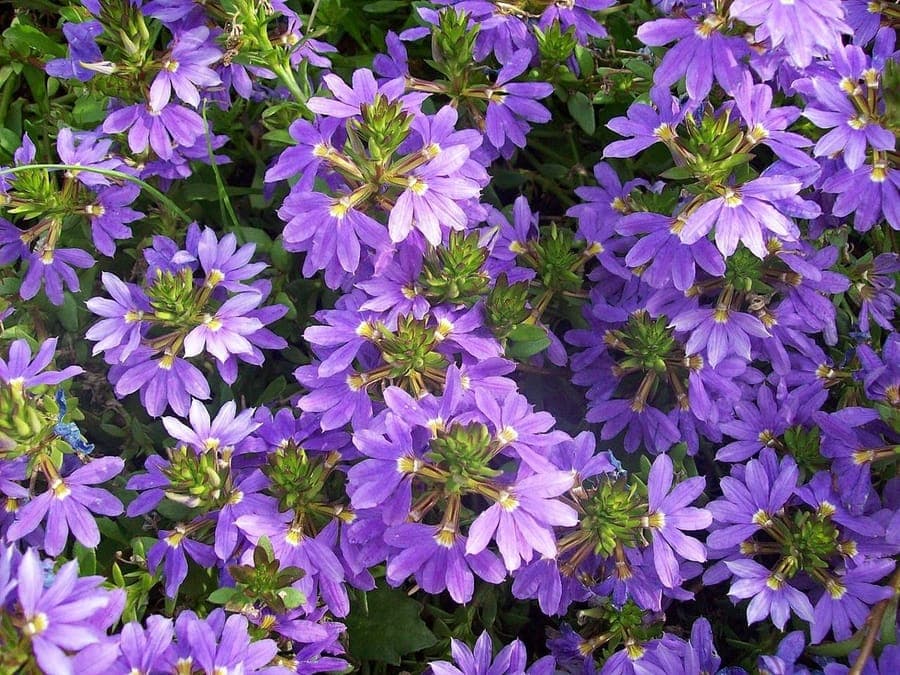
Nemracc / CC BY-SA 3.0, via Wikimedia Commons
Fairy fan-flower (Scaevola aemula): complete guide
Scaevola aemula
Want to see Fairy fan-flower (Scaevola aemula): complete guide in your garden?
Full design in HD: €7.99
Look after your Fairy fan-flower with the GardenWorld app
Identify plants with your camera and get a care calendar with reminders for this plant.


Overview
Fairy fan-flower (Scaevola aemula) has earned its place as one of the most reliable trailing plants for baskets, window boxes and patio pots. From May until the first frost it is smothered in violet-blue flowers that look as if someone has cut them in half: all five petals sit on one side, spread out like an open fan. That shape gives the plant its common name, and the genus name hints at it too. Scaevola comes from the Latin scaevus, meaning left-handed, a nod to the lopsided flowers.
Scaevola aemula belongs to the Goodeniaceae family and grows wild in south-eastern Australia, often on sandy, poor soils near the coast. There it is a low, sprawling perennial that reaches about 50 cm. In Britain and the rest of north-western Europe it is not hardy, so most gardeners treat it as summer bedding, although it can be overwintered with a little effort.
What makes fan flower so popular is its toughness. It copes with heat, wind and the odd missed watering better than most container plants, and it drops its spent flowers on its own, so there is no deadheading to do. Well-known cultivars include 'Blue Wonder' and 'Saphira' (classic violet-blue), 'Bombay White' and the Surdiva series in blue, lilac, pink and white. On gardenworld.app you can have a garden design made that finds the right spot for fan flower, whether in hanging baskets, troughs or along the front of a sunny border.
Appearance and bloom cycle
The plant produces long, trailing or creeping stems 40 to 60 cm in length. In a hanging basket they spill gracefully over the edge; planted in the ground they form a low mat 15 to 25 cm high. The stems are slightly hairy and become a little woody at the base as the plant ages.
The leaves are fresh green, oblong to oval, 2 to 5 cm long and coarsely toothed along the margin. They are spaced along the stems and stay healthy all season as long as the plant gets enough light.
The flowers are 2 to 3 cm across and appear in the leaf axils along the full length of every stem. Each has five narrow, pointed petals fanning out in a half-circle around a yellow or white throat. The photo shows how tightly they pack together on a well-grown plant: a carpet of violet-blue dotted with small yellow eyes. Flowering starts in May and carries on without a break until October, sometimes until the first frost. Bees, bumblebees and hoverflies are regular visitors.
Ideal location
Fan flower is a sun lover. Give it at least six hours of direct sun a day for the best display. A south- or west-facing balcony, a sunny windowsill box or a basket on a bright wall is perfect. It will grow in light shade, but flowering drops off noticeably and the stems become long and floppy.
Wind and rain are rarely a problem. The flowers are robust and do not collapse after a downpour the way petunias sometimes do, which makes fan flower a good choice for exposed balconies and coastal gardens.
Use it in hanging baskets, window boxes, bowls and large pots, or as ground cover at the front of a sunny border. Space plants about 25 cm apart in containers.
Compost and soil
Choose a good-quality, free-draining multipurpose or container compost. Scaevola aemula prefers slightly acidic to neutral conditions, with a pH between 5.5 and 6.5. In chalky soil, or when watered with hard tap water, the young leaves turn yellow between green veins. This is iron deficiency (chlorosis): the plant struggles to take up iron in alkaline conditions. If your water is hard, use rainwater where possible or give an occasional feed with added iron.
Always make sure excess water can drain away. A hole in the bottom of the container and a layer of clay pebbles prevent the roots from sitting in water. For this Australian plant, wet feet are a far greater danger than a few dry days.
In open ground, fan flower does best on light, sandy or sandy loam soils.
Free preview
Want to see Fairy fan-flower (Scaevola aemula): complete guide in your garden? Make a free preview of your design.
Watering and feeding
Although fan flower tolerates drought better than many container plants, a hanging basket dries out quickly in summer. Water as soon as the top few centimetres of compost feel dry. On hot days that often means daily for baskets and every two or three days for larger troughs. Let the compost dry slightly between waterings, and water thoroughly rather than little and often.
If the plant wilts after a missed watering it usually perks up within an hour. Do not leave it standing in a saucer of water, though, as the roots will rot.
From June, feed every week or fortnight with a liquid fertiliser for flowering plants at half strength. Fan flower is not a hungry plant; too much feed produces lush leaves and long stems at the expense of flowers. Stop feeding in September.
Pruning and pinching
Proper pruning is not needed. The plant is self-cleaning: faded flowers drop by themselves and new ones keep coming.
It does pay to pinch out young plants once after planting. Nip off the stem tips just above a pair of leaves so the plant branches out and becomes bushier. If it grows leggy and bare in the middle during July or August, cut the stems back by a third. Within two or three weeks it will be in full flower again.
Pests are unusual. Occasionally mealybugs or aphids appear; wash them off with a jet of water or remove them with a cotton bud. Root rot is almost always caused by overwatering.
Maintenance calendar
March-April: Move overwintered plants somewhere warmer and bright, and cut them back. Take cuttings from the new shoots if you want extra plants.
May: Only plant fan flower outdoors once the risk of frost has passed, usually from mid to late May. Pinch out young plants once.
June-July: Full flower. Water regularly and start feeding at half strength.
August: Cut back long, bare stems by a third. Take cuttings 5 to 8 cm long if you want to keep the plant.
September-October: Flowering continues until the frost. Stop feeding. Bring in plants you want to overwinter before the first frost.
November-February: Keep overwintering plants cool, bright and fairly dry, or compost them and buy new plants in spring.
Winter hardiness and overwintering
Scaevola aemula is not frost hardy. It is damaged around freezing point and will not survive more than a few degrees of frost. In the UK and the Low Countries it is therefore grown as an annual, even though it is a perennial by nature.
If you want to try overwintering, bring the plant in during October, cut it back to about 10 cm and keep it somewhere bright and cool, between 5 and 10 °C, such as a cold greenhouse or frost-free porch. Water just enough to stop the rootball drying out completely. In a warm living room it becomes weak and attracts aphids. Overwintering does not always succeed; taking cuttings in August and keeping the young plants cool and bright often gives better results.
Little is known about toxicity. There are no reports of poisoning in people or pets, but as with any ornamental plant it is sensible to stop children and animals from eating it.
Companion plants
The violet-blue of fan flower looks its best alongside yellow, white and silver. A classic pairing is ivy-leaved pelargonium (Pelargonium peltatum) in white or soft pink: two tough sun lovers that both shrug off heat. A white marguerite (Argyranthemum frutescens) in the centre of a large pot adds height while fan flower tumbles over the rim.
For silver accents, liquorice plant (Helichrysum petiolare) works beautifully; its grey felted leaves make the blue stand out even more. Golden creeping Jenny (Lysimachia nummularia 'Aurea') creates a fresh colour contrast in baskets, and white sweet alyssum (Lobularia maritima) fills the gaps between plants with honey-scented flowers.
For a calmer scheme, choose white and lilac varieties. Avoid partners that want shade and constant moisture, such as busy Lizzie, as their needs clash with those of fan flower.
Final thoughts
Fan flower is one of the few container plants you can almost forget about without it holding a grudge. Sun, a free-draining compost that never stays soggy and a little feed now and then are all it asks. There is no deadheading, and it flowers from May to October without pause.
When you plan your summer containers and baskets, check the planting calendar on gardenworld.app to see when it is safe to plant out and when to take cuttings. Hang a basket of fan flower on your sunniest wall this spring and enjoy its little blue fans all summer long.
Frequently asked questions about Fairy fan-flower
Is Fairy fan-flower winter hardy?
Scaevola aemula is not frost hardy. It is damaged around freezing point and will not survive more than a few degrees of frost.
When and how do you prune Fairy fan-flower?
Proper pruning is not needed. The plant is self-cleaning: faded flowers drop by themselves and new ones keep coming.
How much water does Fairy fan-flower need?
Although fan flower tolerates drought better than many container plants, a hanging basket dries out quickly in summer. Water as soon as the top few centimetres of compost feel dry.
Where does Fairy fan-flower grow best?
Fan flower is a sun lover. Give it at least six hours of direct sun a day for the best display.

See it in your garden
See Fairy fan-flower in your garden
One photo of your garden and a few questions. You see the result in about a minute.
Try it with a photoIdentify this plant in your own garden. Identify a plant
Similar plants
Ivyleaf geranium: complete guide
Pelargonium peltatum
Discover ivyleaf geranium, a practical hanging plant with purple and pink flowers. Learn about cultivation, pruning and winter storage in this guide.
Boston daisy: complete guide
Argyranthemum frutescens
Boston daisy is a prolific Canary Island shrub with vibrant green foliage and abundant flowers from spring through autumn. Ideal for borders, containers, and patio plantings.
Helichrysum petiolare: complete guide
Helichrysum petiolare
Helichrysum petiolare, the licorice plant, is a graceful trailing plant with silvery-gray foliage perfect for containers and hanging baskets.
