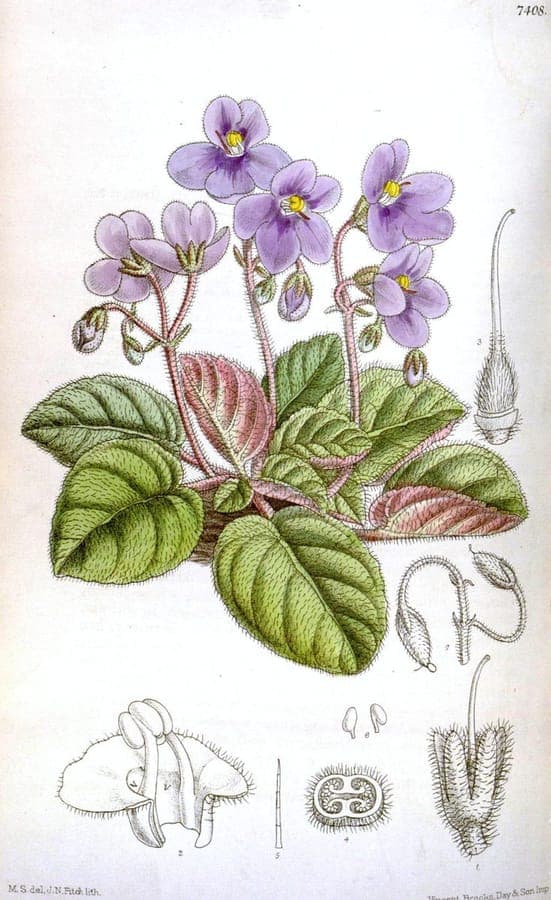
M. S. del. ( = Matilda Smith, 1854-1926), J. N. Fitch lith. ( = John Nugent Fitch, 1840–1927) Description by Joseph Dalton Hooker (1817—1911) Colour and contrast altered to remove paper yellowing by Peter coxhead / Public domain, via Wikimedia Commons
African violet (Saintpaulia ionantha): care guide
Streptocarpus ionanthus
Want to see African violet (Saintpaulia ionantha): care guide in your garden?
Full design in HD: €7.99
Look after your African violet with the GardenWorld app
Identify plants with your camera and get a care calendar with reminders for this plant.


Overview
The African violet has been one of the most popular flowering houseplants for more than a century. A neat rosette of soft, hairy leaves topped with clusters of purple, pink, blue or white flowers, almost all year round: few plants bloom so faithfully on a windowsill. Despite its name, it has nothing to do with true violets.
You probably know it as Saintpaulia ionantha. DNA research showed that the genus Saintpaulia sits right inside the genus Streptocarpus, and since 2015 the species has officially been called Streptocarpus ionanthus. In the trade and in everyday speech, 'saintpaulia' remains perfectly normal. The plant belongs to the Gesneriaceae, the same family as Cape primroses (Streptocarpus) and gloxinias.
In the wild the species grows in the mountain forests of Tanzania and south-eastern Kenya, especially in the Usambara and Nguru Mountains. It clings to shady rocks and slopes in a humid, even climate with neither frost nor great heat. Wild populations are small and threatened by deforestation. The old genus name honours Walter von Saint Paul-Illaire, a German colonial official who sent seed to Europe in 1892. Since then thousands of cultivars have been bred, with single, semi-double and double flowers, frilled or variegated leaves, plus miniature and trailing forms.
Although it is a houseplant, it can spend summer in a covered porch or conservatory. You can have a garden design made on gardenworld.app for your terrace or conservatory, so the spaces inside and out work well together.
Appearance and bloom cycle
A standard plant forms a flat rosette 20 to 30 cm across and 10 to 15 cm tall. The leaves are round to oval, fleshy and densely covered in fine hairs, which gives them a velvety feel. They are mid to dark green above and sometimes flushed red or purple underneath. The leaf stalks are brittle and snap easily if the plant is handled roughly.
The flowers are carried in small clusters on stems that rise just above the foliage. Each flower is 2 to 4 cm across with five petals, two smaller ones at the top and three larger ones below, and a striking pair of yellow anthers in the centre. The wild form is violet-blue. With good light and the right care an African violet flowers almost continuously, with short rests in between; each flush usually lasts six to eight weeks.
Ideal location
Light is the key to generous flowering. Choose a bright spot without harsh midday sun: an east-facing window is ideal, a north-facing one can work if it is bright enough, and in a south- or west-facing window set the plant back from the glass or behind a sheer curtain. Too much sun causes yellow or scorched patches on the leaves. Too little light shows as leaves reaching upwards, long leaf stalks and few or no flowers. In winter a small LED grow light above the plant can work wonders; African violets bloom best with 10 to 12 hours of light a day.
Give the pot a quarter turn every week so the rosette stays symmetrical. Avoid draughts and cold windowpanes in winter: leaves that touch cold glass turn glassy and die.
Potting mix
Use a specialist African violet compost or a light houseplant compost with about a fifth perlite added. The mix should be slightly acidic, around pH 6 to 6.5, and hold moisture well without compacting. The pot is smaller than you might expect: roughly a third of the width of the rosette. In an oversized pot the compost stays wet and the plant produces mostly leaves. Plastic pots work well here because they keep the moisture even.
Repot every spring into fresh compost, setting the plant so the lowest leaves sit just above the rim.
Free preview
Want to see African violet (Saintpaulia ionantha): care guide in your garden? Make a free preview of your design.
Watering
African violets like evenly moist compost but not wet roots. Water when the top centimetre feels dry, usually about once a week. Always use water at room temperature, as cold water on the leaves leaves pale spots and rings. Many growers water from below: stand the pot in a dish of water for half an hour, then let it drain thoroughly. If you water from above, aim beside the rosette rather than into its centre.
Wet leaves are not a disaster, but do not leave them wet in sun or cold. Humidity of about 50 % is ideal, and a tray of water and pebbles nearby helps in dry, heated rooms.
Care and propagation
From spring to autumn feed every two weeks with a quarter- to half-strength fertiliser for flowering plants or a specialist African violet feed. In winter, when growth slows, feed once a month. Remove faded flowers along with their stalks and take off the oldest lower leaves when they go limp or yellow. Pinch out side shoots that appear next to the main rosette, since a plant with a single crown flowers better.
Propagation is a real pleasure. Cut a healthy, medium-sized leaf with 2 to 3 cm of stalk at an angle and set it in a small pot of moist cutting compost or a glass of water. Roots appear within a few weeks, and after two or three months tiny plantlets emerge at the base of the stalk. Separate them once they have a few leaves each and pot them up individually. They flower after six to nine months.
Maintenance calendar
- January and February: give as much light as possible, perhaps with a lamp. Feed monthly.
- March and April: repot, remove old leaves and side shoots, take leaf cuttings.
- May to August: shade from strong sun, feed every two weeks, keep moisture even.
- September and October: move closer to the window again as light levels drop.
- November and December: watch out for cold panes and dry air from radiators.
In the plant calendar on gardenworld.app you can schedule repotting and feeding month by month so your African violet never misses a turn.
Temperature and overwintering
The African violet is a true houseplant and does not tolerate cold. Day and night temperatures between 18 and 24 °C are ideal. Below 15 °C growth stops, and colder still the leaves turn glassy. In summer it can at most go to a warm, covered, shady spot outdoors, but it usually looks better kept inside. Above 30 °C it suffers too: flowers become smaller and paler.
Common problems include mealybug in the leaf axils, thrips in the flowers and cyclamen mite, which makes the centre of the plant shrivel. Crown rot is caused by overwatering and turns the centre brown and mushy.
Toxicity to pets
The ASPCA lists the African violet as non-toxic to cats, dogs and horses, and no toxic compounds are known for people either. That makes it a safe choice for a windowsill in a home with animals or small children. Cats sometimes nibble the soft leaves, which does the cat no harm but does damage the plant. Do take care with fertilisers and pest treatments, which can be harmful if an animal licks them.
Companion plants
African violets like the company of other houseplants that want the same soft light and warmth. Begonia rex with its patterned leaves makes a fine contrast. Moth orchid (Phalaenopsis amabilis) and peace lily (Spathiphyllum wallisii) also enjoy a bright window without harsh sun, and Chinese money plant (Pilea peperomioides) fits in nicely. Florist's cyclamen (Cyclamen persicum) flowers alongside it in winter, though it prefers somewhat cooler conditions.
Final thoughts
Streptocarpus ionanthus, still Saintpaulia ionantha to most of us, is a small plant with a big heart. Give it bright light without harsh sun, room-temperature water, a small pot and regular light feeding, and it will reward you with fresh flowers year after year. A few leaf cuttings will also give you new plants to share in no time.
Frequently asked questions about African violet
How much water does African violet need?
African violets like evenly moist compost but not wet roots. Water when the top centimetre feels dry, usually about once a week.
Where does African violet grow best?
Light is the key to generous flowering. Choose a bright spot without harsh midday sun: an east-facing window is ideal, a north-facing one can work if it is bright enough, and in a south- or west-facing window set the plant back from the glass or behind a sheer curtain.

See it in your garden
See African violet in your garden
One photo of your garden and a few questions. You see the result in about a minute.
Try it with a photoIdentify this plant in your own garden. Identify a plant
Similar plants
King Begonia: complete guide
Begonia rex
The painted-leaf begonia, Begonia rex, is a spectacular foliage plant with incredible leaf patterns in silver, red, pink, and purple. Discover everything about care, propagation, and enjoying this prima donna of the plant world.
Phalaenopsis amabilis: complete guide
Phalaenopsis amabilis (L.) Blume
Phalaenopsis amabilis (Moon Orchid) is an elegant houseplant with gorgeous white flowers. Learn care, watering, and blooming techniques.
Peace lily: complete guide
Spathiphyllum wallisii
How to grow a peace lily (Spathiphyllum wallisii): light, watering, repotting, getting it to flower again, and why it is toxic to cats and dogs.
