
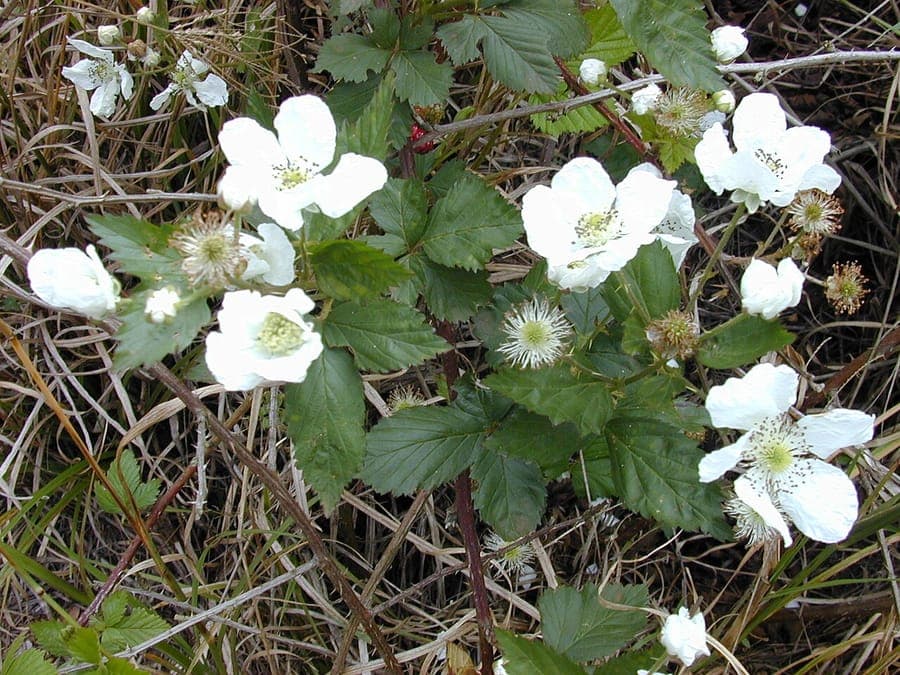
Forest & Kim Starr / CC BY 3.0, via Wikimedia Commons
Sawtooth blackberry (Rubus argutus): complete guide
Rubus argutus
Want to see Sawtooth blackberry (Rubus argutus): complete guide in your garden?
1 minute, no credit card
Overview
The sawtooth blackberry (Rubus argutus), also known as prickly blackberry or southern blackberry, is a robust native shrub from eastern and central North America. This compact shrub is a bird paradise, offering food, shelter, and nesting opportunities for bird species.
For people, this blackberry is also attractive. The black berries are edible and tasty, though they are not always equally sweet. In gardens, this plant offers a wild, natural beauty.
Appearance and bloom
The sawtooth blackberry typically reaches 1 to 2 meters in height and is equally wide, sometimes taller. The shrub grows densely and forms natural hedge structures.
The most striking feature is the leaves. They are large, about 5-10 cm long, and have very characteristic saw-like edges. The leaves are dark green, rough, and have a textured appearance. In autumn, they can turn brownish-red.
The stems have fine thorns that are not very sharp. This makes the plant much less aggressive than other blackberries.
The bloom appears in late spring (May to June). The flowers are white to very light pink, about 1-2 cm across. They grow in small clusters. The flowers are very attractive to bees and other insects.
The fruits (berries) appear from summer to autumn (July to September). They start red and turn black when ripe. The berries are about 1-1.5 cm large and have a characteristic blackberry shape. They are edible and delicious, though somewhat less sweet than other blackberry species.
Ideal location
The sawtooth blackberry grows best in full sun to lightly shaded locations. Full sun leads to more fruiting and better leaf color.
This blackberry is very adaptable. It grows on virtually all soil types, from acidic to neutral. It even accepts wet conditions, though it prefers well-draining soil.
The plant is winter-hardy to USDA zone 5b (-15 to -12 degrees Celsius). In the UK, this blackberry grows without issue.
Soil
The sawtooth blackberry is very adaptable to soil types. Sandy, clayey, and loamy soils are all suitable. The ideal pH is between 5.5 and 7.5, from acidic to neutral.
The plant grows even in nutrient-poor soils. In fact, too much fertilizer can lead to excessive leaf growth instead of fruits.
Waterlogging is not well tolerated. Ensure reasonably well-draining soil.
Free design
Want to see Sawtooth blackberry (Rubus argutus): complete guide in your garden? Make a free design now.
Watering
The sawtooth blackberry has moderate water requirements. After establishment, the plant tolerates reasonable drought.
During the first growing season, water regularly. This helps form strong roots.
Once established, your plant can survive reasonably long periods without water. In very dry periods, supplementary water can be useful, especially during fruiting.
In rainy regions, extra water is usually not needed.
Pruning
The sawtooth blackberry can be easily pruned. In fact, it grows better with regular pruning.
Pruning can happen in late winter. Remove old, dark branches (two years or older) and keep the plant compact. Keep two to three-year-old branches for production.
Heavy pruning can also be done to keep the plant in shape. This stimulates new growth.
After the season, you can remove dead or diseased branches.
Maintenance calendar
February to March: Prune old wood and shape plant.
April to May: Growing period. Observe for blooming.
May to June: Blooming period. Bees visit flowers.
July to September: Fruiting. Harvest berries.
October to November: End of production. Winter preparation.
December to January: Winter rest. Minimal activity.
Winter hardiness
The sawtooth blackberry is winter-hardy to zone 5b (-15 to -12 degrees Celsius). In the UK, it grows without issues. In very cold winter regions, protection against sharp winds can be useful.
Companion plants
The sawtooth blackberry combines well with:
Other native berries, like Sambucus. Bird food plants. Insect attractors like Angelica. Wildflowers.
This combination creates a bird paradise.
Closing
The sawtooth blackberry is a fantastic choice for bird gardens and natural landscapes. The plant provides food, shelter, and nesting opportunities for birds, while you can also enjoy the berries yourself.
See gardenworld.app for bird inspiration in garden design.
Order now and create your own bird paradise.
Want to see Sawtooth blackberry (Rubus argutus): complete guide in your garden? Make a free design now.
Upload a photo, pick a style, and get a photorealistic design with plant list in under a minute.
10,000+ gardens designed already
No credit card required


Similar plants
Common bramble: complete guide
Rubus fruticosus
Learn everything about growing common bramble, its benefits, and maintenance. Discover how to cultivate this productive shrub in your garden for fresh berries every season.
Cutleaf blackberry: complete guide
Rubus laciniatus
Everything you need to know about Cutleaf blackberry: growth, care, pruning and ideal garden placement. A tough plant for wild edges and screens.