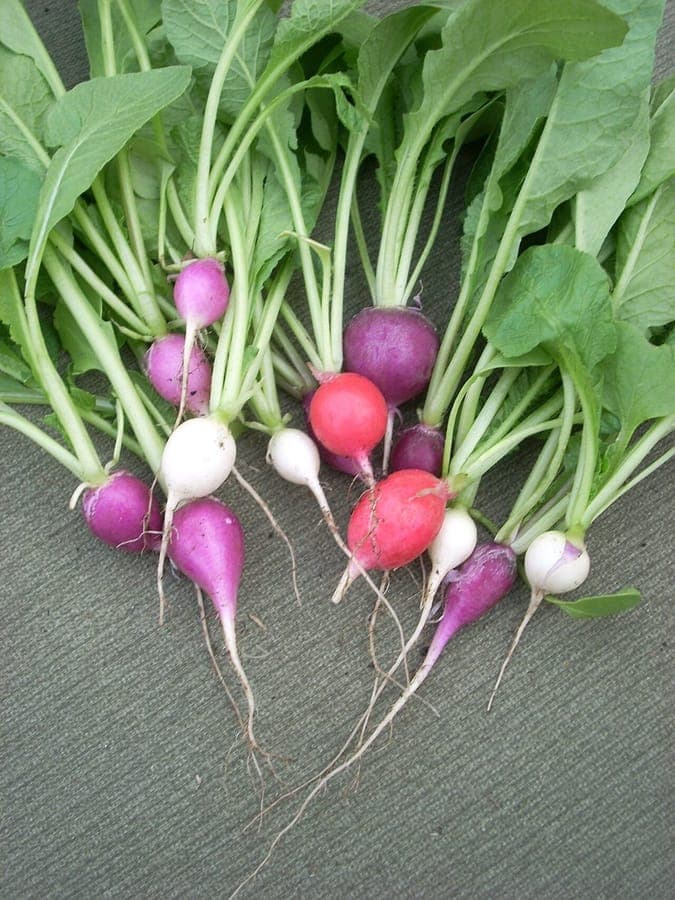
Self, en:User:Jengod / Public domain, via Wikimedia Commons
Radish: complete guide to sowing, growing and harvesting
Raphanus sativus
Want to see Radish: complete guide to sowing, growing and harvesting in your garden?
Full design in HD: €7.99
Look after your Radish with the GardenWorld app
Identify plants with your camera and get a care calendar with reminders for this plant.


Overview
The radish (Raphanus sativus) is the vegetable many people start their first plot with, and rightly so. You sow in March and a month later you are biting into a crisp, peppery root. Few crops give results so quickly for so little effort. Radish belongs to the cabbage family, along with kale, oilseed rape and mustard, and has been grown around the Mediterranean and in Asia since ancient times.
Several forms belong to the same species. The small round or elongated radishes we eat raw are the best known. There is also winter radish, a larger root sown in summer and lifted in autumn and winter, and the Japanese daikon with its long white root. The photo shows a mixed seed blend with red, pink, purple and white radishes, an easy way to bring colour to the plate.
Radish is ideal as a catch crop: on ground not yet in use, or between slower crops. It is a simple way to get more out of a small vegetable garden.
Appearance and growth
Radish is an annual that forms a rosette of rough, hairy, lobed leaves within a few weeks. The swollen hypocotyl, the part between root and stem, becomes the edible root. In ordinary radishes it is 2 to 4 cm across and round or cylindrical; in winter radish it can reach 20 cm or more. The skin is red, pink, purple, white, yellow or black, and the flesh usually white.
Leave a plant in the ground and it bolts, sending up a stem up to a metre tall with white to lilac four-petalled flowers that attract bees and hoverflies. Green seed pods follow. These young pods are edible and mildly peppery, good in a stir-fry or raw in salads. The root itself turns woody and pithy once the plant bolts.
Ideal location
Radish grows best in full sun to light shade. In spring and autumn choose your sunniest spot; in summer, a place with some afternoon shade is welcome, as heat and long days encourage bolting. Radishes are also happy in a container or trough on a balcony, as long as it is at least 15 cm deep.
Bear crop rotation in mind. Do not sow radishes where cabbages, turnips or other brassicas grew the year before, so that clubroot and cabbage root fly get no foothold.
Soil requirements
Radish wants a loose, crumbly, moisture-retentive soil without stones or fresh manure. A pH of 6 to 7 is ideal. On heavy clay, lighten the top 10 cm with some sieved compost. Fresh manure leads to split, blemished roots and attracts cabbage root fly, so only use well-rotted compost, ideally dug in a season earlier.
Radish needs few nutrients. A bed where compost was used for another crop the year before is usually enough.
Sowing
Sow outdoors from mid-March to mid-September, and under glass or fleece from February. The seeds germinate from about 5 °C and come up within four to seven days. Sow 1 cm deep in rows 10 to 15 cm apart, and thin the seedlings to 3 to 5 cm once they have two true leaves. Radishes sown too thickly make plenty of leaf but no root.
The secret of a steady supply is to sow little and often: a short row of a metre every two weeks rather than one long row. In summer, choose varieties that are slow to bolt. Winter radish and daikon are sown in July and August for lifting in October and November.
A handy trick: mix some radish seed in with carrot or parsnip seed. The radishes come up quickly and mark the row, and by the time you pull them, the carrots need the space.
Free preview
Want to see Radish: complete guide to sowing, growing and harvesting in your garden? Make a free preview of your design.
Watering
Regular watering is the key to tender radishes. Never let the soil dry out, or the roots become hot, woody and hollow and bolt more readily. After a dry spell followed by heavy watering they split. In dry weather water every two or three days with a fine rose, about 5 litres per square metre.
A thin mulch of fine material such as grass clippings between the rows keeps the soil moist and cool.
Pests and problems
Flea beetle is the best-known pest: tiny jumping beetles that eat round holes in the leaves, especially in warm, dry weather. Keep the soil moist and cover the rows with fine insect mesh or fleece. The same mesh also keeps out cabbage root fly, whose maggots tunnel into the roots. Slugs relish the young seedlings, particularly in a wet spring.
Harvesting
Ordinary radishes are ready three to six weeks after sowing, depending on the season. Pull them as soon as the roots are 2 to 3 cm across. Do not wait too long: a radish left in the ground becomes pithy and fiery. Harvest in the morning if you can, when they are firm and cool.
Cut off the leaves straight away and the roots stay crisp in the fridge for a week. The young leaves are edible and good in soup or pesto. Winter radish is lifted in autumn and stored somewhere cool in damp sand, or left in the ground for a while in mild weather.
Maintenance calendar
February: First sowing under glass or in a cold frame.
March to May: Sow a short row outdoors every two weeks. Thin and keep the soil moist.
April to June: Pull the first radishes. Cover with mesh against flea beetle and cabbage root fly.
June to August: Sow bolt-resistant varieties in a spot with some afternoon shade. Water regularly.
July to August: Sow winter radish and daikon.
September: Last sowing of ordinary radish.
October to November: Lift winter radish and daikon.
To see at a glance when to sow and harvest in your own vegetable garden, use the planting calendar on gardenworld.app.
Winter hardiness
Raphanus sativus is grown as an annual. Seedlings tolerate light frost of a few degrees below zero, which makes early sowing in March possible. Winter radish copes with more and can stay in the ground until December in mild weather, though hard frost turns the root soft. Radish is not toxic to people or pets; only in sensitive people can its heat irritate the stomach a little.
Companion plants
Radish makes a good neighbour for lettuce (Lactuca sativa) and spinach (Spinacia oleracea): they grow just as quickly and share the same moist soil. Among carrots (Daucus carota) radish acts as a marker crop. Alongside peas (Pisum sativum) it uses the space between rows before the peas fill out. Nasturtium (Tropaeolum majus) at the edge of the bed lures aphids away and adds colour. Avoid other brassicas right next to or after radish.
Final thoughts
Radish is the perfect crop for impatient gardeners and children: fast, easy and colourful. Sow little and often, keep the soil moist and harvest in time, and you will have crisp radishes from April to October. Want to lay out your vegetable plot cleverly with rotation and catch crops? Have a garden design made on gardenworld.app with a kitchen garden that fits your space.
Frequently asked questions about Radish
Is Radish winter hardy?
Raphanus sativus is grown as an annual. Seedlings tolerate light frost of a few degrees below zero, which makes early sowing in March possible.
How much water does Radish need?
Regular watering is the key to tender radishes. Never let the soil dry out, or the roots become hot, woody and hollow and bolt more readily.
Where does Radish grow best?
Radish grows best in full sun to light shade. In spring and autumn choose your sunniest spot; in summer, a place with some afternoon shade is welcome, as heat and long days encourage bolting.
What soil does Radish need?
Radish wants a loose, crumbly, moisture-retentive soil without stones or fresh manure. A pH of 6 to 7 is ideal.

See it in your garden
See Radish in your garden
One photo of your garden and a few questions. You see the result in about a minute.
Try it with a photoIdentify this plant in your own garden. Identify a plant
Similar plants
Lettuce (Lactuca sativa): complete growing guide
Lactuca sativa
Learn how to grow fresh lettuce at home with this comprehensive guide. Tips for continuous harvesting, ideal growing conditions, and popular varieties for spring to fall production.
Spinacia oleracea: complete guide
Spinacia oleracea
Spinacia oleracea is common spinach, a nutritious leafy green for kitchen gardens. Fast-growing plant full of vitamin A, iron and nutrients.
Carrot: complete guide
Daucus carota
Learn how to successfully grow Carrot (Daucus carota) in your garden. Tips on sunlight, soil, watering, and companion planting.
