Karduelis / Public domain, via Wikimedia Commons
Quercus pontica: complete guide
Quercus pontica
Want to see Quercus pontica: complete guide in your garden?
Full design in HD: €7.99
Look after your Quercus pontica with the GardenWorld app
Identify plants with your camera and get a care calendar with reminders for this plant.


Overview
The Armenian oak or Pontic oak (Quercus pontica) is a fascinating tree from the Caucasus region and eastern Turkey. This large-leaved, strong-growing tree offers considerable potential as an ornamental and landscape tree. With its large, deep green leaves and upright growth form, this tree makes an impressive statement in the landscape.
Appearance and bloom
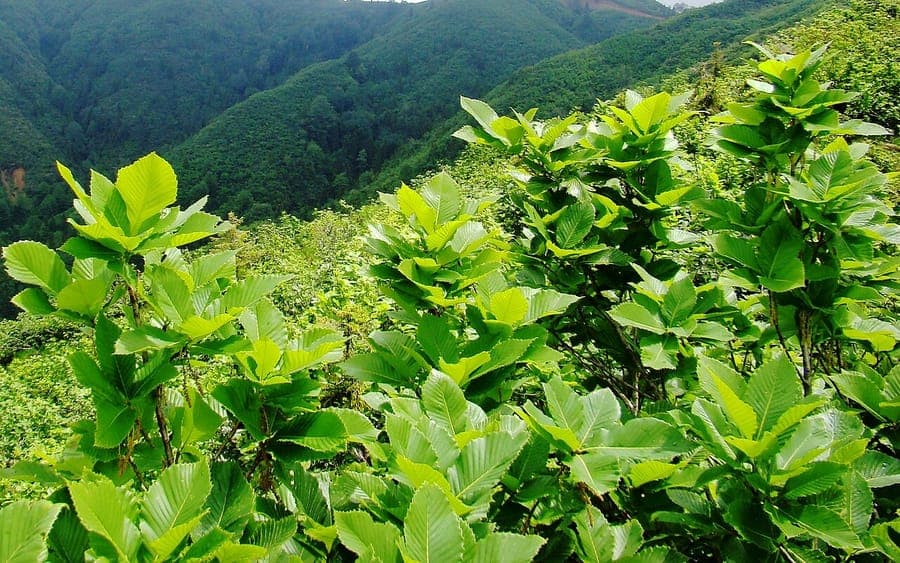
The Armenian oak grows as a large, upright tree, usually 15-20 meters tall and equally broad. The leaves are strikingly large - 7-15 centimeters long and 5-10 centimeters wide - with deep green color and distinct vein pattern. The leaf surface is smooth and glossy, while the underside is slightly hairy. The foliage gives the tree a full, dense appearance. In spring, yellowish-green male catkins appear along with less conspicuous female flowers. The fruits are medium-sized acorns in brown "cups".
Ideal location
The Armenian oak grows best in full sun to partial shade. Ensure it receives at least 4-6 hours of direct sunlight. This tree develops better under good light conditions. Plant it in a location where it has sufficient space to reach its full, broad crown without colliding with buildings or other trees. This is a tree suited for larger gardens and parks.
Soil
The Armenian oak grows best on well-drained, moderately fertile soil. This is not as extreme as some other oaks - it accepts both sandy and clay soils, as long as well-drained. Slightly acidic to neutral is ideal, though it also accepts alkaline soil. If you have very poor soil, adding some organic material helps. This is a more nutrient-demanding oak than many related species.
Watering
Once established, the Armenian oak is reasonably drought-tolerant, though not to the degree of southwestern oaks. In the first growing season, water regularly, especially during dry periods. After the first year, you can reduce watering. During normal European rainfall, it needs little supplemental water. In very dry, hot summers, supplemental water can aid growth.
Free preview
Want to see Quercus pontica: complete guide in your garden? Make a free preview of your design.
Pruning
The Armenian oak naturally grows in a neat, upright form. In the first one to two years, you can remove weak branches to encourage a strong central stem. Avoid heavy pruning on mature trees; this tree prefers to form naturally. Dead or diseased wood can always be removed. Prune in winter when the tree is dormant.
Maintenance calendar
- Spring (March-May): Check for winter damage. Light pruning as needed.
- Summer (June-August): Water during very dry periods.
- Autumn (September-October): Foliage begins falling; no special care.
- Winter (November-February): Tree is dormant; perform maintenance pruning.
Winter hardiness
The Armenian oak is very frost-hardy to approximately -20 to -25 degrees Celsius. This means it is suitable for almost all parts of the Netherlands, Germany, and France, including more northern and mountainous regions. This is a tree that thrives in a continental climate.
Companion plants
The Armenian oak pairs well with other Caucasian mountain plants and East European tree species. Plant it near other cold-hardy species. In larger landscapes, it works well with other large trees. Avoid underplanting close beneath its crown - this is a dense tree that lets little light through.
Conclusion
The Armenian oak is an exciting choice for those wanting a large, robust oak suited to northern Europe. With its large leaves and upright growth, this tree makes an impressive statement. This is a tree for those with space and patience. Available through specialized nurseries and European institutions.
Fun fact: The name "pontica" refers to the Pontic region, an ancient name for the coastal area of the southeastern Black Sea region where this tree originally occurs.
Frequently asked questions about Quercus pontica
Is Quercus pontica winter hardy?
The Armenian oak is very frost-hardy to approximately -20 to -25 degrees Celsius. This means it is suitable for almost all parts of the Netherlands, Germany, and France, including more northern and mountainous regions.
When and how do you prune Quercus pontica?
The Armenian oak naturally grows in a neat, upright form. In the first one to two years, you can remove weak branches to encourage a strong central stem.
How much water does Quercus pontica need?
Once established, the Armenian oak is reasonably drought-tolerant, though not to the degree of southwestern oaks. In the first growing season, water regularly, especially during dry periods.
Where does Quercus pontica grow best?
The Armenian oak grows best in full sun to partial shade. Ensure it receives at least 4-6 hours of direct sunlight.
What soil does Quercus pontica need?
The Armenian oak grows best on well-drained, moderately fertile soil. This is not as extreme as some other oaks - it accepts both sandy and clay soils, as long as well-drained.

See it in your garden
See Quercus pontica in your garden
One photo of your garden and a few questions. You see the result in about a minute.
Try it with a photoIdentify this plant in your own garden. Identify a plant
Similar plants
Lucombe oak: complete guide
Quercus crenata
Lucombe oak (Quercus crenata): a majestic semi-evergreen giant with corky bark, perfect for large gardens, parks, and country estates.
Blue oak: complete guide
Quercus douglasii
Discover the blue oak, a drought-tolerant Californian shade tree with striking blue-green foliage, ideal for large, climate-resilient gardens.
Quercus montana: complete guide
Quercus montana
Quercus montana, the chestnut oak, is a rugged American shade tree with deeply furrowed bark and large acorns, well suited to dry, rocky, spacious gardens.
