
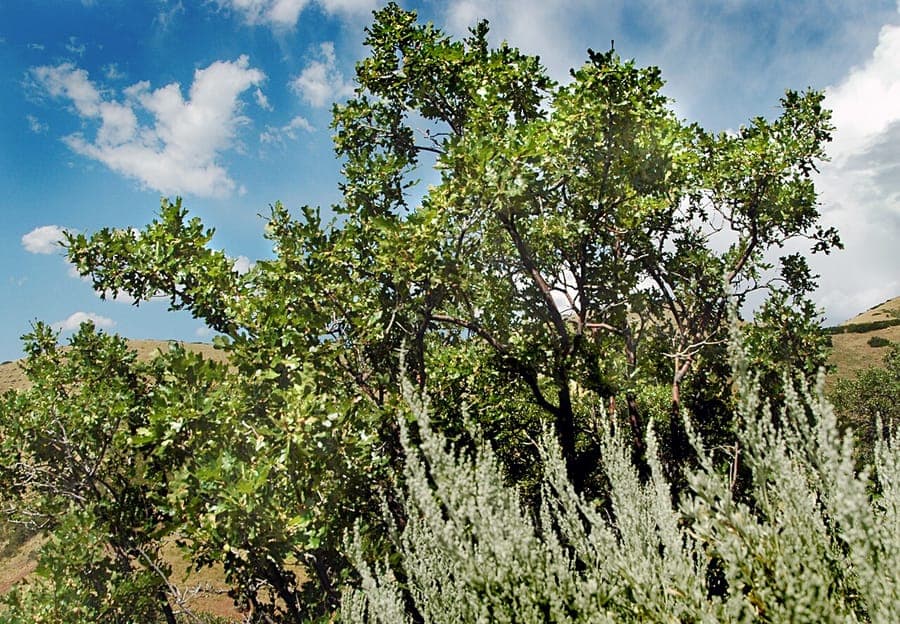
Wikimedia Commons / CC BY-SA 3.0, via Wikimedia Commons
Gambel oak (Quercus gambelii): complete guide
Quercus gambelii
Want to see Gambel oak (Quercus gambelii): complete guide in your garden?
1 minute, no credit card
Overview
Gambel oak (Quercus gambelii), also known as Gambel's oak, is a robust and adaptable native tree from western North America. With its preference for highlands and dry slopes, this tree is excellent for modern, drought-conscious garden designs. The tree is extremely cold-tolerant and grows well in harsh winters.
This oak is highly versatile and found extensively in the wild in mountain areas of New Mexico, Colorado, Arizona, and Utah. In gardens, it offers the opportunity for crafted, tall designs.
Appearance and bloom
Gambel oak typically reaches a height of 5 to 10 meters, sometimes more in optimal conditions. The tree has a fairly compact, full crown providing plenty of shade. The branch structure is finely branched, creating a natural, pleasant silhouette.
The leaves are large, approximately 5-10 cm long, and have a characteristic light brown color in summer. The leaves are deeply lobed, conveying a certain elegance. In autumn, the foliage turns beautiful colors - from yellow to brown, sometimes with red tints.
The flower appears in early spring, before the leaves fully unfold. The flowers are small and inconspicuous, as is typical for oaks. The male catkins are pendulous and yellowish-green.
The acorns are fairly large, about 1-1.5 cm, with a deep cup. These acorns are food for many wild animals, from squirrels to wild boar.
Ideal location
Gambel oak grows best in full sun. This is essential for good growth and autumn color. The tree can tolerate some shade, but thrives in full sunlight.
This tree is exceptionally winter-hardy to USDA zone 4 (-30 to -23 degrees Celsius). This makes it suitable for very cold climates. In the UK (zone 7b-8a), this tree grows without issue.
The tree is also very drought-tolerant after establishment. In fact, it typically grows on mountain slopes with low moisture.
Soil
Gambel oak accepts many different soil types. Sandy, rocky to loamy soils are all suitable. The ideal pH is between 5.5 and 7.5, so neutral to acidic.
The tree thrives best in well-draining soils. Waterlogging must be avoided, especially in the early years.
Once established, this tree needs no feeding. Its deep roots draw nutrients from deeper soil layers.
Free design
Want to see Gambel oak (Quercus gambelii): complete guide in your garden? Make a free design now.
Watering
After planting, Gambel oak needs regular water during the first growing season and possibly the second year. This helps develop strong roots.
Once established (usually after 2-3 years), this tree tolerates long periods of drought. In rainy regions, supplementary water is usually not needed.
In extremely dry periods, watering can be worthwhile, especially on young trees. Ensure well-draining soil to prevent waterlogging.
Pruning
Gambel oak needs relatively little pruning. In the early years, you can support the leader and remove competing shoots.
Later, you can carefully remove dead wood and weak branches. Heavy pruning is not recommended, as it disturbs the natural beauty.
Pruning is best done in late winter or early spring, before leaf growth begins.
Maintenance calendar
February to March: Check for winter-damaged branches. Remove dead wood.
April to May: Spring growth. Protect young trees from drought.
June to July: Full growth. Enjoy form and shade.
August to September: Prepare for autumn. Autumn color begins.
October to November: Beautiful autumn color. Collect and compost leaves.
December to January: Winter rest. No pruning needed.
Winter hardiness
Gambel oak is exceptionally winter-hardy to zone 4 (-30 to -23 degrees Celsius). This makes it ideal for cold winter regions. In the UK, this tree grows well without protection.
Young trees may benefit from protection against very sharp winds in the first year.
Companion plants
Gambel oak combines well with:
Grasses like Festuca or Stipa, for movement. Smaller shrubs like Mahonia, for structure. Helenium, for late summer color. Aromatics like Lavandula. Wildflowers that grow in mountain areas.
This combination creates a natural mountain landscape.
Closing
Gambel oak is a reliable, winter-hardy tree for northern and higher-altitude gardens. The tree offers beautiful autumn color and is very low-maintenance.
See gardenworld.app for more inspiration. Create your own garden design with this beautiful tree.
Order now via gardenworld.app and enjoy years of beauty.
Want to see Gambel oak (Quercus gambelii): complete guide in your garden? Make a free design now.
Upload a photo, pick a style, and get a photorealistic design with plant list in under a minute.
No credit card required


Similar plants
Quercus dumosa: complete guide to coastal sage scrub oak
Quercus dumosa
Coastal sage scrub oak from California: dense shrub-tree with coarse foliage, drought tolerant, slow growing. Ideal for Mediterranean gardens and xeriscaping.
Bur Oak: complete guide
Quercus macrocarpa
Discover the Bur oak, a robust North American tree with impressive large acorns. Learn everything about planting, care, and ideal growing conditions.