
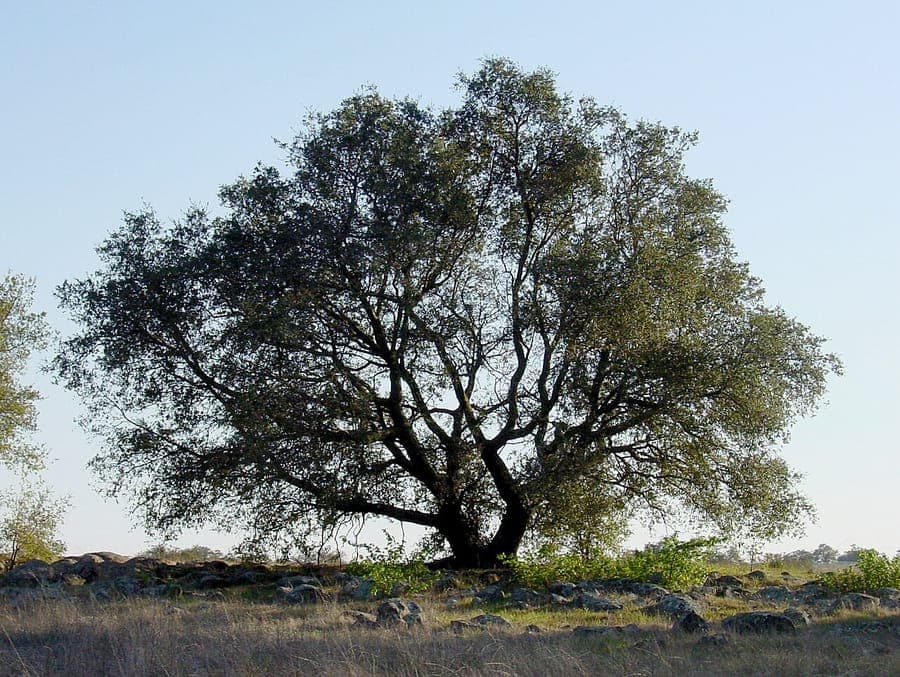
No machine-readable author provided. NoahElhardt assumed (based on copyright claims). / Public domain, via Wikimedia Commons
Quercus engelmannii: complete guide
Quercus engelmannii
Want to see Quercus engelmannii: complete guide in your garden?
1 minute, no credit card
Overview
Quercus engelmannii, known as the Engelmann Oak, is a native tree or large shrub native to Southern California and Northern Baja California. This strong, resilient oak is highly valuable for landscaping in warm, dry regions and is celebrated for its attractive dark green leaves and robust growth habit. The plant typically reaches 6-12 metres in height in natural conditions.
The Engelmann Oak is highly suitable for xeriscape design, ecological restoration, and landscape applications in warm climates. This is a plant for gardeners wishing to contribute to native ecosystem restoration while keeping their gardens beautiful.
Appearance and Growth
The Engelmann Oak has very attractive, glossy dark green leaves approximately 4-8 centimetres long, with lightly toothed or smooth edges. The leaves have a healthy, luxuriant appearance and remain evergreen year-round (the tree is evergreen).
The growth habit is usually more shrubby in very dry conditions but can become more tree-like and larger under better water availability. The plant grows at a moderate pace under favourable conditions.
The acorns are egg-shaped and approximately 1-2 centimetres long, sitting in shallow, scaly cups. These acorns were important food for native peoples and remain important for current fauna.
Ideal Location
Quercus engelmannii grows best in full sun on warm locations. This is a plant for open, exposed places where it can be windy but sun is always abundant.
Provide minimum 6-8 hours direct sunlight daily. The more sun, the better growth. Avoid shaded places where this plant won't thrive optimally.
The plant is very wind-tolerant and actually grows better in windy conditions.
Soil
The Engelmann Oak grows in very lean, well-drained soils, similar to Quercus durata:
- Sandy and gravelly soils (preferred)
- Low-moisture soils
- High-moisture soils provided drainage is good
- Acidic to neutral pH (pH 5-7.5)
Excellent drainage is essential. The plant cannot tolerate waterlogging and dies under wet conditions. Plant on raised beds or slopes if your soil is dense.
Free design
Want to see Quercus engelmannii: complete guide in your garden? Make a free design now.
Watering
Once well-established (after 2-3 years), the Engelmann Oak is very drought-tolerant and needs very little water.
In the first year, water newly planted specimens about once monthly during growing period, with deep watering. In the second year this can reduce to once every two months. After year 2-3, add rarely to never water except in extremely severe drought.
In gardens with regular rainfall, supplemental water is not needed after establishment.
Pruning and Maintenance
Minimal maintenance is required. Remove only dead or damaged branches. The plant grows better in its natural form.
Limit pruning to winter when the plant is dormant. Do not prune during growing season as this can increase water use.
Maintenance Calendar
March-April: Growth begins. Water young specimens lightly. No feeding needed.
May-July: Active growth. Water very sparingly. Watch for pests.
August-October: Growth slows. Minimal water if rainfall insufficient.
November-February: Dormancy. No water unless extreme drought. Pruning may occur.
Winter Hardiness
Quercus engelmannii is hardy to approximately -12 to -15 degrees Celsius (USDA zones 8-10, borderline 9). This is a plant for warmer climates, especially on the American West Coast.
In areas with colder winters, protect newly planted specimens from hard frost. Mature trees can tolerate some frost.
Companion Plants
The Engelmann Oak grows well with other native California and Southwestern plants:
- Cercocarpus (Mountain mahogany) - other California native
- Artemisia califonica (California wormwood) - drought tolerant
- Salvia mellifera (Black sage) - California native
- Ribes (Wild currant) - native North American
- Acacia smallii (Small acacia) - Southwest native
Closing
Quercus engelmannii offers a special opportunity for gardeners in warm climates to grow a true, native California tree that delivers beauty with minimal water inputs. This is a plant for ecologically conscious gardeners wishing to help restore ecosystems while growing beautiful, strong trees.
Looking for native California trees for warm climates? Many nurseries stock growing collections of native-friendly species. Visit gardenworld.app for more advice on native plant landscaping.
Want to see Quercus engelmannii: complete guide in your garden? Make a free design now.
Upload a photo, pick a style, and get a photorealistic design with plant list in under a minute.
No credit card required


Similar plants
Quercus castaneifolia: complete guide
Quercus castaneifolia
Discover the striking Chestnut-leaf Oak from the Caucasus. Complete guide to growing, maintaining, and landscape design with this impressive tree.
Quercus durata: complete guide
Quercus durata
Discover the tough Leather Oak from California. Practical guide to growing this native species with drought tolerance and beautiful habit.