
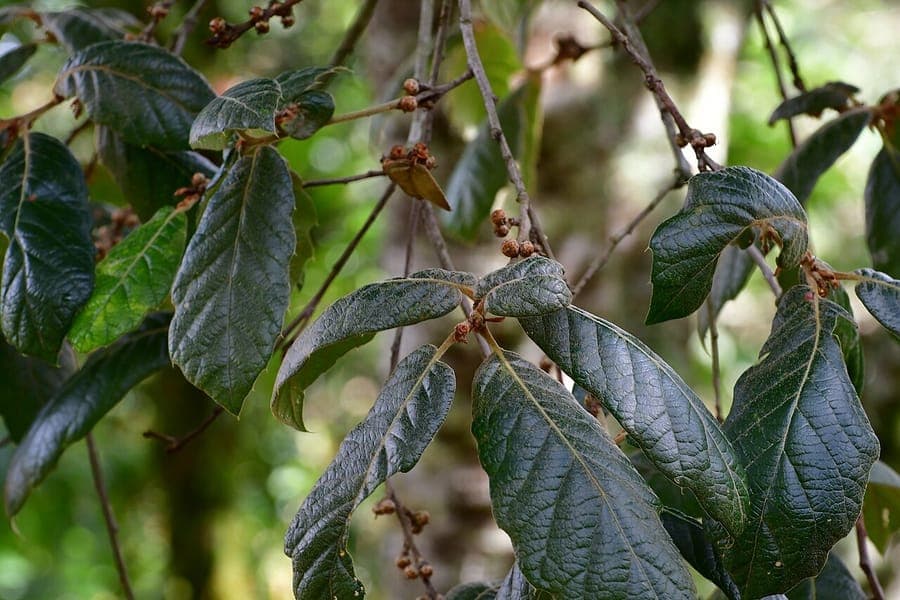
Neptalí Ramírez Marcial / CC BY 4.0, via Wikimedia Commons
Quercus crassifolia: complete guide to leather-leaf oak
Quercus crassifolia
Want to see Quercus crassifolia: complete guide to leather-leaf oak in your garden?
1 minute, no credit card
Overview
Quercus crassifolia, commonly known as leather-leaf oak, is an impressive deciduous tree native to the mountains of Mexico. This oak tree is renowned for its thick, leathery leaves that give it its distinctive name. With a natural range extending from Mexico to Guatemala, this tree adapts readily to various climate conditions. For large gardens and landscape projects, it offers elegant character and longevity.
Appearance and Bloom
Leather-leaf oak grows as a medium to large tree, reaching heights of 15 to 25 meters. Its most striking feature is the thick, leathery foliage: dark green, glossy, and remarkably durable throughout the season. These leaves retain their structure and color even through harsh conditions. Spring brings delicate male catkins that add visual interest against the dark foliage.
The trunk develops a robust, dark brown bark that gains character and textural interest with age. The crown spreads wide and open, making this an excellent specimen tree in larger landscapes. This is not a tree for small gardens - it demands space to reach its full potential. The overall silhouette is broad and spreading, providing excellent shade.
Ideal Location
Leather-leaf oak thrives in full sun to partial shade environments. Position it where it receives at least six hours of direct sunlight daily. This tree excels in large gardens, parkland settings, and natural woodland designs. Its inherent drought tolerance makes it well-suited to warm, sunny exposures.
Allow generous spacing to accommodate its mature width and height. As a solitary specimen in larger lawn areas, it becomes truly spectacular. It combines beautifully with other native trees and structural plants in Mediterranean or semi-arid garden designs. The architectural form makes it valuable in contemporary landscape schemes.
Soil
Quercus crassifolia performs best in well-draining soil. It tolerates diverse soil types from sandy to clay, provided waterlogging doesn't occur. This tree has adapted to poor mountain soils in its native habitat, so it's not particularly demanding.
Ensure good drainage at planting. In heavy clay soils, amend with sand or gravel. Apply a 5 to 10-centimeter mulch layer to help retain moisture during the establishment year. Soil pH can be neutral to slightly acidic - this tree shows no strong preferences.
Watering
Once fully established, this oak becomes drought-resistant and requires minimal supplemental water. During the first year after planting, regular deep watering is essential to encourage deep root development.
During warm, dry summers, water young trees deeply once weekly rather than shallow frequent sprinkling. This promotes profound rooting. Established trees tolerate dry periods well. In excessively wet winters, prevent standing water around the trunk base.
Free design
Want to see Quercus crassifolia: complete guide to leather-leaf oak in your garden? Make a free design now.
Pruning
Leather-leaf oak requires minimal pruning. Allow it to develop its natural form. Remove only dead or damaged branches during late spring. While young, you may perform light structural pruning to guide form development.
Avoid heavy pruning wounds: this tree heals slowly from major cuts. Annual inspection for dead wood is sufficient. Pruning occurs optimally during dormancy or early spring.
Maintenance Calendar
Year one demands regular deep watering. Mulch around the base aids moisture retention. From year two onward, maintenance becomes minimal:
Spring (March-April): Inspect for damage and remove any dead branches. Summer: Water young trees during drought periods. Fall: Collect fallen leaves to use as mulch. Winter: No maintenance required.
This oak grows deliberately. Patience is part of its appeal. After ten years, this becomes an impressive specimen tree commanding attention.
Winter Hardiness
Quercus crassifolia suits temperate climate zones. In British and Northern European gardens, it thrives particularly in warmer regions and favorably sited locations. USDA zones 8 to 10 are optimal.
Young trees may need protection during severe winters. Generous mulch layers and windbreaks assist in exposed sites. Once established, winter hardiness rarely presents challenges.
Companion Plants
Combine leather-leaf oak with native trees and shrubs from dry regions. Other Quercus species create handsome groupings. Rock-dwelling perennials, lavender, and other drought-tolerant plantings thrive in its dappled shade.
Partial shade beneath the canopy suits shade-loving groundcovers and smaller shrubs. This tree excels in combination with rockeries, scree plantings, and Mediterranean shrubs. Its dark foliage provides striking contrast with silver-leaved plants.
Conclusion
For gardeners with space and patience, Quercus crassifolia is an exceptional choice. This robust Mexican oak offers decades of beauty and character. Major garden centers and landscape suppliers stock quality material. Plant it where gardenworld.app can integrate it into broader landscape design schemes.
In GardenWorld designs, increasingly clients commission major landscape transformations. A tree like this becomes the centerpiece of such visions. Ask gardenworld.app to redesign your garden around this impressive specimen oak as the focal point!
Want to see Quercus crassifolia: complete guide to leather-leaf oak in your garden? Make a free design now.
Upload a photo, pick a style, and get a photorealistic design with plant list in under a minute.
No credit card required

