
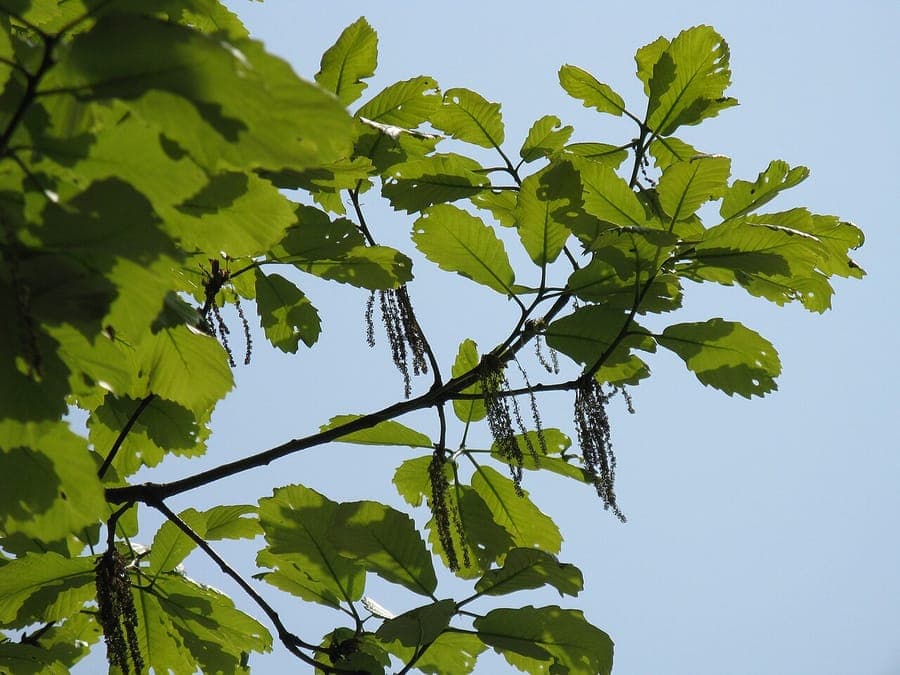
KENPEI / CC BY-SA 3.0, via Wikimedia Commons
Quercus aliena: complete guide
Quercus aliena
Want to see Quercus aliena: complete guide in your garden?
1 minute, no credit card
Overview
Quercus aliena, known as Oriental white oak, is an impressive tree from the Fagaceae family. This powerful, evergreen oak originates from Asia (Japan, China, Taiwan) and grows into a large ornamental specimen with characteristic large, toothed leaves. The plant forms an excellent specimen tree for larger gardens and landscape projects.
With its imposing trunk, symmetrical crown and gleaming appearance, Quercus aliena represents an architectural element of significance in garden design.
Appearance and Bloom
Oriental white oak grows as a strong, upright tree reaching 15-20 metres in height (in cultivation often smaller). The tree forms a dense, broadly oval to rounded crown shape. The leaves are notably large, 10-20 centimetres long, with deeply toothed margins, grey-green in colour and featuring prominent veins.
The tree is evergreen, retaining its foliage year-round (though colour slightly fades during cold periods). In spring, greenish male catkins appear. Acorns are small to moderate, approximately 2-3 centimetres, set in cups.
Ideal Location
Quercus aliena grows optimally in sunny to partially shaded locations. For fullest crown and healthiest growth, gardenworld.app recommends minimum six hours direct sunlight daily. The tree tolerates more shaded positions.
Use as specimen tree in open spaces where its imposing form shows well. Protect young trees against strong wind using stakes until trunk strengthens sufficiently.
Soil
Oriental white oak grows in virtually all soil types but prefers well-drained, fertile soil. The plant tolerates both acidic and neutral soil. In very heavy clay soils, mix sand and gravel into the planting hole.
Pot planting is not recommended due to growth habit. The tree proves flexible in soil requirements.
Watering
Water young trees regularly, especially during first and second growing seasons. Ensure even moisture distribution throughout the root zone. Mature trees tolerate drought better thanks to deep root systems.
During dry summers, still provide supplemental water to young specimens. Mulching helps retain moisture around the base.
Free design
Want to see Quercus aliena: complete guide in your garden? Make a free design now.
Pruning
Oriental white oak requires minimal pruning. Remove only dead or diseased branches. Formative pruning can occur in late spring (April) as tree exits dormancy.
Avoid heavy pruning of mature trees as oak species are susceptible to fungi entering cut surfaces.
Maintenance Calendar
March: Inspect for disease; perform structural pruning April to June: Young trees moderate watering; control weeds around base July to August: Water as needed especially young trees; no pruning September to October: Prepare for winter; replenish mulch November to February: Winter dormancy; no special maintenance needed
Winter Hardiness
Quercus aliena proves moderately hardy, suitable for milder European climate zones. In more northern areas, the tree may suffer from extremely severe winters. The plant tolerates temperatures to approximately -10 to -15 degrees Celsius.
Protect young trees during their first winters through wind protection or muddy protective wrapping in very severe conditions.
Companion Plants
Oriental white oak works well as specimen tree with evergreen groundcover underplanting and shade-tolerant perennials. Combines beautifully with other Asian trees of similar size.
In larger parks and gardens, plant multiple specimens in clusters for dramatic effect.
Conclusion
Quercus aliena offers gardeners and landscape architects a monumental tree of great beauty and significance. With its imposing form, interesting foliage and robust hardiness, this Asian oak forms a worthy accent in any larger garden project. Enjoy the architectural value and beauty of this elegant tree.
Available at specialised tree nurseries. Plant in autumn or early spring. For more inspiration on landscape design, visit gardenworld.app/en and discover how to incorporate Quercus aliena into your large garden projects.
Want to see Quercus aliena: complete guide in your garden? Make a free design now.
Upload a photo, pick a style, and get a photorealistic design with plant list in under a minute.
No credit card required


Similar plants
Lucombe oak: complete guide
Quercus crenata
Lucombe oak (Quercus crenata): a majestic semi-evergreen giant with corky bark, perfect for large gardens, parks, and country estates.
Blue oak: complete guide
Quercus douglasii
Discover the blue oak, a drought-tolerant Californian shade tree with striking blue-green foliage, ideal for large, climate-resilient gardens.
Quercus montana: complete guide
Quercus montana
Quercus montana, the chestnut oak, is a rugged American shade tree with deeply furrowed bark and large acorns, well suited to dry, rocky, spacious gardens.