Wikimedia Commons / CC BY-SA 3.0, via Wikimedia Commons
Asian pear (Pyrus pyrifolia): growing nashi at home
Pyrus pyrifolia
Want to see Asian pear (Pyrus pyrifolia): growing nashi at home in your garden?
Full design in HD: €7.99
Look after your Asian pear with the GardenWorld app
Identify plants with your camera and get a care calendar with reminders for this plant.


Overview
The Asian pear or nashi (Pyrus pyrifolia) looks like an apple and tastes like a pear, but with the crunch and juiciness of a slice of fresh melon. The first bite usually comes as a surprise because of how much juice runs out. In Japan, Korea and China this pear has been grown for more than two thousand years and is as ordinary there as 'Conference' is here. Nashi trees are turning up more and more in British and European gardens, and with good reason: they are hardy, handsome and start cropping within a few years.
Nashi is simply the Japanese word for pear. Two groups are on sale. The russet varieties have a rough, bronze skin, such as 'Hosui', 'Kosui' and 'Chojuro'. The smooth-skinned ones are green-yellow, such as 'Nijisseiki' (also sold as 'Twentieth Century') and 'Shinseiki'. On a dwarfing to semi-vigorous rootstock the tree stays at 3 to 5 m, which suits an ordinary garden. On gardenworld.app you can have a garden design drawn up that gives a nashi its place alongside other fruit trees, as a standalone tree or trained against a sunny wall.
Appearance and bloom cycle
Pyrus pyrifolia forms an upright crown that broadens with age. The leaves are oval with a pointed tip, 7 to 12 cm long, glossy dark green and finely toothed with tiny bristle points along the margin. In autumn they turn orange, red and sometimes purple, more vivid than most European pears.
Flowering comes in April, usually a few days earlier than European pears. The white flowers are 3 to 3.5 cm across and appear in clusters of six to ten, just before or with the young leaves. A nashi in full blossom is an ornamental tree in its own right.
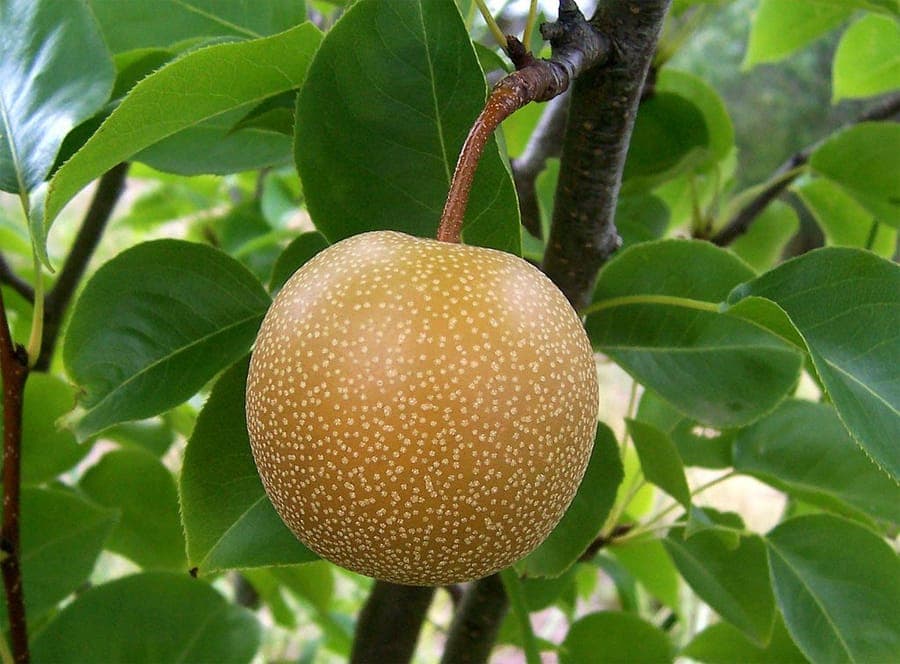
The fruits are round, 6 to 10 cm across and weigh 200 to 400 grams. The flesh is white, crisp, sweet and very juicy, with a mild flavour and sometimes a hint of honey or cinnamon. The photograph at the top shows a typical russet nashi with a golden-brown skin covered in pale speckles.
Ideal location
Plant your nashi in a warm, sunny spot with at least six hours of sun a day; the more sun, the sweeter the fruit. Because it flowers early, avoid low-lying frost pockets where cold air settles. A slope or a site by a south- or west-facing wall protects the blossom from night frost.
Nashi trees do very well as espaliers or fans on a sunny wall. The wall gives off warmth, the fruit ripens better and you can easily cover the blossom with fleece on frosty nights. Allow 4 to 5 m between open-grown trees and 2 to 3 m between trained ones.
Soil requirements
Nashi likes a deep, humus-rich soil that holds moisture yet drains well. Loam is ideal. On sandy soil dig in plenty of compost; on heavy clay make sure drainage is good. The best pH is 6 to 7. On very chalky soil the leaves may yellow from iron deficiency.
Plant between November and March. Dig a generous hole, keep the graft union at least 10 cm above the soil and fit a sturdy stake. In March scatter compost or an organic fruit fertiliser around the tree, out to the edge of the canopy. Go easy on nitrogen: it produces long, soft growth that is vulnerable to fireblight.
Watering
Nashi trees need more water in summer than apples and European pears. In July and August, when the fruits are swelling, moisture decides how large and juicy they become. In dry weather give 30 to 40 litres per tree once a week, slowly, so it soaks in deeply. A mulch of compost or grass clippings around the trunk keeps the soil moist for longer. Irregular watering can cause the fruit to split.
Pollination
Most nashi varieties are largely self-sterile, so for a good crop you need a second tree that flowers at the same time. That can be another nashi, for example 'Hosui' with 'Kosui' or 'Shinseiki', or an early-flowering European pear. 'Shinseiki' and some forms of 'Nijisseiki' set some fruit on their own, but with a partner you get more fruit and more regular crops.
Pear blossom offers little sugary nectar, so honeybees visit it less eagerly than apple blossom. Wild bees and bumblebees are therefore important, and a flower-rich strip nearby helps.
Free preview
Want to see Asian pear (Pyrus pyrifolia): growing nashi at home in your garden? Make a free preview of your design.
Pruning
Pyrus pyrifolia fruits on short spurs on wood that is two years old or more, much like an apple. In the early years build a strong framework with a central leader and three or four side branches. Later, aim for an open crown that lets light into the centre.
Winter pruning runs from December to February: remove dead, diseased and crossing wood, thin out congested spurs and shorten the leaders of the main branches by a third. In August follow up with summer pruning, removing long upright shoots or cutting them back to three leaves. On trained trees this summer pruning is especially important.
Watch for fireblight: shoot tips that suddenly wilt and blacken should be cut 30 cm into healthy wood in dry weather, using disinfected secateurs. Pear rust causes orange spots on the leaves and comes from nearby junipers.
Harvesting
Thinning is the first step towards a good harvest. Nashi trees often set far too many fruits. In June leave just one fruit per cluster, 15 to 20 cm apart. This way they grow large and juicy, and the tree avoids cropping only every other year.
Unlike European pears, nashi ripen on the tree. Depending on the variety, you pick from late August into October. A ripe fruit changes from green to yellow or golden bronze, comes away with a gentle upward twist and is ready to eat straight away. Taste one first: an unripe nashi is hard and bland. Pick carefully, as the skin bruises easily.
In the fridge nashi keep for two to four weeks, and some varieties such as 'Chojuro' even longer. They are best eaten cool and raw, in salads or straight from the hand.
Maintenance calendar
December-February: Winter pruning. Planting time when the ground is not frozen.
March: Scatter compost or fruit fertiliser around the tree. Lay a mulch.
April: Blossom. Cover trained trees with fleece on frosty nights.
May-June: Fruit set. Thin to one fruit per cluster in June. Check for fireblight and pear sucker.
July-August: Water in dry spells. Summer pruning in August.
Late August-October: Harvest, variety by variety.
November: Leaf fall and autumn colour. Clear fallen leaves with rust or scab spots. The plant calendar on gardenworld.app shows which jobs are due when in your area.
Winter hardiness
Pyrus pyrifolia is hardy to about -25 °C and comes through British and north-west European winters without protection. Its weak point is the early blossom: flowers and tiny fruitlets are damaged by just a few degrees of frost. Choose a sheltered spot and cover small or trained trees on frosty April nights.
Nashi is not poisonous to people or pets. As with all pears and apples, the seeds contain small amounts of cyanogenic compounds, which is no concern with normal eating.
Companion plants
Under and around fruit trees, choose plants that attract pollinators and keep the soil alive. Chives (Allium schoenoprasum) flower in May and June and draw in bumblebees. Comfrey (Symphytum officinale) supplies leaves for mulch and liquid feed. White clover (Trifolium repens) in the grass around the tree fixes nitrogen and flowers for months. A strip of phacelia (Phacelia tanacetifolia) nearby is a magnet for bees.
Daffodils under the tree flower before the leaves open and are left alone by voles. As a second fruit tree, a European pear (Pyrus communis), an apple (Malus domestica) or a quince (Cydonia oblonga) fits well. Do not plant junipers nearby, as they host pear rust.
Final thoughts
A nashi brings a touch of East Asia to your fruit garden: a graceful tree with white blossom, fiery autumn colour and fruit crisper and juicier than any pear you know. Give it a sunny, sheltered spot, a pollination partner nearby, enough water in summer and thin the fruit in good time. Then you will pick a basket of Pyrus pyrifolia from your own garden year after year.
Frequently asked questions about Asian pear
Is Asian pear winter hardy?
Pyrus pyrifolia is hardy to about -25 °C and comes through British and north-west European winters without protection. Its weak point is the early blossom: flowers and tiny fruitlets are damaged by just a few degrees of frost.
When and how do you prune Asian pear?
Pyrus pyrifolia fruits on short spurs on wood that is two years old or more, much like an apple. In the early years build a strong framework with a central leader and three or four side branches.
How much water does Asian pear need?
Nashi trees need more water in summer than apples and European pears. In July and August, when the fruits are swelling, moisture decides how large and juicy they become.
Where does Asian pear grow best?
Plant your nashi in a warm, sunny spot with at least six hours of sun a day; the more sun, the sweeter the fruit. Because it flowers early, avoid low-lying frost pockets where cold air settles.
What soil does Asian pear need?
Nashi likes a deep, humus-rich soil that holds moisture yet drains well. Loam is ideal.

See it in your garden
See Asian pear in your garden
One photo of your garden and a few questions. You see the result in about a minute.
Try it with a photoIdentify this plant in your own garden. Identify a plant
Similar plants
Common pear: complete guide
Pyrus communis
Master growing Pyrus communis with elegant spring flowers and delicious fruit. Complete care instructions for this classic heritage fruit tree variety.
Apple: complete guide
Malus domestica
Everything you need to know about growing Malus domestica: location, soil, pruning, and care. Ideal for home orchards and gardeners in temperate zones.
Quince: complete guide
Cydonia oblonga
Everything about the quince (Cydonia oblonga): growing, care, ideal location and garden use. Perfect for cottage gardens and small orchards.
