
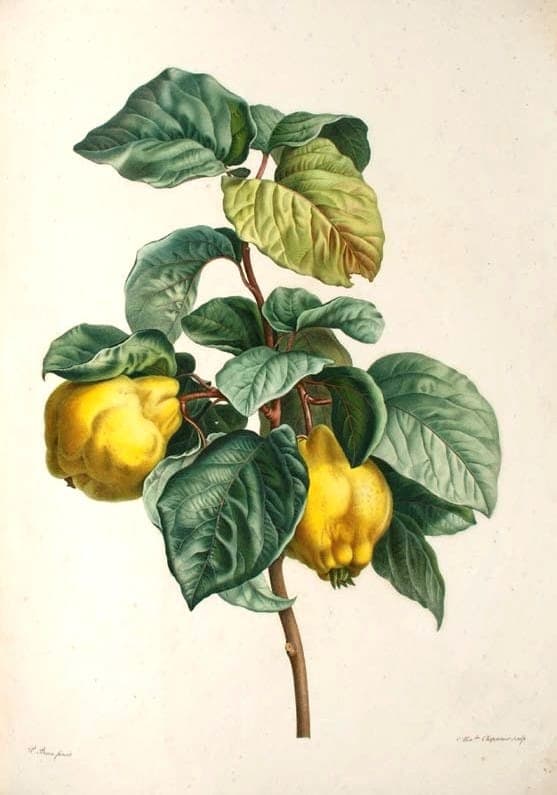
Pancrace Bessa / Public domain, via Wikimedia Commons
Quince: complete guide
Cydonia oblonga
Want to see Quince: complete guide in your garden?
1 minute, no credit card
Overview
Cydonia oblonga, commonly known as quince, is a hardy fruit tree with a long-standing reputation in kitchen and garden alike. Though it's not commonly seen in modern gardens, it's making a comeback among gardeners who value heirloom flavours and sculptural forms. Native to Iran, Iraq, and the Caucasus region, this member of the Rosaceae family thrives in temperate climates. In the UK and similar zones (USDA 5–9), it grows well when given space and sunlight.
The fruit is hard and astringent when raw, but transforms into fragrant jams, jellies, and pastries when cooked. Its scent is a mix of apple, pear, and citrus, often filling an entire kitchen. Beyond fruit, the quince is ornamental: its spring blossoms and golden autumn display make it a standout.
On gardenworld.app, you can design a layout where your quince tree has room to spread and complement other fruiting species.
Appearance & bloom cycle
The quince is a deciduous tree reaching 4 to 6 meters in height with a spread of 3 to 4 meters. It has a rounded, dense canopy with spreading branches. Young stems are downy, turning grey-brown and scaly with age.
From April to early May, large single flowers appear. They're pale pink to white, 4–5 cm wide, with a soft, satiny finish. Each bloom lasts up to two weeks and attracts bees and hoverflies. The leaves are oval, 6–12 cm long, dark green above, and slightly fuzzy underneath.
Fruit development begins in June and continues until harvest in October. The fruits are golden-yellow, sometimes with an orange blush, and measure 7–12 cm. They hang on short stalks and give the tree a lush appearance in autumn.
Ideal location
Quince trees need full sun for best flowering and fruiting. Plant in a sunny or lightly shaded spot, ideally sheltered from strong winds. Late spring frosts can damage blossoms (down to -2°C), so a south- or southeast-facing wall is ideal-radiating warmth and offering protection.
Allow at least 4 meters between trees or nearby structures. On gardenworld.app, you can visualise spacing and sunlight patterns to ensure your quince fits well in your garden design.
Soil requirements
The soil should be well-draining but moisture-retentive. Loam or sandy loam with a pH of 6.0–7.0 is ideal. Avoid heavy clay or waterlogged soils-root rot is a real risk. At planting, mix in compost or well-rotted manure to improve structure.
Quinces don't thrive in dry, sandy soils without organic matter. Extremely acidic or alkaline soils should also be avoided.
Free design
Want to see Quince: complete guide in your garden? Make a free design now.
Watering
For the first two growing seasons, water weekly during dry spells-10 to 15 litres per tree. Use a soaker hose or water slowly at the base. After year two, the tree usually draws moisture from deeper soil layers, but supplemental watering during extended droughts is wise, especially when fruit is forming.
Avoid overhead watering to prevent fungal issues.
Pruning
Pruning maintains an open canopy and encourages fruit production. Do this in winter (December to February), during dormancy. Remove dead, crossing, or inward-growing branches. Keep 4–6 main scaffold branches radiating from the trunk.
Don't cut back fruiting spurs too hard-these are where flowers and fruit develop. Avoid heavy pruning; quinces respond slowly. Use sharp, sterilised tools to prevent disease.
Maintenance calendar
- Jan: Prune, remove dead wood
- Feb: Finish pruning tasks
- Mar: Check soil, add compost if needed
- Apr: Blossoms appear; watch for late frost
- May: No extra care required
- Jun: Fruits start forming; light feeding possible
- Jul: Monitor for aphids or scab
- Aug: No pruning; check for drought stress
- Sep: Fruits swell rapidly
- Oct: Harvest when golden and fragrant
- Nov: Clear fallen leaves; compost
- Dec: Prepare for winter; protect trunk from rodents
Winter hardiness
Quince is hardy to USDA zone 5 (-20°C to -29°C). In the UK (zone 8), it survives winter easily. The real threat is spring frost damaging blossoms. Protect young trees with horticultural fleece if frost is forecast.
Mature trees are resilient, but young trunks may suffer from rabbit or vole damage. Wrap the lower trunk with a mesh guard in winter.
Companion plants
Underplant with shade-tolerant, early bloomers like wood anemones (Anemone nemorosa), snake's head fritillary (Fritillaria meleagris), or dog's mercury (Mercurialis perennis).
For pollinators, add herbs like thyme or chives around the base. They attract beneficial insects and help deter pests.
Avoid aggressive ground covers like ivy, which compete for water and nutrients.
Closing
The quince isn't the easiest tree to grow, but it's deeply rewarding. With attention to location and care, it produces aromatic fruit and stunning seasonal beauty for decades. It fits well in cottage gardens, heritage orchards, or as a standalone feature.
Buy young trees from reputable garden centres. In the UK, look for quince at local nurseries or larger chains. Plant in autumn or early spring for best establishment. And remember: on gardenworld.app, you can map out your tree's growth and integrate it into a long-term garden plan with complementary plants.
Want to see Quince: complete guide in your garden? Make a free design now.
Upload a photo, pick a style, and get a photorealistic design with plant list in under a minute.
No credit card required


Similar plants
Siberian crab apple: complete guide
Malus x robusta
Complete guide to the Siberian crab apple (Malus x robusta): location, soil, pruning, winter hardiness and the best companion plants for your garden.
Chinese flowering crabapple (Malus x spectabilis): complete guide
Malus x spectabilis
Meet the Chinese flowering crabapple (Malus x spectabilis): a classic spring bloomer with carmine buds and pink blossom.
Potentilla crassinervia: complete guide
Potentilla crassinervia
Potentilla crassinervia, the Corsican cinquefoil, grows wild on Corsica and Sardinia's peaks. Discover how to grow this hardy alpine rock garden gem.