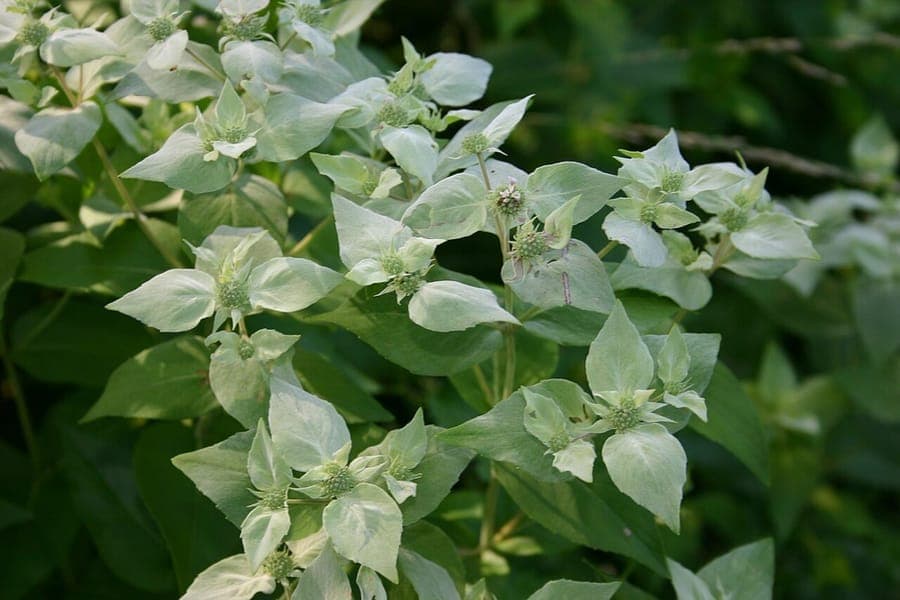
User:SB_Johnny / CC BY-SA 3.0, via Wikimedia Commons
Clustered mountain mint: growing Pycnanthemum muticum
Pycnanthemum muticum
Want to see Clustered mountain mint: growing Pycnanthemum muticum in your garden?
Full design in HD: €7.99
Look after your Clustered mountain mint with the GardenWorld app
Identify plants with your camera and get a care calendar with reminders for this plant.


Overview
Pycnanthemum muticum, known as clustered mountain mint or short-toothed mountain mint, is a perennial of the mint family that is still something of an insider's plant in European gardens. Anyone who has watched one in full flower in August tends to become a convert. It comes from the eastern United States, where it grows in damp meadows, open woodland edges and rough grassland from the coast well inland.
The attraction is not really the flowers, which are tiny, but the silvery bracts that surround them. From July into September the top of the plant looks as if it has been dusted with icing sugar, and that pale crown draws an astonishing range of insects: honeybees, solitary bees, hoverflies, parasitic and hunting wasps, and butterflies. In American trial gardens it has repeatedly ranked among the most visited perennials, and the Perennial Plant Association named it Perennial Plant of the Year for 2025.
Plants reach 60 to 90 cm in height and spread steadily by underground runners into a clump 60 to 90 cm across, often more over time. It is far less aggressive than true mint, but it does creep outwards each year. If you are not sure where a clump of that size belongs, gardenworld.app can create a garden design that already allows for the eventual spread of every plant.
Appearance and bloom cycle
The stems are square, as in all members of the Lamiaceae, upright and sturdy. Leaves sit in opposite pairs and are oval to broadly lance-shaped, 4 to 10 cm long, with smooth or faintly toothed margins bearing short, blunt teeth. That is what the species name refers to: muticum means blunt, without a point. The foliage is mid-green, slightly velvety, and gives off a powerful peppermint scent with a camphor edge when you brush past it.
From late June, dense, flattened heads 1 to 2 cm across appear at the stem tips. Each is made up of dozens of minute white to pale pink flowers speckled with purple. The real show comes from the bracts and the uppermost leaves beneath each cluster, which turn silver-grey to almost white, as though rubbed with chalk. The effect lasts for weeks.
Flowering runs roughly from July to mid-September, peaking in August. Afterwards the grey-brown seed heads stay upright through winter, look lovely in frost and are picked over by small birds now and then.
Ideal location
Mountain mint does best in full sun to light shade. In full sun it stays more compact, flowers more freely and the bracts colour to their brightest silver. In partial shade, under the light canopy of a birch or on the east side of a hedge, it still performs well, although the stems grow taller and flowering is a little less generous.
Plant it where you can watch the visitors, beside a patio or along a path. It suits naturalistic borders, prairie-style plantings and flowery margins around a pond, and is a valuable neighbour for a vegetable plot because of the pollinators and beneficial wasps it brings in. Space plants 50 to 60 cm apart; after two seasons the clumps will knit together.
Bear in mind that it travels. Beside small, slow perennials such as a little sedum or a young peony it can take over within a few years, so give it neighbours that can hold their own.
Soil requirements
In the wild Pycnanthemum muticum grows in moist to damp ground, often loamy or clay-rich and sometimes rather acidic. In the garden it is easy-going. Ordinary garden soil, heavy clay and humus-rich sandy soil all work, provided the ground does not turn bone dry in summer. A pH between 5.5 and 7.5 is ideal.
On thin, dry sand, mix some leaf mould or well-rotted manure into the top 20 cm at planting time. After that it needs little feeding, and overly rich soil only gives floppy stems. A 2 to 3 cm layer of compost each spring is plenty. It copes with wet winter conditions better than most Mediterranean herbs, but weeks of standing water around the roots are too much even for this plant.
Watering
Water regularly for the first few weeks after planting so the roots establish well: one or two good cans of 5 to 10 litres per plant each week, depending on the weather. From the second year onwards mountain mint manages on rainfall in most soils.
During long dry spells in July and August the leaves can droop a little, especially on sand or in a hot border. Water thoroughly at the base once a week, ideally in the morning. A mulch of compost, wood chip or shredded leaves keeps the soil cool and moist. It also grows well in a large container, but the compost dries out much faster there, so check every two or three days in summer.
Free preview
Want to see Clustered mountain mint: growing Pycnanthemum muticum in your garden? Make a free preview of your design.
Pruning
There is very little pruning involved. Leave the spent stems standing through autumn: the seed heads look good in winter and the hollow stems shelter overwintering insects. Cut everything back to 5 to 10 cm in February or early March, just before new shoots appear.
If your plants grow too tall or flop after a summer storm, a light trim in late May or early June helps. Shorten the stems by a third. The plant branches, stays lower and sturdier, and flowers a week or two later.
The main job is keeping the runners in check. Each spring, slice around the edge of the clump with a sharp spade and remove or pass on the pieces you cut away. Every three or four years you can lift the whole plant, divide it and replant the youngest, strongest sections.
Harvesting and uses
The leaves are edible and were brewed as a tea by Native Americans and later by settlers. Pick young tips just before or during flowering, when the scent is strongest. A few leaves in hot water make a bracing, fresh infusion that is noticeably stronger than garden mint. You can also tie stems in bunches and hang them upside down in an airy, shaded spot to dry.
Use it in moderation, though. The essential oil of Pycnanthemum muticum is rich in pulegone, a compound that strains the liver in large quantities. An occasional cup of tea is fine, but do not drink it daily in quantity, and avoid it during pregnancy. There is no reliable data on toxicity to dogs and cats; the strong smell means pets rarely nibble it, but do not let them eat large amounts.
The silver stems also make a long-lasting filler in a vase.
Maintenance calendar
February–March: Cut old stems back to just above ground. Slice off runners around the edge of the clump.
April: Plant new specimens or divide older clumps. Spread a thin layer of compost.
May–early June: Optionally shorten stems by a third for a lower, sturdier plant.
July–September: Flowering and peak insect season. Water during prolonged drought. Harvest tips for tea or the vase.
October–November: Leave stems standing for insects and winter structure. Planting is still possible while the ground is not frozen.
December–January: Dormant period. No protection required.
Winter hardiness
Pycnanthemum muticum is fully hardy throughout Britain and north-western Europe. In its native range it survives harsh winters down to roughly -30 °C. The top growth dies back in autumn; the rhizomes overwinter underground and shoot again in April. Plants in open ground need no winter protection anywhere in the region.
In containers the root ball is more vulnerable because it freezes from every side. Choose a pot of at least 30 litres, move it against a wall in winter and wrap it in hessian or bubble wrap during long hard frosts. Waterlogged compost in winter is a bigger risk than the cold itself.
Companion plants
Mountain mint is a fine partner for other North American prairie perennials in a naturalistic border. Purple coneflower (Echinacea purpurea) and black-eyed Susan (Rudbeckia fulgida) add colour above the silver-grey. Bee balm (Monarda didyma) and anise hyssop (Agastache foeniculum) flower at the same time and attract the same bees and bumblebees. A fine grass such as prairie dropseed (Sporobolus heterolepis) or switchgrass (Panicum virgatum) brings movement and ties the groups together.
At the edge of a vegetable garden it sits happily alongside courgettes, beans and tomatoes, drawing in pollinators and beneficial wasps.
Final thoughts
Pycnanthemum muticum asks for very little and gives a great deal back: silver colour from July to September, a strong minty fragrance, tea for those who like it, and a border humming with insects. It is fully hardy, adapts to many soils and only needs a spade to keep it within bounds.
The plant calendar on gardenworld.app shows the jobs for each month, so you will not forget to cut back the runners in spring. Put a few plants in a sunny border this April and see how many different visitors you can count in August.
Frequently asked questions about Clustered mountain mint
Is Clustered mountain mint winter hardy?
Pycnanthemum muticum is fully hardy throughout Britain and north-western Europe. In its native range it survives harsh winters down to roughly -30 °C.
When and how do you prune Clustered mountain mint?
There is very little pruning involved. Leave the spent stems standing through autumn: the seed heads look good in winter and the hollow stems shelter overwintering insects.
How much water does Clustered mountain mint need?
Water regularly for the first few weeks after planting so the roots establish well: one or two good cans of 5 to 10 litres per plant each week, depending on the weather. From the second year onwards mountain mint manages on rainfall in most soils.
Where does Clustered mountain mint grow best?
Mountain mint does best in full sun to light shade. In full sun it stays more compact, flowers more freely and the bracts colour to their brightest silver.
What soil does Clustered mountain mint need?
In the wild Pycnanthemum muticum grows in moist to damp ground, often loamy or clay-rich and sometimes rather acidic. In the garden it is easy-going.

See it in your garden
See Clustered mountain mint in your garden
One photo of your garden and a few questions. You see the result in about a minute.
Try it with a photoIdentify this plant in your own garden. Identify a plant
Similar plants
Purple coneflower: complete guide
Echinacea purpurea
Everything about Purple Coneflower (Echinacea purpurea): planting, care, pruning and combinations. Expert tips for a thriving prairie-style garden.
Monarda didyma: complete guide
Monarda didyma
Monarda didyma (bee balm) is a vibrant perennial with striking pompon-like flower heads attracting butterflies, bees, and hummingbirds throughout summer.
Blue giant-hyssop: complete guide
Agastache foeniculum
Learn how to grow Agastache foeniculum: care tips, bloom time, ideal soil and companion plants. Perfect for pollinator gardens in full sun.
