
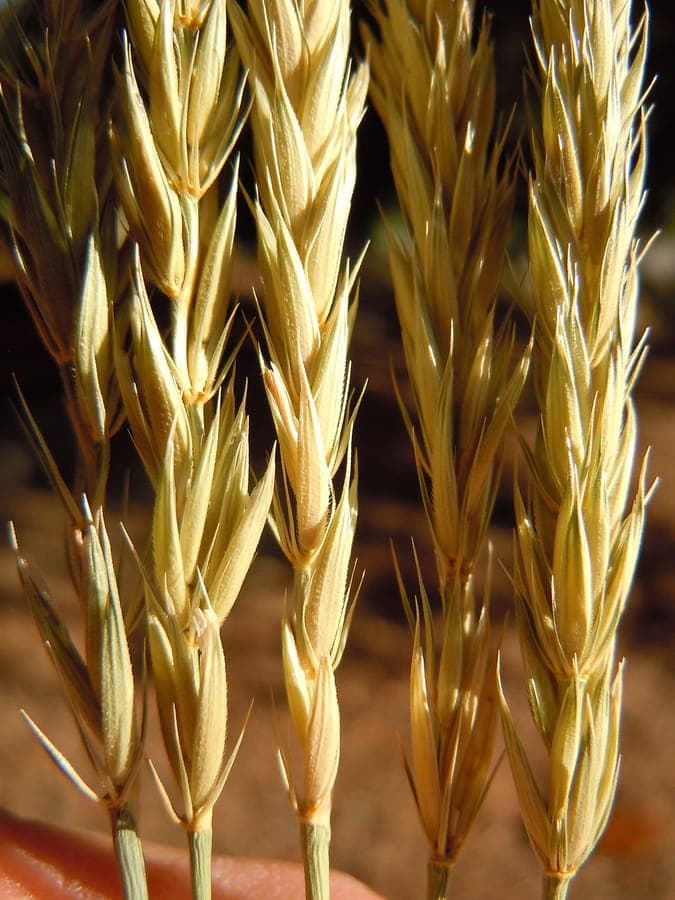
Matt Lavin / CC BY-SA 2.0, via Wikimedia Commons
Russian wildrye: complete guide
Psathyrostachys juncea
Want to see Russian wildrye: complete guide in your garden?
1 minute, no credit card
Overview
Psathyrostachys juncea, commonly known as Russian wildrye, is a perennial bunch grass in the family Poaceae. Native to the dry steppes and semi-arid grasslands of Central Asia - from eastern Europe and Russia eastward through Kazakhstan, Uzbekistan, Afghanistan, Mongolia and northern China - it was formally described by the Russian botanist Nevski in 1934, based on earlier work by Fischer. The genus name Psathyrostachys derives from Greek words meaning brittle and spike, referring to the stiff, somewhat fragile nature of the seedhead. Russian wildrye has been deliberately introduced to North America as a forage and range grass, particularly across the Great Plains and Intermountain West states such as Montana, North Dakota, Colorado, Wyoming and Utah, where its exceptional drought tolerance and cold hardiness make it a valued pasture plant for arid rangelands. For the ornamental garden, it offers a compact, upright, fine-textured clump that combines structural presence with extremely low maintenance needs. At gardenworld.app, you can explore personalised garden designs featuring drought-tolerant plants in sunny dry borders and prairie-style plantings.
Appearance and bloom cycle
Russian wildrye is a cool-season bunch grass, meaning it grows most actively in spring and autumn and naturally slows during the hottest summer months - a direct adaptation to the continental steppe climate of its homeland. It forms dense, upright clumps of narrow, stiff, dark-green leaves reaching 60 to 80 cm in height. The leaves have a noticeably coarse texture, stiffer than many ornamental grasses, which gives the clump a robust, architectural quality suited to structured planting schemes. In June and July, stiff, erect flowering culms rise well above the leaf mass, bringing the total plant height to 80 to 120 cm. The spikes are dense, bristly and initially pale green, maturing to a warm straw-yellow as the season progresses. The seedheads remain decorative on the plant well into autumn. After flowering, small brown seeds form and disperse by wind. The yellow flower colour is a notable distinguishing feature from closely related steppe grass species. As a cool-season grass it maintains some greenery through mild winters.
Ideal location
Russian wildrye requires full sun and will not perform well in shade. A minimum of six hours of direct sunlight per day is needed to develop the plant's characteristic compact, upright form. In overly shaded positions, the leaves become limp and the clump loses its architectural quality. This grass is particularly well suited to hot, dry, open situations: gravel gardens, rock gardens, xeric borders, prairie plantings and any area with light, free-draining soil. It is not suitable for sites with heavy clay, waterlogged ground or persistently high soil moisture. Rated for USDA zones 3 to 8, it survives minimum winter temperatures of around -40 degrees Celsius, making it one of the hardiest ornamental grasses available to European gardeners.
Soil
Russian wildrye thrives on dry to moderately moist, well-drained soils of low to moderate fertility. It performs well on poor, lean ground - just as it does on the nutrient-poor steppes of Kazakhstan and Mongolia. The pH tolerance is wide: 6.5 to 9.0, meaning the plant adapts well to alkaline, calcareous garden soils that many other grasses struggle with. Heavy, moisture-retentive or compacted soils are the main risk factor, leading to crown and root rot. On sandy, gravelly or light loamy ground the grass establishes readily without soil amendment. There is no need to enrich the planting site with compost or fertiliser - lean soil produces the stiffest, most compact and most visually attractive clumps.
Free design
Want to see Russian wildrye: complete guide in your garden? Make a free design now.
Watering
Once established - typically after four to six weeks - Russian wildrye is highly drought-tolerant and requires very little supplemental watering. In the first weeks after planting, water regularly to help the roots anchor into the soil. After that initial period the plant can generally survive on natural rainfall alone, even during dry summer spells in Northern Europe. During periods of extreme drought, a thorough deep soaking once every two weeks is sufficient and appropriate. The key rule is to avoid overwatering: standing water or persistently moist soil around the roots and crown leads to rot. This grass is as self-sufficient as the bare Central Asian steppe it originates from.
Pruning
Russian wildrye requires minimal pruning. In late winter or early spring - February or March, before new growth begins - cut back the previous year's foliage to about 10 cm above ground level using sharp hedge shears or hand pruners. Clear away all clippings to prevent fungal disease. In many gardens, the dry seedheads and golden straw foliage are left standing through winter as structural interest and as a food source for seed-eating birds, with cutting back deferred until the new green shoots are just visible at the base in late winter. This timed cut refreshes the clump and encourages dense, healthy new growth for the coming season.
Maintenance calendar
February-March: cut back previous year's foliage to 10 cm before new growth emerges; remove clippings. April-May: active growing season; new leaves develop; ensure good drainage; no fertiliser needed. June-July: flowering season; stiff golden spikes rise above the foliage - a real highlight. August-September: seeds ripen, spikes dry to straw-yellow and remain ornamental; leave for birds or collect seed. October-November: growth slows as temperatures drop; remove dead foliage if desired for tidiness. December-January: winter dormancy; no protection needed on well-drained soil. For inspiring dry border designs tailored to your garden, visit gardenworld.app.
Winter hardiness
Psathyrostachys juncea is one of the hardiest ornamental grasses available for garden use. Across its native range it survives frozen in the steppes of Siberia, Kazakhstan and Mongolia, where temperatures of -40 degrees Celsius are not unusual. It is rated for USDA zones 3 to 8, tolerating extreme cold with no winter protection needed on well-drained soil. In the mild oceanic climates of Western Europe - including the UK, the Netherlands, Belgium, northern France and Germany - it is reliably cold-tolerant year after year. The one caveat is wet winters on heavy clay: waterlogged soil around the crown during cold weather can cause rot. On free-draining soil this risk does not arise.
Companion plants
Russian wildrye fits naturally into dry, sunny borders and prairie-style plantings. Excellent companions include lavender (Lavandula angustifolia), ornamental sage (Salvia nemorosa), catmint (Nepeta x faassenii), globe thistle (Echinops ritro) and sea holly (Eryngium planum). For contrasting textures, combine with blue fescue (Festuca glauca), feather grass (Stipa pennata) or fountain grass (Pennisetum alopecuroides). Low-growing drought-tolerant perennials such as thyme (Thymus serpyllum), stonecrop (Sedum acre) and rock rose (Helianthemum nummularium) make excellent companions at the base of the clumps, filling space between the upright tussocks. Avoid pairing with moisture-loving plants such as astilbe, hosta or marsh sedge, whose water requirements are fundamentally incompatible. Russian wildrye is available from specialist grass nurseries and the perennial plant sections at UK garden centres.
Closing
Psathyrostachys juncea - Russian wildrye - is a tough, drought-resistant bunch grass that brings year-round structure to the low-maintenance garden. Its stiff golden spikes, compact upright habit and exceptional cold hardiness combine to make it an outstanding choice for dry borders, gravel gardens and prairie plantings across Northern Europe. Plant it in full sun on free-draining soil, cut it back once a year in late winter, and it will reward you with decades of reliable ornamental performance without fuss. To see how Russian wildrye fits into a complete garden design with drought-tolerant planting, visit gardenworld.app and explore personalised garden plans.
Want to see Russian wildrye: complete guide in your garden? Make a free design now.
Upload a photo, pick a style, and get a photorealistic design with plant list in under a minute.
10,000+ gardens designed already
No credit card required


Similar plants
Sporobolus pungens: complete guide
Sporobolus pungens
Sporobolus pungens is a stoloniferous Mediterranean coastal grass with outstanding salt and drought tolerance, perfect for seaside and dry gardens.
Mediterranean aegilops: complete guide
Aegilops biuncialis
Everything about Aegilops biuncialis, a Mediterranean annual grass with ornamental spikes and outstanding drought tolerance for dry gardens.
Silver bluestem: complete guide
Bothriochloa saccharoides
Full guide to Bothriochloa saccharoides (silver bluestem): site, soil, watering, winter hardiness, pruning, and garden companions.